
 E-Paper



A brand of magic: Sachin Tendulkar and an advertising revolution
For decades, commercials have capitalised on all that has been lovable about Sachin: his genius, humility, and his image as the boy next door. A look back


There is no better news, in the worlds of sports and advertising, than instant stardom achieved by the young.

At the same time, though, prodigal genius does have a way of imploding. It can be difficult to gauge how long before a scandal or overreach claims a young one, and their reputation.
Sachin Tendulkar burst onto the world of cricket at 16, in 1989, and combined unlikely talent and instant stardom with an entirely unexpected store of wisdom and maturity. The result was a rare kind of longevity, a brand that marketed the aspirations of a generation, and one that still remains durable today.
The timing helped. As fans watched this fearless batter grow in fluidity and confidence, a one-sport nation was opening up to the world. In the booming markets of a post-liberalisation India (Tendulkar was 18 when the process of liberalisation began in 1991), the face of Indian cricket’s golden child would be at the heart of an advertising revolution.
Already, it had tugged at heartstrings. In his debut series (against Pakistan in Pakistan), Tendulkar suffered a bloodied nose from a ball thrown by Waqar Younis. Across the country, peopled waited in front of their TV screens to see what he’d do next.
The Mumbai teen strode back onto the pitch, stayed there, walked away with a half-century that helped India win, and a legend was born. The bloodied nose, in fact, brought him his first TV commercial, for Johnson & Johnson’s Band-Aid. (More on this in a bit.)
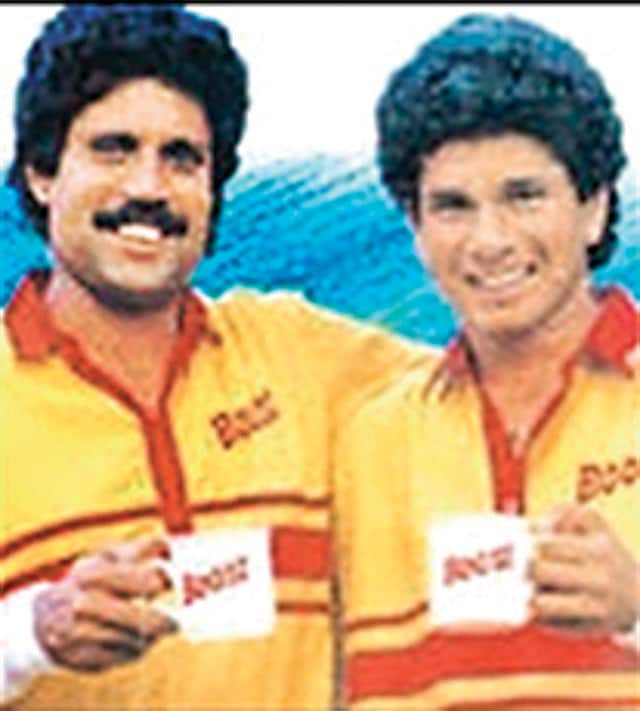
A second revolution — the arrival of colour TV — would help boost his profile at this time. Some of his early ads made in colour include a childlike Tendulkar promoting the energy mix Boost, alongside Kapil Dev, India’s winning skipper from the 1983 World Cup. The trickle had turned into an avalanche by the mid-1990s, as soft drinks, car makers, TV manufacturers, among others, lined up to sign him on.
Meanwhile, an axis began to shift. The Board of Control for Cricket in India (BCCI) started to wield the power of a growing, and increasingly powerful, domestic market; and a game that had until recently been ruled and run by England and Australia saw its epicentre start to shift to India.
Tendulkar would be cricket’s first mega brand. In 1995, he was signed by the late Mark Mascarenhas, a US-based broadcaster of Indian origin, for a five-year deal with WorldTel worth ₹30 crore — a hitherto unthinkable amount at the time. As the economy in general, and the cricket economy in particular, boomed, the deal saw Tendulkar become the face of Adidas, MRF, Philips, and Visa.
Some of the spots were brief — a few words and a grin. Others, in the nature of the ads of the time, captured a moment in history, and told a story that still resonates.
The Band-Aid commercial, created by veteran adman Piyush Pandey, was among the latter. It cashed in on everything there was to love about this boy — his approachable persona; his exuberant love of the game; the fact that he was literally the child from next door (not a prince, not the son of a noble).
The ad opens with a group of boys playing cricket in a middle-class neighbourhood. Sachin returns home from practice, dressed in all-white. The boys are excited. Will he bat to just one ball? He takes the bat; there’s a smooth but gentle knock; a child dives, catches the ball, is grinning and victorious, but he’s grazed his thumb. Sachin, calm (he’s done this before), grabs a slim carton out of his backpack, unwraps a strip. “Band-Aid is first aid,” the tagline says.
Tendulkar and Mascarenhas would set the tone for cricketers as stars. “Some people are risk-takers. They are also smart enough to spot a wave faster than others. Mark was one of those who saw the game going somewhere and wanted to be the first one to get in,” Pandey says now.
India’s most wanted
The numbers climbed rapidly as the millennium drew to a close. Tendulkar was being paid an estimated ₹1.5 crore annually by Pepsi alone, by the time of the “Nothing official about it” ambush marketing campaign, which was timed for the 1996 World Cup — for which Pepsi’s rival Coca-Cola was the official sponsor.
Cricketers as advertising stars has continued, through generations of sportsmen that followed. “All the way to today, Sachin has been followed by MS Dhoni and Virat Kohli,” says Harish Krishnamachar, a sports consultant who was also Tendulkar’s manager in the 2000s.
Mascarenhas would sign Tendulkar for another five-year deal in 2001, this one worth an estimated ₹100 crore. By 2006, Krishnamachar had stepped in to orchestrate a five-year phase worth ₹180 crore.

“At that point in time, there was Sachin and no one else. Indian sport had no other celebrity. The valuations looked impossible, but when he stepped into a category, it would go nuts,” says Shailendra Singh, former joint MD at Percept, one of the agencies that had attempted to woo Tendulkar from WorldTel.
Pepsi cashed in tremendously on the phenomenon. One campaign hinged on the catchphrase, “Sachin Aya Re” (essentially, “He’s here!”). It played on how India couldn’t wait for him to walk to the middle; the game, for the millions back home, only truly began when he took the bat. In these ads, children playing cricket in Sachin masks gasp as he takes off his, and turns out to be, well, him. On celebratory days, such as the kite-flying festival of Sankranti, even superstar Amitabh Bachchan has more fun once Tendulkar arrives on the rooftop.
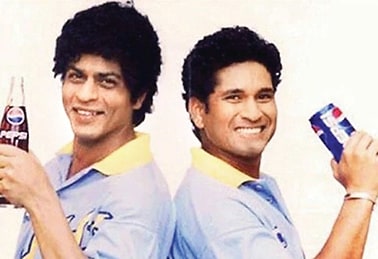
Shah Rukh Khan, in the Yeh Dil Maange More (The Heart Craves More) campaign pretends to be him, in wig and gear, all to get his hands on a can of Pepsi. It is then Sachin’s turn to bat, and the Bollywood superstar is quaking. He’s almost on the field when the real Sachin turns up. “I’ll take it from here,” Tendulkar says with a smile, taking the cola can.
Why Sachin endures
There were plenty of other stars, on and off the pitch. New ones were emerging from Bollywood and fashion. But few could rival the appeal of a young man who made a nation’s heart swell with pride, conducted himself like an honourable boy scout, then came home and treated his family, coaches, elders and peers with simple old-fashioned respect.
Tendulkar’s image survived unscathed in the match-fixing scandal of the late 1990s. “We would always say that he captured the imagination of every mother, and somehow that struck a chord with brands, because it was essentially true,” Krishnamachar says.
“Your brand is partly your performance and how people perceive it. But it’s also about your personality,” says Pandey. “With some performers, people can say ‘He’s a good person as well.’ That worked with Sachin.”
He was even competitive in just the right measure. Photographer-turned-film producer Atul Kasbekar remembers an unscheduled match on the sets of an ad film. “Sachin would lose to his manager in this game Snake that we all had in the early days of the mobile phone. Once, the manager laughed at his loss. Sachin vowed to beat him post-lunch or else gift him a new phone. Sachin won,” Kasbekar says, laughing. These were the stories that did the rounds about the player.
Through the 2000s, as Tendulkar aged and became prone to injury, as he struggled and his game, though always elegant, changed, some brands made the call to move on. Pepsi went for a more youthful campaign, only to see him snatched up by Coca-Cola, in a headlines-making deal worth ₹20 crore.
Today, Sachin, the former cricketer, remains the face of Gillette razors, Apollo tyres, UPI app Paytm, e-learning platform Unacademy, Ageas Federal life insurance, and Savlon. It’s no Band-Aid campaign, but the salve still works.


