E-Paper



The economics of exclusion: How far have we come on caste?

 Prefer HTon Google


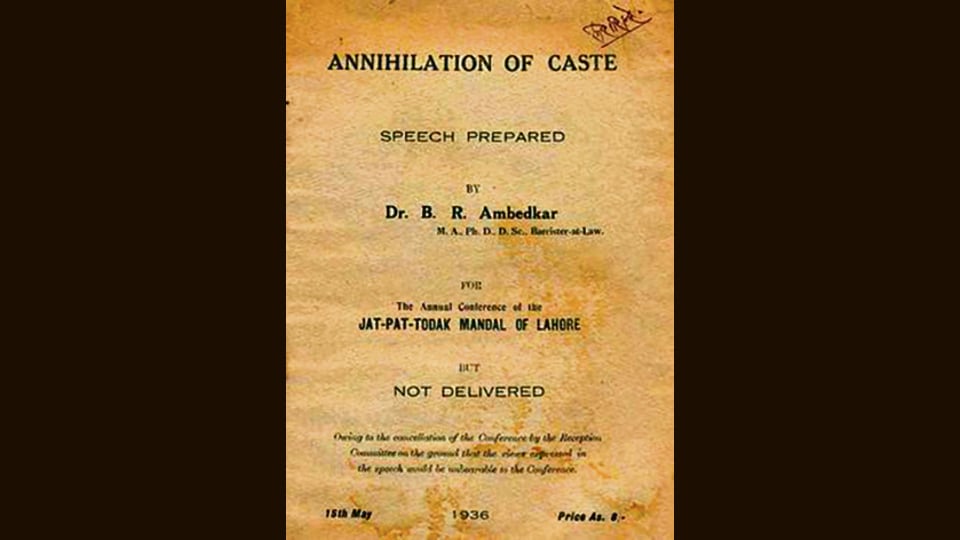
As BR Ambedkar’s Annihilation of Caste turns 90, Roshan Kishore and Abhishek Jha explore how reality compares with the dream his manifesto held out.
Had it not been for BR Ambedkar, India’s social-political contract would be very different, and far worse.
Even before his crucial role in drafting the Constitution, Ambedkar’s standing compelled those at the frontlines of the anti-colonial struggle, and their leader, Mahatma Gandhi, to recognise and accommodate his criticism of India’s brutal social inequality.
His struggle for this equality was economic as much as it was philosophical. He was clear in his mind that true equality in the realm of the former would not come until the country had addressed the latter.
If the new democracy made more room for this, it was in large part because he remained strident and unrelenting in this push for change.
As his pathbreaking treatise, Annihilation of Caste, turns 90, let’s look at how the Republic of India has fared on his cherished ideals, based on the story key numbers tell.
WHO WE VOTE FOR

Basic political representation for the most socially marginalised was secured during Ambedkar’s lifetime, in the form of reserved seats for members of Scheduled Castes (SC) and Scheduled Tribes (ST) in the Lok Sabha and state assemblies, in keeping with their population share.
On the more important question of representation in the executive — made up of the President and governors, prime minister, chief ministers and councils of ministers — there has been progress, but more for Other Backward Classes (OBCs) than SCs and STs. OBCs make up about 42% of the population, giving them more demographic weight than SCs and STs, who together make up about 25% of the population.

This appears to have helped increase OBC share in the executive. HT’s databases on the caste composition of councils of ministers and state chief ministers show this clearly. (See Charts 1A and 1B.)
HOW WE LIVE
In large part because of the way Ambedkar shaped the Constitution, reservations in educational institutions and government jobs, first for SCs and STs and then for OBCs too, set about attempting to address inequalities.
These affirmative-action provisions were coupled with punitive measures against overt caste discrimination. Yet, caste inequality and discrimination persist. The economic and assets gaps remain wide, and barriers to access remain strong.

SC and ST populations are disproportionately represented in the ranks of the poor. To be sure, there is a debate over intra-group inequality too, and growing political pressure to introduce differential provisions within existing reservation, so that such benefits, for instance, accrue to those who need them most.
These debates, rather than being seen as a mutation of the project for larger socio-economic equality, ought to be seen as the evolving dialectics of processes that remain core to the Indian democracy and economy. (See Charts 2A and 2B, on monthly per capita consumption expenditure.)

BATTLES THAT REMAIN
The larger philosophical project of caste annihilation still awaits momentum.
While the Indian democracy has made definite advances in battling poverty and furthering socio-economic gains for more of its population, it does not seem to have moved away from the entrenched value systems around caste.
This is best seen in statistics on caste violence (which remain high) and on inter-caste marriage (which remain low; see Chart 3).

In an irony that would have disappointed Ambedkar, it is often economic parity rather than larger philosophical goals that bring people from these different groups together; with the result that the underlying fractures, as he had predicted, remain.