E-Paper



Time warp: Indus Valley, silken weaves, and the Kashmiri floor covering

 Prefer HTon Google


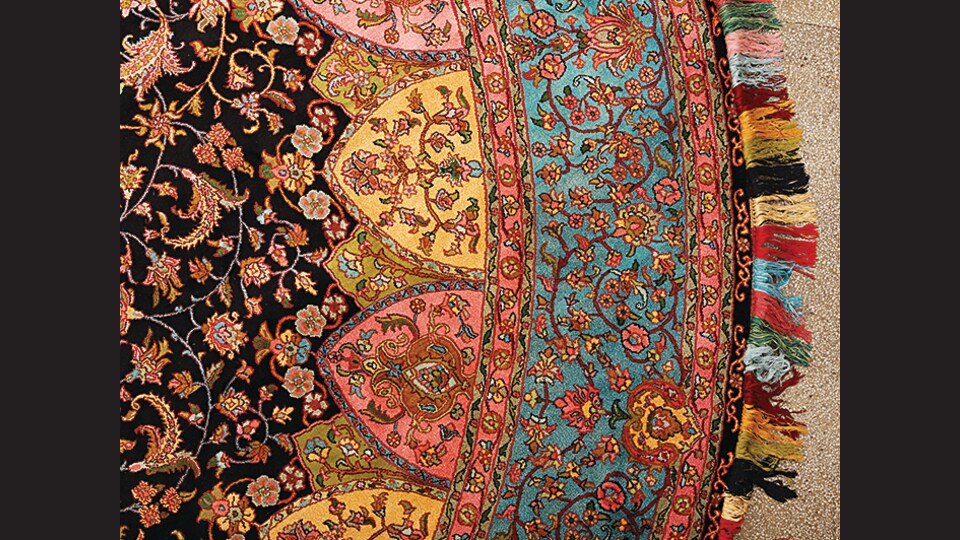
A mat with roots in the Indus Valley. A type of rug designed just for children. A new book traces how floor coverings in Kashmir have evolved over centuries.
The earliest woven mats in Kashmir were simple, but they’re still around, 5,500 years later.
Evidence of the golden-brown wagoo (made from reedmace or bulrush) has been found at Indus Valley sites such as Burzahom in present-day Srinagar district and Kanishkapura in present-day Baramulla. They likely served the same purpose they do now: something to keep out the cold, heat and dirt; to walk and sleep on; to gather around with the family.
Driven by the cold (temperatures here dip below -3 degrees Celsius in winter) and the availability of raw material in a lush land covered in flowers through much of the year, rug-making traditions would expand in variety and complexity over the centuries. They would be made with silk and wool, by hand-knotting; featured intricate embroidery on a woven or felt base, or even on old woollen blankets; and they would find their way into art, poetry, literature and folklore.
“Yet, back in 2000, when I was researching floor covering traditions of India, I found a paucity of scholarship with regards to Kashmiri carpets, mats and rugs,” says textile designer and crafts-heritage researcher Promil Pande, author of Floor Coverings from Kashmir: Kaleen Carpets, Namdah, Gabba, Ari Rugs and Wagoo Mats (2023; Niyogi Books).
The research work that did exist tended to group Indian carpets under broad categories such as “Oriental” and “Islamic”, says Pande. “Such categorisation undermines the indigenous nature of these traditions. The lack of documented information, I felt, was one of the reasons Indian carpets were not accorded the same status or value as, say, Persian ones.”
By 2013, Pande was working on a PhD focused on the floor coverings of Kashmir, at the Sushant School of Art and Architecture, Gurugram. The book is an extension of her thesis.
It traces ancient traditions and knowledge systems that are unique to the region, and are now at risk from cheap imitations, limited patronage and simple lack of appreciation.
“I always knew I wanted my research to reach a larger audience,” says Pande, who has also worked with the United Nations Development Programme (UNDP) and the government of India’s office of the development commissioner for handicrafts. “The idea is to inform readers in a way that allows them to truly appreciate these rich traditions. Because you only conserve what you appreciate.”
Here, then, is a primer on unique types of floor coverings, drawn from Pande’s work.
Carpets full of flowers: The floral patterns on large handwoven Kashmiri carpets and rugs aren’t just geometrically arranged. Look closely and you’ll see that many mimic Mughal gardens.
Under the reign of Shah Jahan (1628-58), the patterns in hand-knotted kaleen — traditionally made of silk and wool — acquired a distinctive appearance, later nicknamed (rather unimaginatively) the Mughal flower style by researchers. These rugs are believed to have been inspired by the Mughals’ love of Kashmir’s natural beauty, which inspired their nickname for the region: Jannat, or paradise.
“It is the remarkable weaving skills of the Kashmiri kalbafi or kaleen weaver that allows for the execution of intricate curvilinear designs. They also use a coded system of communicating designs, which is a long-standing tradition of kani shawl weavers, who transferred their skills to kaleen-making. Their skill makes the kaleen smooth and non-bulky, setting it apart from other kinds of carpets. It feels almost like walking on flowers,” Pande says.
Varieties of the namdah, a kind of embroidered felt rug, are defined by floral designs too. The pamposhdar refers to namdahs bearing the motif of the lotus; the chutposhdar features apple blossoms; emberzaldar-poshdar contains the daffodil. The kulidar features only leaves and branches, while wankidars feature curved branches alone.
Other motifs woven into the kaleen and namdah include hunting scenes, illustrations from folklore, mountainscapes and maps. When a namdah features a bird or animal motif, it is called a janwardar. Specific birds call for their own variants of janwardar namdahs; the moredar, for instance, is centered on imagery of the peacock.
There is a variety of namdah meant for children too. Called awwal naksh (elementary design), it typically features circus characters, toys, numerals, vegetables and fruit.
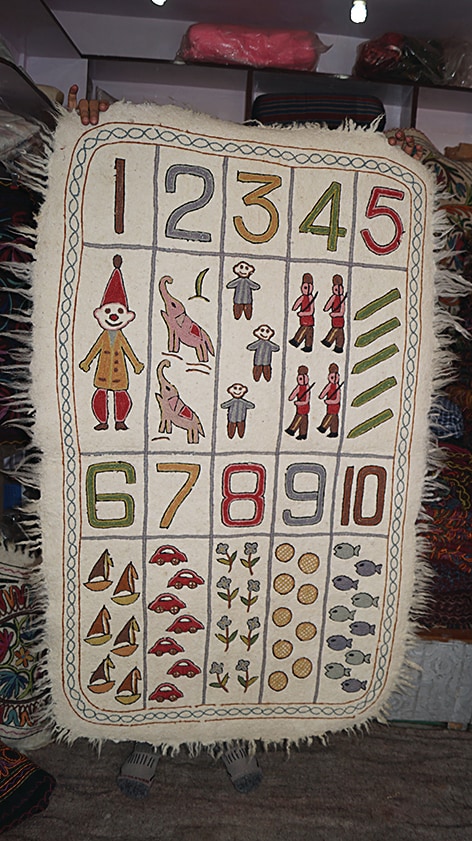
“Because of the coarseness of felt, the motifs on namdah, although identifiable, are depicted in a more stylised manner, while on the fine silk hand-knotted kaleen, the depictions are more realistic,” Pande says.
Embroidered blankets: The gabba — an embroidered floor covering fashioned out of old woollen blankets and designed for local use — is at the centre of two local legends.
One credits a poor tailor, Lasya Tota, with creating it, Pande writes. Tota is said to have stitched worn-out pieces of coloured old tweed together, as an inexpensive but warm floor covering, thus inventing a new style.
In the second origin tale, the gabba has its roots in a gift. Abdur Rahman, a refugee from Kabul, was so grateful to be given shelter that he crafted an intricate floor covering for his host, from an embroidered saddle cover.
However it was born, the craft has since expanded to involves techniques such as applique and ari (embroidery made in a continuous stitch, using a hooked needle). It flourished under the patronage of Maharaja Ranbir Singh (1856-85), who encouraged its use in state upholstery, such as in royal tents and palaces.
The Indus Valley pattern: Wagoo mats — the plain, golden-brown ones made from reedmace or bulrush — are typically woven by women, and once formed a bustling industry on their own.
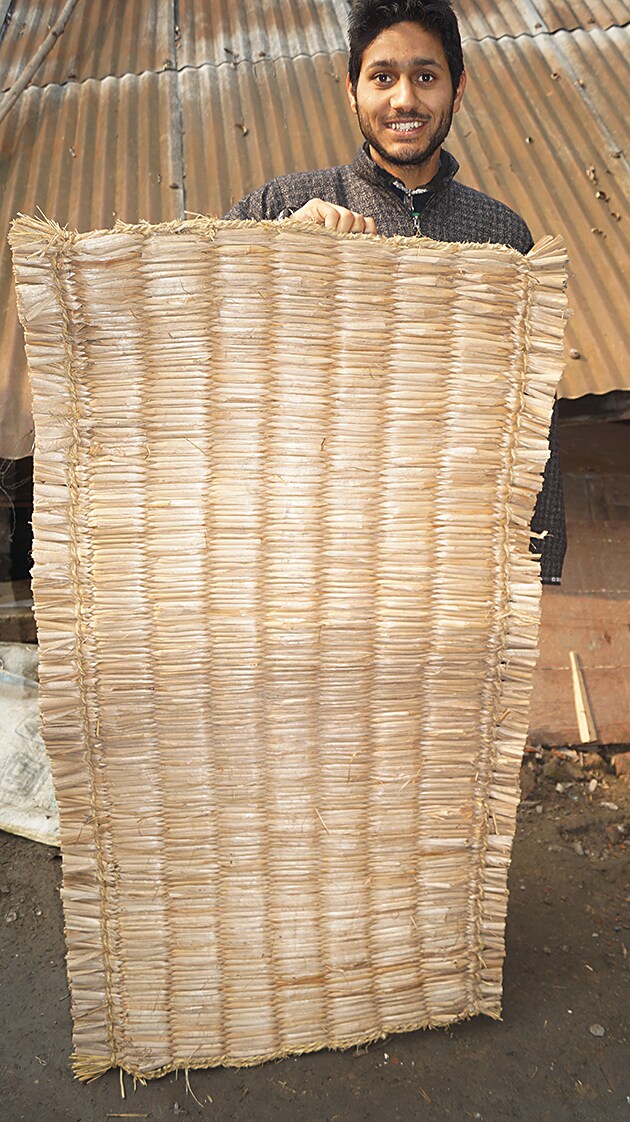
There was a time when one couldn’t go far without seeing a wagoo mat. They served as floor coverings in homes as well as on boats, which were once the primary mode of transport in Kashmir. They are still used on passenger doongas as well as cargo bahats, where they serve as thatched roof, roll-up partition screen and enclosures for seating areas.
The knowledge of how to weave a wagoo is passed down orally from mother to daughter or aunt to niece.
How far back does this mat go? Impressions of its weave have been found on pottery excavated at Indus Valley sites, Pande notes. “Even until about two decades ago, new ones were bought by most households, every year.”
The mat is now disappearing across Kashmir, replaced by blankets made from synthetic fibres such as acrylic and ethylene-vinyl acetate or EVA foam.
“Wagoo mats are perhaps one of the most sustainable floor coverings produced in Kashmir. They are completely organic and biodegradable. It’s a pity that when the world is gearing towards achieving sustainability, these are being replaced by non-sustainable alternatives.”