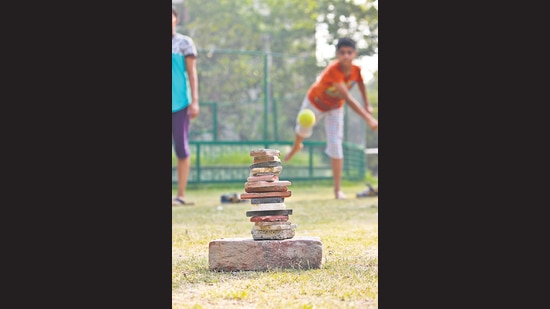
South Korean show and global phenomenon Squid Game has done the unthinkable – taken innocent childhood games and turned them into horrific settings for violence and murder. The series has spawned a million think pieces; critiques of capitalism, the class divide, the debt crisis and so on. It has also prompted umpteen stories about childhood games, many of which (like hide-and-seek) are the same the world over.
Some of the Korean games are not familiar at all. I guess different cultures must have their own variants. But across the subcontinent, children have for generations played largely the same childhood games; the ones that were so much a part of our growing up years. Games like stapoo, langri taang, vish amrit, pakdan-pakdai, oonch-neech and pithu, which we played over and over in our pre-teen years. They were physically tiring; I remember being constantly out of breath and having painful stitches in my side. You can recognise the generation that played these games by the puckered-up scars on their knees. How often we trudged home with badly scraped, bloody knees on which mothers would apply “red medicine” (the ubiquitous Mercurochrome solution; every home had a bottle).
But somehow none of that mattered; not the scabs or little scars; not the fact that no one ever seemed to win.
On summer evenings, we would head to a garden, park or other open area, and play in noisy groups, emitting ear-splitting shrieks, till the shadows lengthened and long-suffering mothers repeatedly sent out emissaries to round us up. The girls would be in pigtails and home-stitched frocks and the boys in shorts (for some reason always called “knicker”). In the winter, playtime would be pushed up a little, since it got dark so much earlier. While mothers would have a well-deserved afternoon lie-down, the kids would be out of the house in a trice, squabbling over which game to play and who would be the “den”.
All the games were different and had their own rules, but most included non-stop running around and racing against time (otherwise you would be “out”). Pithu was particularly frenetic. You had to, in feverish haste, place seven flat stones one on top of the other in a stable tower and the opposing team would try to scatter them with a throw of a ball. Pithu is known by different names in different parts of India — for instance, it’s called lagori in Karnataka, and I believe a few years ago, an Indian Lagori Premier League was set up to re-popularise the game!
Some games didn’t require you to rush around quite so frantically. I Spy, which we proudly called ice-pice, was one such. (A thrilling indoor variation was Dark Room where you commandeered a room in the house, drew all the curtains, switched off the lights and then wandered around trying to find people hidden behind curtains or cupboards. Looking back, it couldn’t have been that difficult finding people; after all, how many places could there be to hide in a room? But we loved the game.)
There was also the Statue game, where you had to freeze when the den yelled “L-O-N-D-O-N… London!” Why London? Who knows!
Kids have never had it as hard as they have in the last few years. Polluted air, safety concerns and now Covid-19 have ensured that they remain cooped up indoors, staring into a series of brightly lit screens. Even before the external factors, the hypnotic attraction of the mobile phone and computer were proving too hard to resist.
It’s not like kids have stopped playing outdoor games entirely. It’s just that it seems mostly to be football or cricket. The childhood games I’m talking about are gone.
Maybe if mobile phones and computers had been around back in the day, we too would have been hunched over our screens all the time. I’m so thankful that we weren’t.

 E-Paper