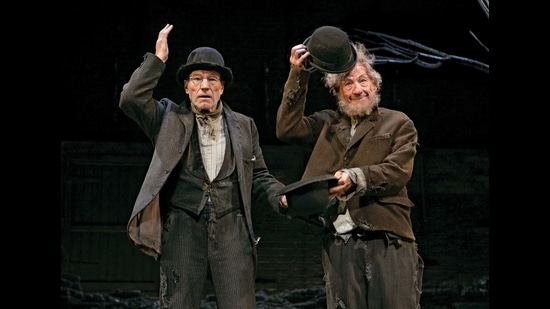
Some months ago, this question, referring to a famous work of literature, appeared in a Mumbai college exam. (This is true).
Identify the FALSE statement:
a) Gogo and Didi engage in a discussion while [removed so it isn’t a giveaway].
b) Lucky and Pozzo are slave and master respectively.
c) In Act 2, Pozzo has become blind and Lucky has become dumb.
d) None of the above.
You’re a student taking this exam. You’ve studied this work well, so you know that the first three statements are true.
Question: How do you answer this question?
Bonus questions: What’s the name of this work of literature? Who wrote it? Besides writing and winning a major literature prize, this person had an interesting and unexpected (for a famous writer) distinction in their youth. What was that?
Scroll down for the answers.
.
.
.
.
.
.
.
Answers
If (a), (b) and (c) are true, none of them are false and so you’d be tempted to choose (d) as the answer. But wait! If (a), (b) and (c) are true, (d) is also true — because it’s true that “none of the above” are false. But you’ve been asked to identify the FALSE statement. So you cannot choose (d).Your best bet, then, might be to add this bonus option below and choose it as your answer: (e) All of the above. Of course, you could also have (e) Statement (b) above.or(e) Donald Trump is the President of the United States. or (e) The Sun rises in the West.
Bonus answers: Waiting for Godot, by the Irish writer Samuel Beckett (1906-1989), who won the Nobel Prize in 1969. In 1925 and 1926, Beckett played two first-class cricket matches for Dublin University against Northamptonshire.
 E-Paper