
 E-Paper



That Feeling When by Nikhil Taneja: It is okay for men to cry

 Prefer HTon Google


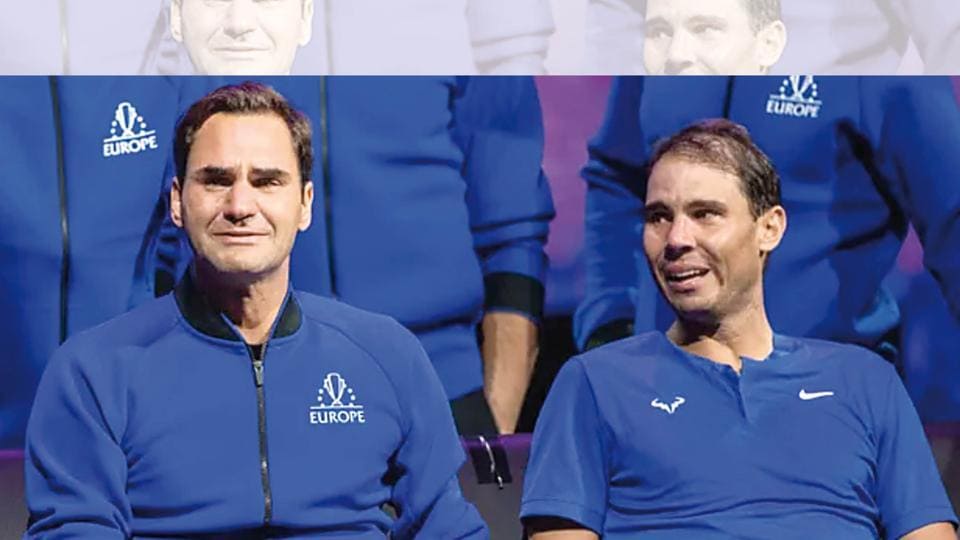
The images of tennis legends Roger Federer and Rafael Nadal crying and holding hands could well change the world
I distinctly remember the first time I saw a man cry on a sports field. It was the 1996 Men’s Cricket World Cup and India, after beating Pakistan in the quarter-finals of what was possibly the match of the decade, found themselves against the unstoppable Sri Lankans in the semi-finals.
Vinod Kambli played 29 balls for 10 runs, and was the last one standing, watching his partners on the other end crumble under pressure as the score went from 98/1 to 120/8 in 34 overs. When the match ended, Kambli was inconsolable on his long walk towards the pavilion. More than about exiting the World Cup just before the finals or getting beaten so comprehensively, every Indian cricket fan’s heart broke just seeing Kambli cry.
Was he crying because we lost? Or because this could be his last World Cup? Or his last match? Was he crying for himself or was he crying for his teammates? Or was he crying for his country? No one really knew and no one really cared at the time, as the clip was frenziedly and relentlessly played on national television. The anger and disappointment at losing the semi-finals was trumped by the mass empathy that every Indian felt on seeing a sportsperson cry on a national stage—a man cry on a national stage.
Boys to men
This remains an iconic moment, a milestone of India’s collective consciousness, because Indian men rarely cry. Growing up with movies shouting ‘Mard ko dard nahin hota’ (men don’t feel pain) and in a patriarchal culture where the ‘man of the house’ has to always keep the appearance of being steady and strong, men in India have been conditioned to look at crying as weakness, or what is considered to be worse, as ‘femininity’.
The gendered idea that ‘girls cry and boys are strong’ is inculcated into every boy, whether in their childhood homes, or in their nursery schools, to the extent that anytime a boy cries, if there isn’t an elder who scolds him, there is mostly another boy who laughs at him for being so weak or ‘girlish’.
It is tragic that we live in a world where, even as patriarchy benefits men, it first oppresses the boys they once were. The boys who could have grown up not necessarily to be engineers or doctors or MBAs, but perhaps poets and artists and dancers, if they were allowed to be. The boys who could have grown up not necessarily to constantly and continually work for money, but perhaps be present fathers and husbands. The boys who could have grown up without a stigma against feeling vulnerable, punishing any perceived ‘weakness’ through violence, but perhaps be kinder and gentler to the world around, and to themselves.
Only human
It is for these reasons and many, many others that footage of tennis legends Roger Federer and Rafael Nadal or ‘Fedal’ as they are lovingly called, crying and holding hands after the last ever match that Federer played, will go down in history as one of the greatest moments of normalising male intimacy, pain, love and friendship.
To have two all-time world champions being okay with being seen at their most vulnerable, at their least guarded, and at the zenith of their heartfelt emotions, is as historic for the world outside of tennis as what they have done for the world within it. Because the message for all the young boys in the world watching the G.O.A.T.S. cry, was to recognise and realise that men do cry, not only because they are men, but also because they are human.
Nikhil Taneja is a writer, producer, storyteller, public speaker, feeler of feelings, men’s mental health advocate and co-founder of Yuvaa
That Feeling When is a fortnightly column that offers a relatable take on mental health and emotional well-being.
From HT Brunch, October 22, 2022
Follow us on twitter.com/HTBrunch
Connect with us on facebook.com/hindustantimesbrunch


