
 E-Paper



Total Solar Eclipse 2024: Looking at a Solar Eclipse can be dangerous without Eclipse glasses. Here’s what to know

 Prefer HTon Google


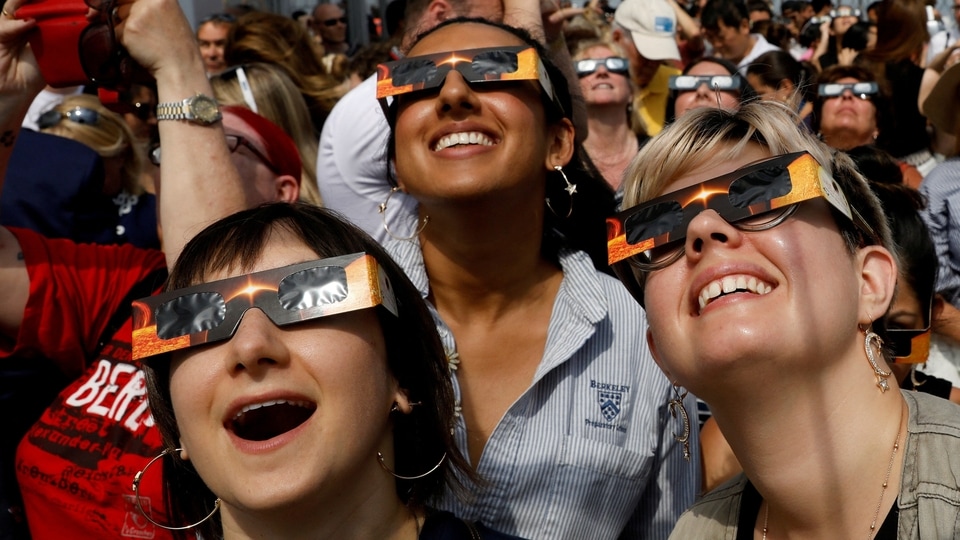
Solar Eclipse 2024: Learn all you need to know about watching the Total Solar Eclipse on April 8 inside.
Millions of people along a narrow band in North America will look up when the sky darkens during a Total Solar Eclipse on April 8. When they do, safety is key. Staring directly at the sun during a Solar Eclipse or at any other time can lead to permanent eye damage. The Eclipse is only safe to witness with the naked eye during totality, or the period of total darkness when the moon completely covers the sun.
(Also Read | Solar Eclipse 2024: Will it be visible in India? When, Where and How to watch First Total Solar Eclipse of 2024)
Those eager to experience the Eclipse should buy Eclipse glasses from a reputable vendor. Sunglasses are not protective enough, and binoculars and telescopes without a proper solar filter can magnify light from the sun, making them unsafe.
“Please, please put those glasses on,” NASA Administrator Bill Nelson said.
Where to find Eclipse glasses
Since counterfeit glasses abound, consider purchasing glasses from a local science museum or order online from a seller cleared on the American Astronomical Society’s website.
Eclipse safety experts say legitimate Eclipse glasses should block out ultraviolet light from the sun and nearly all visible light. When worn indoors, only very bright lights should be faintly visible – not household furniture or wallpaper.
Old Eclipse glasses from the 2017 Total Solar Eclipse or October's “Ring of Fire” Annular Eclipse are safe to reuse, as long as they aren't warped and don't have scratches or holes.
Glasses should say they comply with ISO 12312-2 standards, though fake suppliers can also print this language on their products. NASA does not approve or certify Eclipse glasses.
How to view the Eclipse without glasses
If you don't have Eclipse glasses, you can still enjoy the spectacle through indirect ways such as making a pinhole projector using household materials.
Poke a hole through a piece of cardstock or cardboard, hold it up during the Eclipse and look down to see a partial crescent projected below. Holding up a colander or a cracker will produce a similar effect.
Another trick: Peering at the ground under a shady tree can yield crescent shadows as the sunlight filters through branches and leaves.
Eye experts warn against viewing the Eclipse through a phone camera. The sun’s bright rays can also damage a phone’s digital components.
Why looking at a Solar Eclipse is dangerous
Eye damage can occur without proper protection. The sun's bright rays can burn cells in the retina at the back of the eye. The retina doesn’t have pain receptors, so there’s no way to feel the damage as it happens. Once the cells die, they don’t come back.
Symptoms of solar eye damage, called solar retinopathy, include blurred vision and colour distortion.
In a rare case of Eclipse eye damage, a woman who viewed the 2017 Eclipse without adequate protection came to Mount Sinai’s New York Eye and Ear Infirmary, complaining of a black spot in her vision. Doctors discovered retinal damage that corresponded to the Eclipse’s shape.
“The dark spot she was describing was in the shape of a crescent,” said Dr Avnish Deobhakta, a Mount Sinai ophthalmologist.
There’s no set rule for how long of a glance can lead to permanent damage. Severity varies based on cloudiness, air pollution and a person's vantage point.
But doctors say looking at a solar Eclipse for even a few seconds unprotected isn’t worth the risk. There are reports of solar retinopathy after every solar eclipse, and US eye doctors saw dozens of extra visits after the one in 2017.
Spectators who plan ahead can secure a stress-free Eclipse viewing experience.
“It can be dangerous if we aren’t careful, but it’s also very safe if we take the basic precautions,” said Dr Geoffrey Emerson, a board member of the American Society of Retina Specialists.


