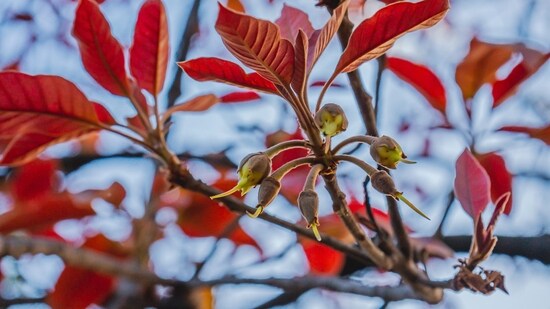
THE little brown nubs look like earwax-coloured pencil erasers. Anyone curious enough to try one would find it tastes a bit like a date. They are flowers of the mahua tree, indigenous to India. When distilled, they produce a strong liquor reminiscent of grappa or unaged whisky: floral and mildly sweet, with hints of apple and berry, and a long, clean finish. The spirit may be coming soon to a bar near you.
Families do not pluck blooms, but gather them once they have fallen, thereby ensuring ripeness and maximum sugar content. (Adobe Stock)
Indian tribes have been making mahua—the name of the booze as well as the tree—for centuries. Families do not pluck blooms, but gather them once they have fallen, thereby ensuring ripeness and maximum sugar content. After fermentation, the flowers are distilled in clay pots.
Tribal families mark births, marriages and deaths by sharing mahua. A lively folklore surrounds it. According to one tribe, a little mahua makes a person act like a parakeet, giggly and repetitive; a lot makes people tigerish, roaring and full of bluster; and too much makes people act like pigs or mice, “rolling on the ground, wallowing in mud or looking for a hole to hide in”.
Distillation remains small-scale and often clandestine. The spirit was banned by the British Raj in the late 19th century, supposedly to protect public health (though many reckon it was to protect the market for spirits imported from Britain). Even after India gained independence in 1947, some states kept bans in place, so many drinkers still chug moonshine, which is dirt cheap and sometimes fatal. Other bureaucrats heavily taxed mahua production and restricted its sale.
Yet, after years of lobbying by Desmond Nazareth, the founder of DesmondJi, a Goan distillery, the state loosened its liquor laws in 2018 and allowed the spirit to be sold in shops. Other regions, including Karnataka, Maharashtra and Madhya Pradesh, have also relaxed the rules. DesmondJi now makes around 10,000 bottles of mahua a year, available in 500 shops across several states. Six Brothers, based in Dahanu, began making high-end mahua in 2024. Many hope that the drink will, in time, become a national treasure akin to Mexican tequila.
As a result, Indian distillers are targeting curious drinkers farther afield. Mah, made from mahua flowers and distilled in Cognac, is available in France. DesmondJi is looking for stockists in Britain; Six Brothers is being served in cocktail bars in London. Mixologists note that mahua’s sweet, subtle flavour means it best suits simple mixers such as lime or vermouth.
Mahua is not the only Indian spirit with big ambitions. Feni, a Goan liquor made from coconut palm sap or cashews, is also increasingly available in the West; unfortunately, it tastes of feet. Mahua has two advantages. First, it has the sort of history that will appeal to urban lefties who love anything artisanal and “indigenous”. Second, and more important, it is delicious.

 E-Paper