
 E-Paper



They Needed a Surrogate, So They Asked a Sibling to Do It
Turning to friends and family can lower the cost of surrogacy—for those willing to navigate legal minefields and tricky family dynamics.


This week, we’re bringing you stories about what it costs to raise a child in 2025, and how families are making it work.

Having a surrogate give birth to your baby can cost as much as $200,000. Taylor and Ben Shinoskie found a cheaper womb to rent.
Ben’s sister, Emilee Shinoskie, gave birth to their healthy baby in May. Taylor and Ben, both 33 years old, saved money by taking on much of the administrative work themselves, though the birth still drained about $57,000 from their savings. The three of them, in Columbus, Ohio, navigated legal minefields and family dynamics that no contract could anticipate.
“We flew by the seat of our pants the whole time,” Taylor said.
Surrogacy is often a last-resort option for couples struggling to have a biological child, and a common route for same-sex couples. It is typically the most expensive path to parenthood, and only a precursor to the massive cost of raising children. It combines the expenses of involving another person for nine months with the costs of in vitro fertilization, through which embryos are conceived in a lab.
Working with a friend or family member can be cheaper than hiring a stranger, but also messier. Taylor and Ben’s lawyer advised them to compensate Emilee, but she refused to be paid. After she wouldn’t deposit a $10,000 check, they bought her maternity clothes, paid for groceries and secretly replaced the tires on her car.
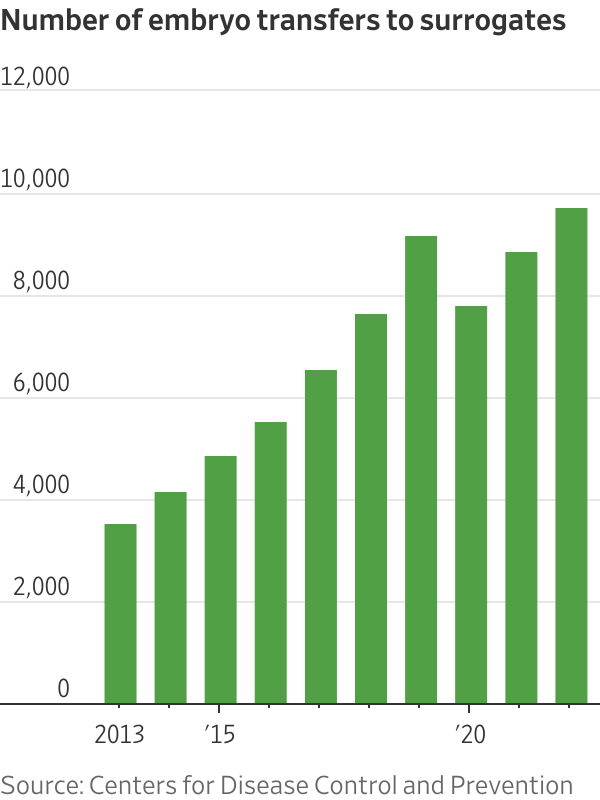
There were nearly 10,000 embryos transferred to surrogates in 2022, according to the latest data from the Centers for Disease Control and Prevention. Some women receive multiple transfers, and some types of surrogacy aren’t tracked.
Typical compensation for a surrogate is $50,000 in the U.S., according to Jeff Hu, who runs a surrogacy agency in Los Angeles. He said that is up 35% from five years ago. Adding to the overall bill are medications, egg or sperm donations and health-insurance coverage for the surrogate. Many clients pay for all this out of pocket, though some have employer-provided benefits that help defray costs.
A surrogacy agency might charge an additional fee of $25,000 to $35,000, and for many couples, the comprehensive support and intermediation is worth it. An agency finds a surrogate, handles legal contracts, provides psychological counseling, ensures the surrogate attends medical appointments and manages communication between parties. The fast-growing surrogacy industry is lightly regulated.
Others choose to cut out the agency and find their own surrogate. Of the 10 such couples who spoke with The Wall Street Journal, no two experiences looked alike. One couple ended up having to pay for two surrogates at once because of a fertility clinic’s rule change. Financial strain led another to sell their car and move in with parents.
The Shinoskies’s surrogacy plan came together over a weekly Sunday dinner at Ben’s parents’ house in April 2024.
Taylor had previously suffered two late-term pregnancy losses. The couple’s fertility doctor, Akas Jain, brought up surrogacy with them and suggested the possibility of a family member carrying their child.
“It’s such an intimate process that having someone you already know and trust makes it much easier,” Jain said.
The couple had recently come out of IVF with four viable embryos. When they shared that news at dinner and mentioned they would need a surrogate, both of Ben’s sisters volunteered on the spot. Veronica, 25, had just gotten engaged and was planning a wedding, so they agreed Emilee, 26, was a better candidate.
Emilee said she didn’t have any hesitation about the pregnancy. “I saw them go through those two losses, and it was something I could do,” said Emilee, who along with Taylor and Ben works at a natural-gas company.
Taylor and Ben Shinoskie with their daughter. The baby’s middle name, Lee, honors her aunt and surrogate, Emilee.Emilee Shinoskie, who carried her niece for nine months, now helps as a regular babysitter.
The Shinoskies’ insurance didn’t cover fertility treatments or surrogacy expenses, though Emilee’s existing health insurance covered her prenatal care.
First up were Emilee’s medical clearance and psychological evaluations, both required by the fertility clinic. A counselor was initially reluctant to sign off because Emilee had never been pregnant, which agencies typically require as evidence that a woman can carry a pregnancy to term. And in a group session with Taylor, Ben and Emilee, the therapist brought up the subject of dietary requirements for the surrogate.
“I’m not gonna eat, like, crap, but if you want me to eat a certain way, you gotta cook for me every day,” Emilee remembers saying. Taylor and Ben ended up buying her snacks and cooking her an occasional meal.
Unlike traditional pregnancies, surrogacy requires contracts to establish parental rights, financial responsibilities and which party makes medical decisions. Surrogacy laws vary by state. Louisiana allows only uncompensated surrogacy. Arizona won’t enforce surrogacy contracts.
The Shinoskies paid Thomas Taneff, an Ohio attorney specializing in fertility, about $3,500 for assistance with contracts.
He advised the couple to compensate Emilee because if two parties exchange something of value, that can serve as evidence, if needed, that a surrogate was aware the baby wouldn’t belong to her.
“Is it probable that a family member is going to contest the surrogacy? No. Is it possible? Lightning can strike,” Taneff said.
Taylor, Ben and Emilee bonded over the humor in these technicalities.
“We’re only giving you this because the lawyer is making us,” Taylor told Emilee when handing her the $10,000 check she never cashed.
Same-sex male couples can face additional costs, often paying for both an egg donor and a surrogate, who generally are two different people.
For Joseph Ryan Hughes, 37, and his husband, Nathan Wayne Hughes, 45, surrogacy was a decade in the making.
Nathan Wayne Hughes and Joseph Ryan Hughes with their ‘million dollar babies’ born via surrogacy.Joseph Ryan Hughes with one of the twins born from their ‘core four’ arrangement.
Joseph had gently brought up the subject with his sister for years, knowing that as a gay man, having a surrogate would be his only path to biological fatherhood. He and Nathan assembled what they call their “core four” arrangement. Besides the two of them, the group included Joseph’s sister as the surrogate and the manager of the hair salon they co-own in Dallas as the egg donor.
They paid for two embryos to be transferred, hoping for twins. They got them. The couple paid Joseph’s sister roughly $65,000 for the surrogacy and covered her salary when pregnancy complications kept her from work. They also covered medical, legal and other expenses. Joseph calls the twins his “million dollar babies.”
“We put every single effort, every single dollar, every single bit of energy that we had into creating our family,” Joseph said.
Having a relative carry a baby often disrupts existing family dynamics, too.
For the 26 years Ben had been Emilee’s big brother, he had treated her as older brothers often do, teasing Emilee and giving her playful shoves. Now that she was carrying his baby, he had to find new ways to interact.
“You could see it hurt him physically to stop himself from making jokes,” Emilee said.
Taylor found herself newly hesitant, too. When she would get the urge to touch her sister-in-law’s baby bump, she would keep it to herself.
“It’s your kid, but it’s not in your belly,” Taylor said.
One of the biggest challenges arrived at the same time as the baby.
Over Memorial Day weekend, Emilee found out she had preeclampsia, and required an emergency induction two weeks before her due date. The birth went smoothly, but Taylor and Ben’s prebirth order—the legal document that would establish them as the parents—hadn’t yet been signed by a judge. Scarred by Taylor’s lost pregnancies, they were slow to finalize the paperwork to avoid paying more legal fees if something went wrong again.
As a result, the baby was legally Emilee’s.
It took Taylor and Ben four days and another $6,500 in attorney fees to redo the legal documents after birth.
In total, the Shinoskies spent about $36,000 on legal and medical expenses, including IVF. They saved money compared with paying an agency, but not as much as they had hoped.
Today, Emilee has transitioned to being just an aunt. She babysits regularly. Since the birth, she learned that although she can still have her own biological children, she can’t serve as a surrogate again, due to preeclampsia. She has no regrets.
“It was 100% worth it,” she said. “If I could go back, I would do it all over again.”
After months of legal and emotional challenges, the Shinoskies say old sibling dynamics are coming back.
The old sibling dynamics are returning bit by bit.
“I was walking by her and flicked her the other day,” Ben said.
He and Taylor have three more frozen embryos and hope to have a second child.
They said they would consider a family member over a stranger—a preference conveyed by the name they gave their daughter. Her middle name is Lee, after Emilee.
To receive Personal Finance email alerts, including stories in this series as soon as they publish, click here. Read the full series here.
Write to Dalvin Brown at dalvin.brown@wsj.com
TOP PHOTOS: MADDIE MCGARVEY AND SHELBY TAUBER FOR WSJ






Catch your daily dose of Fashion, Taylor Swift, Health, Festivals, Travel, Relationship, Recipe and all the other Latest Lifestyle News on Hindustan Times Website and APPs.


