
 E-Paper



Congress, NC friends on 3 J-K seats, but will fight on the other 3
The deal was sealed three days after NC vice-president and Farooq Abdullah’s son, Omar Abdullah, said NC candidates would contest three Lok Sabha seats in J&K and the party was open to an alliance with the Congress if the latter leaves three seats in the Valley to his party.


The Congress and the National Conference (NC) reached a seat-sharing pact on Wednesday in Jammu and Kashmir under which the former will not put up a fight against NC president Farooq Abdullah in the Srinagar Lok Sabha seat and the latter will give up two seats in the Jammu region.
The two parties will both contest the remaining three of the six seats J&K fills in the Lower House.
Farooq Abdullah said the idea behind the deal, finalised in Jammu after the Congress’s leader of Opposition in the Rajya Sabha, Ghulam Nabi Azad, and the chairperson of the Congress coordination committee for elections, Ambika Soni, held talks with NC leaders, was that all Lok Sabha seats in J&K should be won by either the NC or the Congress.
“Secular parties should emerge as winners,’’ the veteran Kashmir politician said.
The deal was sealed three days after NC vice-president and Farooq Abdullah’s son, Omar Abdullah, said NC candidates would contest three Lok Sabha seats in J&K and the party was open to an alliance with the Congress if the latter leaves three seats in the Valley to his party.
It also comes at a time when the Congress is struggling to work out a deal with the Aam Aadmi Party (AAP) in Delhi, is close to ironing out its seat-sharing agreement with the Nationalist Congress Party (NCP) in Maharashtra, and appears to have reached an agreement with the Rashtriya Janata Dal (RJD) in Bihar.
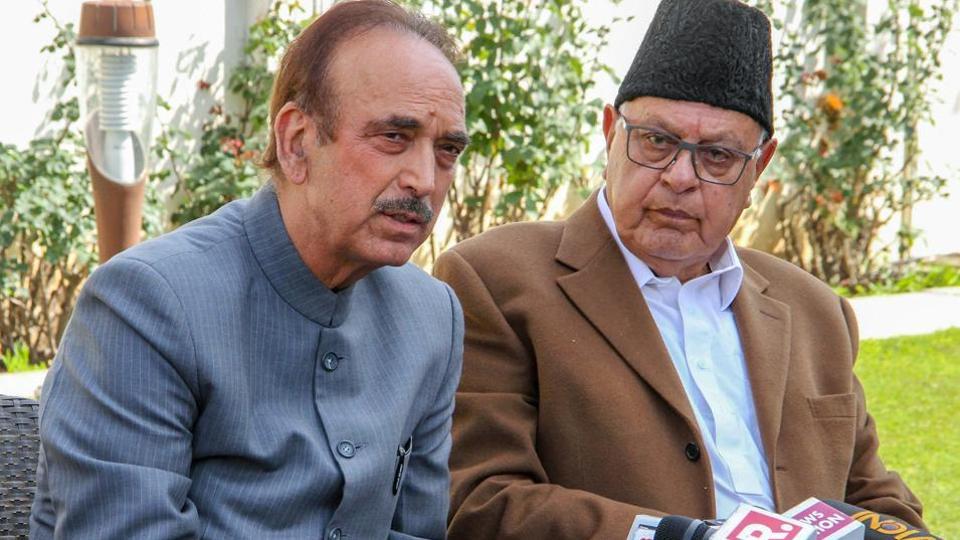
“We discussed how to strengthen the secular front and for this both the parties had to adopt a give-and-take formula. We have decided to leave Jammu and Udhampur Lok Sabha seats for the Congress. I will be contesting from Srinagar and there will be friendly contests in the Baramulla and Anantnag Lok Sabha seats. We are also thinking of a friendly contest on the Ladakh seat,’’ Farooq Abdullah said, flanked by Azad, Soni and J&K Congress chief Ghulam Ahmad Mir.
Azad said Farooq Abdullah and Omar Abdullah had been actively engaged in meetings of opposition parties over the past five years, trying to forge unity among secular forces
“They always made efforts that at the national level secular parties should form a united front. Our decision was based on live-and-let-live...,” he said, adding that had the NC contested the two seats in the Jammu region, it could have helped the Bharatiya Janata Party (BJP) and had the Congress contested Srinagar, it would have made a transfer of votes to NC difficult.
Azad said Farooq Abdullah will be the joint candidate of the two parties from Srinagar. “We all will campaign for Farooq Abdullah as he is a legendary leader and belongs to both the parties,” he said.
The NC has already named three candidates. While Farooq Abdullah, who is a sitting MP, will be in the f ray in Srinagar, former minister Akbar Lone will be in the race for Baramulla and former high court judge, Husnain Masood, will contest Anantnag. The Congress hasn’t named any of its candidates yet.
People familiar with the development said J&K Congress president Mir could be the Congress candidate from Anantnag ,south Kashmir; Salman Soz, son of former J& K Congress chief Saifudin Soz, could contest Baramulla. In 2014, the NC and the Congress had contested elections for all six seats jointly and lost all seats to the Peoples Democratic Party and the BJP. In a 2017 by-elections, Farooq Abdullah emerged victorious from Srinagar amid low voting.
BJP state spokesperson Altaf Thakur said, “We have defeated them in the last election, and their coalition will face defeat this time as well.”
Peoples Conference general secretary Imran Reza Ansari said, “God save Kashmir from their friendship.”
Gowhar Geelani, a political analyst, said, “It seems that NC has an eye on the upcoming assembly elections and sees itself as the single largest party, which would then need a small coalition partner in Congress.”


