
 E-Paper



Lok Sabha Elections 2019: UP’s Awadh region will have a high-pitched battle for ballot
The high-pitched battle for the ballot in Lok Sabha Elections 2019, would be most keenly watched and fought on three VIP seats of UP’s Awadh region - Lucknow, Amethi and Rae Bareli.


Unlike the clean sweep by the Bharatiya Janata Party (BJP) in 2014 in which it won 15 out of the total 17 parliamentary constituencies in Awadh, the Uttar Pradesh region is set to witness a multi-corner contest this time around.
Culturally, historically and politically, the significance of the region can be gauged from the fact that it has given three prime ministers to the country - Indira Gandhi, who represented the Rae Bareli constituency between 1967 and 1977; VP Singh, who was elected to the 9th Lok Sabha from Fatehpur constituency; and Atal Bihari Vajpayee, who represented Lucknow in the parliament.
The high-pitched battle for the ballot, however, would be most keenly watched and fought on three VIP seats of Lucknow, Amethi and Rae Bareli.
According to Congress leaders, the party’s east UP in-charge Priyanka Gandhi has planned meetings and roadshows in Faizabad and Ayodhya from March 25 to 27 to regain lost ground.
Experts say the Temple movement of the ‘90s in Ayodhya which had catapulted BJP to the centre stage of national politics, is no longer an emotive issue. Instead employment, agrarian distress, river pollution and, above all, the caste of the candidate, would be major poll planks.
“Known as the granary of India, Faizabad (now rechristened as Sri Ayodhya by the Yogi Adityanath government) was once the heart of Awadh. It was the most advanced, historic and culturally rich capital of what was then called the United Province of Awadh and it also included Agra,” says social scientist DK Bajpai of the Giri Institute of Research and Studies. “Agriculture and industrialisation have now changed the landscape of the area dominated by the other backward classes (OBCs) and Muslims,” says Bajpai.
Also Read | What UP tie-ups portend for BJP in Lok Sabha polls
BJP’s attempt to revamp Ayodhya with a Rs 300-crore development package, including the installation of a huge statue of Lord Ram, better civic amenities, pilgrim shelters, clean water, promotion of vegetarianism and a ban on alcohol to maintain the sanctity of holy sites would be put to the major test here.
Political analysts, however, feel the party is unlikely to repeat its performance of 2014 and Faizabad, represented by Lallu Singh of the BJP, would not be a cakewalk either.
After 1999, the BJP has won the seat only once. In 2009 and in 2004, the seat was won by candidates from the Congress and the Bahujan Samaj Party (BSP), respectively. The BJP faces a formidable caste-based alliance of the BSP and the SP, which count Dalits, OBCs and Muslims among their supporters. The big question is whether SP’s OBC votes would get transferred to Mayawati and vice versa.
Besides regional political heavyweights, a retired bureaucrat Vijay Shankar Pandey has also thrown his hat in the ring from Faizabad on Lok Gatbandhan Party’s ticket. Pandey had served as the district magistrate of Faizabad in the aftermath of the demolition of the disputed structure in Ayodhya.
Professor AK Verma of Kanpur, who has done research on the politics of social polarisation and its limitations, says: “Uttar Pradesh was a strong bastion of the Congress party till 1989. The electoral politics here can be divided into two phases – of Congress domination from 1952 to 1989 and the non-Congress phase of coalition governments from 1989 to 1999 characterised by three political formations of the SP, BSP and BJP.”
“The second phase of the state’s politics was marked by competition among political parties based on caste and communal factors,” he adds.
“However, an interesting development that has emerged during the second phase is that most parties have come to realise the limitations of ‘exclusive politics’ that is the inadequacy of caste or religion to be the only basis for a political formation and are now trying to cross-expand their social base and steadily move towards inclusive politics to attract all sections of the society, irrespective of caste or religion,” Verma says.
Also Read | BJP releases first list of 184 names, PM to contest from Varanasi
Despite their dismal performance of 2014, the BSP and the SP secured 20 per cent and 22.5 per cent votes. Their combined vote share was almost equivalent to the NDA’s. Despite the landslide victory of BJP in 2014, the combined vote share of the SP-BSP alliance was more in 41 parliamentary constituencies.
On 10 seats where the Muslim, Yadav and Dalit population was more than 60 per cent, the combined vote share of the SP-BSP alliance was more.
“In the 86 reserved assembly seats, we won only three seats in 2012 but won all 17 reserved Lok Sabha constituencies in 2014 Lok Sabha polls,” a BJP leader says. With Congress fighting outside SP-BSP alliance, the BJP has pinned its hope on the division of 19 per cent Muslim and seven per cent Yadav votes between these two parties because of a family feud in SP.
Also Read | In Congress first list, Sonia Gandhi to contest from Rae Bareli, Rahul from Amethi
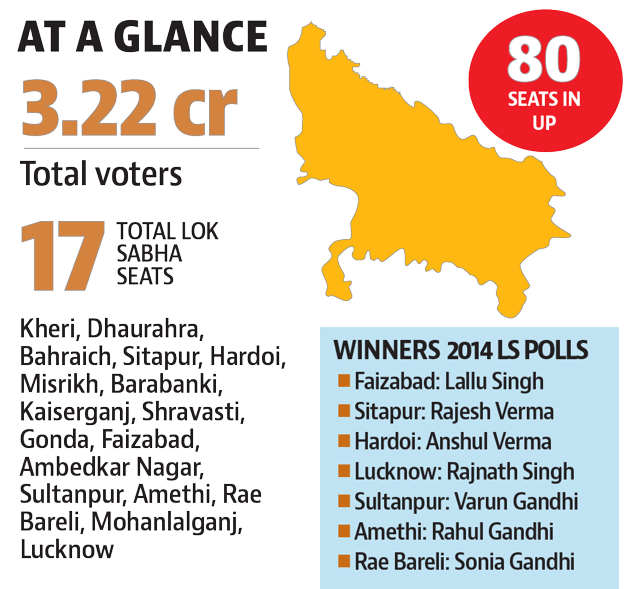
AWADH: AN OVERVIEW
With approximately 3.22 crore voters spread over 17 Lok Sabha seats, the Awadh region comprises of Kheri, Dhaurahra, Bahraich, Sitapur, Hardoi, Misrikh, Barabanki, Kaiserganj, Shravasti, Gonda, Faizabad, Ambedkar Nagar, Sultanpur, Amethi, Rae Bareli, Mohanlalganj and Lucknow.
LUCKNOW
Lucknow has been a BJP bastion ever since the 10th Lok Sabha election in 1991 with former prime minister Atal Behari Vajpayee winning for a record five times consecutively from this constituency. In the 2014 Lok Sabha elections, the seat was won by Rajnath Singh. Rita Bahuguna Joshi (who was then with the Congress and is now a minister in the Yogi Adityanath government after joining the BJP) stood second while Abhishek Mishra (SP), Nakul Dubey (BSP) and Jaaved Jaffrey (AAP) occupied the third fourth and fifth place respectively. Lucknow is one of the 80 parliamentary constituencies of Uttar Pradesh which came into existence before the 1951 elections and has five legislative assembly segments. It has a total population of 16.53 lakh out of which out of these 8.89 lakh voters are males and 7.63 lakh females. The cleaning of city’s lifeline, Gomti river, is an election issue here.
FAIZABAD
Situated on the banks of river Ghaghra, Faizabad was once the cultural capital of Awadh. The constituency has 15.16 lakh voters, 8.34 lakh males and 6.97 lakh females. BJP’s Lallu Singh won the seat in 2014 while Mitra Sen Yadav of the Samajwadi Party was the second runner-up. The parliamentary constituency comprises of five Vidhan Sabha segments of which one is reserved for the SC category.
SITAPUR
Agriculture is the mainstay of Sitapur located 89 kilometres from Lucknow. The parliamentary constituency has a total population of 17.73 lakh with a voter strength of 12.30 lakh, 6.62 lakh males and 5.67 lakh females. Rajesh Verma of the BJP wrested this seat from Qaiser Jahan of the BSP. The constituency has 73 per cent Hindus and 26 per cent Muslims.
HARDOI
The BJP won all the 17 reserved parliamentary constituencies in 2014, Hardoi being one of them. Anshul Verma of the BJP won the elections in 2014 while BSP nominee Shive Prasad Verma stood second. The parliamentary constituency has a total population of 14.17 lakh, 6.33 lakh female and 7.83 lakh males. The seat represents Hardoi district which is under Lucknow division with the headquarters located in Hardoi city. It has five tehsils and consists of over 2,000 villages.
SULTANPUR
Sultanpur is essentially an agricultural district located on the banks of river Gomti. The constituency witnessed a triangular contest among SP’s Shakeel Ahmad, BJP’s Varun Gandhi, and BSP’s Pawan Pandey. However, Varun Gandhi emerged a clear winner in 2014 elections defeating Pawan Pandey by a margin of 1.78 lakh votes. Sultanpur was once a Congress stronghold represented by party MP Sanjay Sinh. It has 14.30 lakh voters out of which 7.64 lakh are males and 6.66 lakh females. Problems of sugarcane farmers is a major poll issue here.
AMETHI
The Gandhi family stronghold witnessed one of the most closely contested elections in 2014 where BJP’s Smriti Irani was pitted against Congress’s Rahul Gandhi, who has retained the seat ever since Sonia Gandhi vacated it for him in 1999. Rahul managed to retain the seat against the BJP onslaught though his winning margin was reduced considerably from his past performance. It has a total of 14.31 lakh voters comprising 6.79 lakh females and 7.52 lakh males. It comprises of five Vidhan Sabha segments of which two are reserved for the SC category. It covers the entire district of Amethi, previously known as the Chhatrapati Shahuji Maharaj Nagar district. Muslims have a majority here.
RAE BARELI
A Gandhi family bastion. United Progressive Alliance (UPA) chairperson Sonia Gandhi has posted four consecutive wins from here since 2004. She defeated BJP’s Ajay Agarwal with a margin of over three lakh votes. The parliamentary constituency has a population of over three million. It has 13.79 lakh voters out of which 6.45,861 are females and 7.33 lakh males. Hindus form 68% majority followed by Muslims (30%). Non-functional factories, land acquisition and compensation for farmers are election issues in Rae Bareli.


