
 E-Paper



Parties invoking ‘soft Hindutva’ to tide over hard times?
Many secular politicians are trying to be demonstratively Hindu by wearing their religious identity on their sleeves - something they had been refraining from in the past.


On being pointed out by an anchor during a television programme in March that he had the image of an anti-Hindu leader, Samajwadi Party president Akhilesh Yadav said he would tweet pictures of religious functions at his house to prove he was also a Hindu.
Replying to the query, Akhilesh said: “As always, I will observe fast for all the nine days during Navratri but this time I will release a picture of ‘puja paath’ (religious programmes) at my home so that people may know I am also a Hindu.”
Akhilesh might have made the remark in a lighter vein, but he kept his word by tweeting a picture of his wife and Kannauj MP Dimple Yadav offering food to ‘kanyas’ (girls) on Ram Navmi.
The post, captioned ‘Kanya pujan ka saubhagya’, garnered 1.71 lakh likes on Facebook and 29,000 on Twitter, besides thousands of shares and re-tweets as on April 2.
This is not a one-off case. Many ‘secular’ politicians are trying to be demonstratively Hindu by wearing their religious identity on their sleeves – something they had been refraining from in the past.
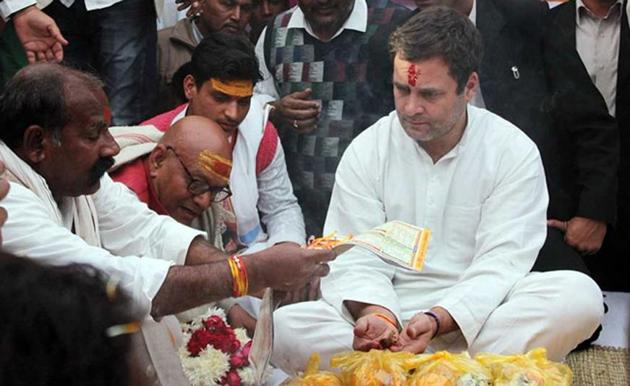
During Gujarat assembly elections, Congress leader Rahul Gandhi’s visits to temples sporting a ‘janeu’ (sacred threat) raised many eyebrows.
His temple visits continued when he visited his Lok Sabha constituency Amethi in January this year after being appointed the Congress president.
Before entering his constituency, he made a point to pay obeisance at Lord Hanuman temple in Bachhrawan.
Rahul also participated in ‘khichdi puja’ in Rae Bareli, the parliamentary constituency of his mother Sonia Gandhi, on the occasion of ‘Makar Sankranti’.
He has also been visiting temples in Karnataka where assembly elections are due in April-May.
Bharatiya Janata Party spokesman Chandramohan said besides Akhilesh Yadav and Rahul Gandhi, even West Bengal chief minister Mamata Banerjee was trying to prove she was not anti-Hindu.
In January this year, an MLA of Mamata Banerjee’s Trinamool Congress held a Brahmin sammelan in Birbhum district where 15,000 Brahmins were reportedly presented a copy of the Bhagavad Gita.
“What Rahul, Akhilesh and Mamata are doing is a desperate bid to correct their anti-Hindu bias,” Chandramohan said, adding the public was intelligent enough to see through their game.
The BJP too, is not far behind. Facing competition, many BJP leaders have been trying to outdo their rivals in demonstrating their Hindu identity.
On Ram Navami, BJP’s national spokesman Sambit Patra appeared on a television debate with his entire forehead covered with a ‘tilak’.
To show his love for Hindu religion, Mohsin Raza, the only Muslim minister in the Yogi Adityanath government, offered prayers at Hanuman temple in Lucknow on Hanuman Jayanti. Later, he made it a point to make the pictures public.
During TV debates, especially on Hindu festivals, spokesmen for various parties are seen wearing ‘tilak’ on their foreheads, tying a ‘kalava’ (sacred red thread) on their wrist or having the idols of gods and goddesses behind them while connected from home or office.
They also begin by greeting the audience on the festival to send out “right signals”.
According to Rajesh Mishra, a social scientist, some non-BJP parties are resorting to Hindu religious symbols due to their sense of insecurity.
“The BJP’s surge to power riding the Hindutva plank has created a sense of insecurity in many non-BJP parties that are trying to adopt soft Hindutva by publicly bearing Hindu religious identities,” he said.
Accusing the BJP of taking its communal agenda to a new low, senior Congress leader Satya Dev Tripathi said the saffron party was trying to portray its opponents as anti-Hindu.
“It is high time we replied to the BJP in the same coin by conveying the message that we are as much Hindus as anyone else. So far as Rahul Gandhi is concerned, he has been visiting all religious shrines – be it temples, churches, or Gurudwaras – as a true secular leader,” he said.
Mishra, however, said the trend of leaders consciously demonstrating Hindu religious symbols was not good either for secularism or for democracy.
“The non-BJP parties should continue to mobilise people on secular issues like poverty, unemployment and corruption rather than resorting to soft Hindutva,” he said.


