
 E-Paper



ISRO detects high energy X-ray black hole emissions
Astrosat – India’s first astronomy satellite – has, for the very first time, observed rapid oscillations of high energy X-ray emission coming from a black hole.


Astrosat – India’s first astronomy satellite – has, for the very first time, observed rapid oscillations of high energy X-ray emission coming from a black hole. A black hole is an area in space with such high gravity pulls that even light cannot escape, and therefore it is invisible.
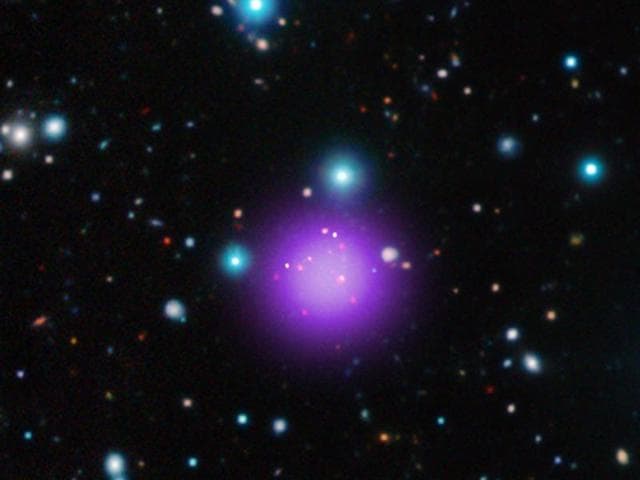
Earlier,NASA’s Rossi X-ray Timing Experiment (RXTE) had detected similar oscillations in low energy X-rays. However, there was no data on high energy X-rays to be able to understand the physics of emissions of both low and high X-ray energies from a black hole system.
Now, the indigenously built Large Area X-ray Proportional Counter (LAXPC) -- the most sensitive detector on Astrosat - by the Tata Institute of Fundamental Research (TIFR) recorded the X-rays oscillations on a time-scale of a few hundred milliseconds from a black hole system GRS 1915+105.
“For astronomy, this finding is very important. There are massive black holes in the centre of each galaxy, and these control the dynamics of the whole galaxy. So understanding black holes is very important to understand the galaxy,” said professor JS Yadav, who was responsible in the building of LAXPC.
With an effective area four to five times more than that used by the RXTE mission between 1996 and 2012, scientists said LAXPC measured the arrival time difference between the high and low energy X-rays (which is of the order of tens of milli-seconds) providing direct clues to the geometry and dynamic behaviour of the gas swirling round a spinning black hole.
Scientists said Astrosat made this observation of GRS 1915+105 in just nine orbits – or a few hours. “Observing the phenomenon in high energy X-rays is critical since higher energy photons (fundamental particle of visible light) are expected to be emitted closer to the black hole than low energy photons,” said Yadav. “No other observatory at present (or earlier) is capable of achieving these results.”
In black hole systems, said scientists, the mass from a regular star gets stripped off and falls towards the black hole forming a disk around the black hole. The temperature of the disk is more than ten million degrees and hence the black hole system emits X-rays. The total power from these systems is often more than 10,000 times that of the sun.
The findings, by TIFR scientists, and astronomers from the Pune-based Inter-University Centre for Astronomy and Astrophysics, University of Mumbai and the Raman Research Institute (RRI), will be published in the Astrophysical Journal.

Stay updated with all the Breaking News and Latest News from Mumbai. Click here for comprehensive coverage of top Cities including Bengaluru, Delhi, Hyderabad, and more across India along with Stay informed on the latest happenings in World News.


