
 E-Paper



‘Poor’ air returns to Mumbai, pollution levels won’t improve this weekend
The pollutant-measuring indicator – air quality index (AQI) – was recorded at 212 during the day, which fell to 210 by the evening – both falling under the ‘poor’ category.


Pollution levels in the city entered the ‘poor’ category on Saturday after 20 days of ‘moderate’ air quality.
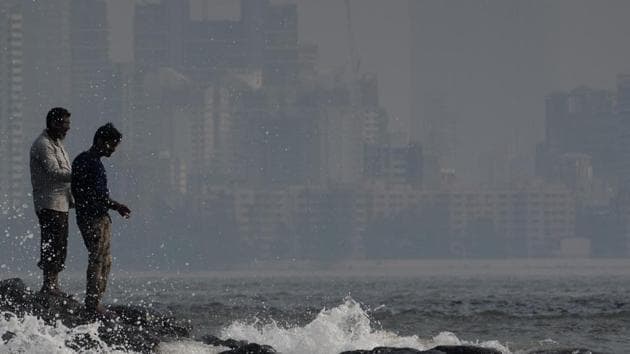
The pollutant-measuring indicator – air quality index (AQI) – was recorded at 212 during the day, which fell to 210 by the evening – both falling under the ‘poor’ category. The System of Air Quality Weather Forecasting and Research (SAFAR) predicted an AQI of 202 (poor) for Sunday.
Mumbai’s air quality was worse than Delhi, Pune and Ahmedabad, the cities where SAFAR records AQI levels. While Delhi recorded 142 (moderate), Pune recorded 143 (moderate) and Ahmedabad 150 (moderate).
Of the 10 locations in Mumbai where SAFAR monitors air quality, Navi Mumbai was the most polluted with an AQI of 316 (very poor). At a close second was Mazgaon at 315 (very poor) and Bandra-Kurla Complex (BKC) at 301 (very poor). Worli had the cleanest air in the city at 79 (satisfactory), followed by Malad at 110, Colaba at 123 and Bhandup at 132 – all falling under the ‘moderate’ category. Remaining locations recorded ‘poor’ air.
HT had reported on March 6 that after 12 days of high pollution levels, Mumbai’s AQI on March 5 was recorded at 149 (moderate) as AQI levels before that were between 233 and 251(poor) from February 21 to March 4. March 5 onwards, AQI levels have been ranging between 125 (March 20) and 196 on Friday, all falling under the moderate category.
Researchers attributed the rise in pollution to a drop in temperatures. On Friday, the day and night temperature in the suburbs was 2 degree Celsius below normal, and close to the normal mark in south Mumbai. “With a drop in temperatures, an automatic rise in pollution levels is observed as the pollutant particles get suspended close to the surface. Dust particles are also high in the air, and speedy dispersion has not taken place because of calm winds,” said Gufran Beig, project director, SAFAR. The weather bureau, however, said dust was the primary cause. “An upper air anti-cyclonic circulation over north Maharashtra is changing the weather pattern over Mumbai. From cool northerly to northwesterly winds during late evenings and early morning and warm easterly winds are bringing dust over the city,” said KS Hosalikar, deputy director general, western region, India Meteorological Department. “We expect a rise in temperatures from Sunday.”
From below normal temperature on Friday, a marginal rise was recorded on Saturday. Colaba and Santacruz recorded 31.5 degree Celsius and 33.2 degree Celsius, both close to the normal mark. The night temperature at both locations continued to be below normal as Colaba recorded 23 degree Celsius, 0.1 degree Celsius below normal and 21.2 degree Celsius was recorded at Santacruz, 0.6 degree Celsius below normal.
The weather bureau has predicted a clear sky for Sunday with maximum temperatures to rise to 35 degree Celsius and the minimum temperature at 21 degree Celsius.
Stay updated with all the Breaking News and Latest News from Mumbai. Click here for comprehensive coverage of top Cities including Bengaluru, Delhi, Hyderabad, and more across India along with Stay informed on the latest happenings in World News.


