
 E-Paper



America pays the cost of dominance
Donald Trump played the isolationist card in 2016. Democrats learnt from it. Circumstances are enabling Trump to benefit from fickle American public opinion

 Prefer HTon Google


As President, when Donald Trump was unhappy with advice offered by any of his national security officials, he called them “globalists”. When Trump’s advisers were competing for influence, the way to discredit the other camp was branding them “globalists”.
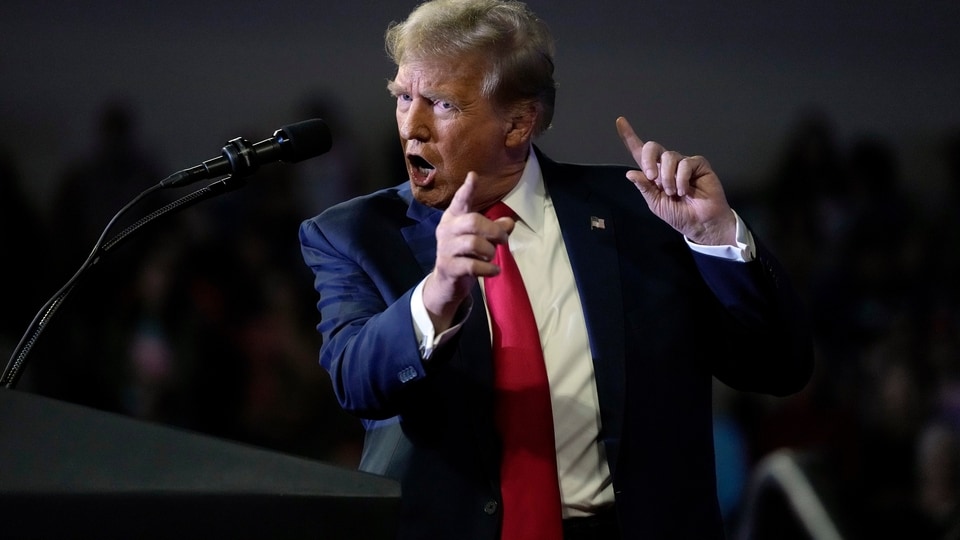
And that is why Trump’s statement that he would not just withdraw the American security umbrella if North Atlantic Treaty Organization (Nato) members don’t meet their financial obligations but also encourage Russia to do whatever it wants isn’t surprising, even though it is an even more extreme formulation than he has previously used. Just Trump saying it has sent jitters across Europe and eroded the idea of a unified security grid and deterrence, based on the US nuclear umbrella. It has reinforced the view that a change in Washington DC will spell doom not just for Ukraine but also make Eastern Europe vulnerable. And it has given Russia renewed confidence about the emerging political dynamics in the US, in the same week that Vladimir Putin reached out to Tucker Carlson’s large American audience on X and House Republicans continue to block funding for Ukraine.
For Trump, the criticism is a part of the globalism that has led to America’s myriad entanglements with high costs and low returns, as opposed to “America first”, an approach that places narrowly defined American interests supreme. And on this, Trump has been relatively consistent. Go back to the first presidential debate with Hillary Clinton in 2016 and there you have Trump saying, “We are not the world’s policeman.”
European leaders, the White House, and even the older Republican establishment have all made more rigorous arguments about the value of Nato and other allies to America, the contribution that Nato members are actually making, and the connections between domestic and external security. But those are not the people Trump is speaking to.
He is speaking to Americans who see their external entanglements as a cause of, or at least a distraction from, internal distress. He is speaking the language of isolationism that goes back to America’s origins and has deepened in a continental geography, which has the luxury of being protected by the oceans and is surrounded by much weaker and smaller neighbours and can pick and choose global engagements. He is speaking to a fickle public opinion that swings from seeing itself as the defender of freedom to having absolute indifference and contempt for complexities elsewhere, an electorate that wants to shape the world in one cycle and have nothing to do with it in the next cycle.
For the Democrats, and for what constituted the then Republican Party, this was a relatively unfamiliar argument in 2016. But after the period of “humanitarian interventions” of the 1990s, the Iraq and Afghanistan wars of the 2000s, the rise of Isis in the 2010s, and the loss of jobs thanks to greater globalisation all through these three decades, American public opinion was receptive to Trump’s simple, often simplistic, message. The more the Democrats criticised Trump for being irresponsible internationally, the more his nationalist credentials grew.
The 2016 elections showed the Democrats that America’s external relationships were a key strength but they had done a poor job of articulating that to their own voters, overreach had generated resentment, and elites stopped listening to the concerns on the ground. Out of office, Jake Sullivan, who was a domestic policy adviser to Hillary Clinton during the 2016 campaign and had seen this disconnect, worked on a major bipartisan document, ‘Making American Foreign Policy Work Better for the Middle Class’.
Even as it claimed that there remained robust American support for a global leadership role, the paper acknowledged that past approaches had “left too many American communities vulnerable to economic dislocation and overreached in trying to effect broad societal change within other countries”. It called for a foreign policy that preserved global openness, but entailed increased investments at home to improve American capabilities that harnessed US leadership but “toward less ambitious ends, eschewing regime change and the transformation of other nations through military interventions”. And Sullivan and his team concluded: “If the US stands any chance of renewal at home, it must conceive of its role in the world differently”.
From a massive manufacturing push within America to calibrated export controls to weaken adversaries, from a focus on diversification of supply chains to make America competitive to investing in allies to share the burden and reduce costs, from a continued aversion to trade arrangements that opened up US markets and caused job losses to buy in America rhetoric, the Joe Biden administration sought to craft a new foreign policy that is a response to Trump’s stinging criticism. The record is mixed but the effort is thoughtful.
The problem, however, for Biden is that there is a time lag between these investments and results, and it is harder to show the complex connections between foreign policy and domestic prosperity and security. Despite having gone through the humiliation of withdrawing American forces from Afghanistan because he wanted to end the endless wars, the President also got ensnared in two wars that were not of his making. When Putin decided to invade Ukraine, the US administration and public opinion were aligned in backing Kyiv; when Hamas attacked Israel, most of the US administration and a majority of Americans were aligned in sympathy for Tel Aviv.
But as the Ukraine war prolonged, as a clear pathway for victory became less apparent, and as fatigue set in, conservative public opinion began asking why the US was involved in such a distant war at all. As the Israeli offensive continued in Gaza, as the war widened, as American personnel and interests began to get attacked, and as public opinion from the Left turned against Biden for aiding Israel, public opinion on the Right began blaming Biden for exercising American power inadequately.
Leave aside the accuracy or cogency of the critiques. The image in popular consciousness today is of Americans struggling with cost-of-living and immigration issues, and a Washington administration engaged in the wars that fetch America little. As Trump creates and speaks to this world, America’s globalists will need to find better answers and a different vocabulary to win over American public opinion.
The views expressed are personal


