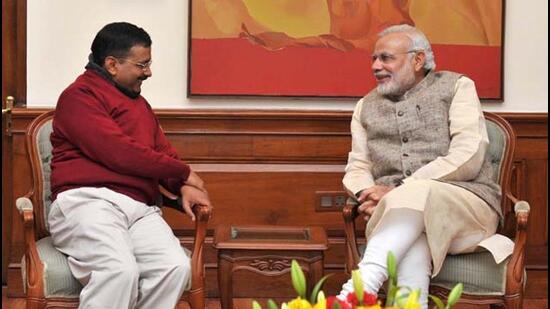
The excitement over the assembly elections in five states has barely subsided. But, Prime Minister (PM) Narendra Modi has sounded the bugle for the next battle with a huge roadshow in Ahmedabad on Friday. The leader of the victorious Aam Aadmi Party (AAP) in Punjab, Arvind Kejriwal, is planning to visit the state soon. Ahmedabad is set to become the epicentre of political activity as Gujarat and Himachal Pradesh go the polls at the end of the year.
Is a confrontation between Narendra Modi and Kejriwal on the cards in the next five years? Early indications of the contours of such a face-off will come at the end of this year. (AFP)
One thing is clear now: Despite some initial hiccups, the Modi magic is intact. Assembly elections were conducted in Maharashtra, Jharkhand, and Haryana after his second victory at the national level. The Bharatiya Janata Party (BJP) was defeated in all three. In Maharashtra, the Shiv Sena broke away from the BJP — which emerged as the single largest party — and joined hands with its traditional opponents to form the government. In Jharkhand, the BJP was not only defeated, but chief minister (CM) Raghubar Das also lost. Haryana ended up with a hung assembly. The BJP had no choice but to ally with Dushyant Chautala’s Jannayak Janata Party. Forming a government with such groups is tricky, but there was no other choice.
Later, elections in Bihar and West Bengal revealed that while voters favour Modi for PM, this was not so in state elections. It’s no surprise that this encouraged Samajwadi Party (SP) leader Akhilesh Yadav, who formed an alliance with some of his former rivals. The Congress also appointed Charanjit Singh Channi as Punjab’s CM, assuming that it would automatically garner more than 30% of the Dalit vote. Uttarakhand and Goa were treated as ancestral fiefdoms, which explains the Congress’s loss in both. In Manipur, the Grand Old Party had hoped to make a dent. But the opposite happened.
Uttar Pradesh CM Yogi Adityanath was able to defy all odds and reclaim power with a two-thirds majority. Not only that, the BJP was able to once again form the government in Goa, Manipur, and Uttarakhand. Modi’s star power, the amazing organisational capability of the party and perception of good administration pushed the party to power. It also showed that the saffron party learnt from its errors.
Despite a defeat, Akhilesh Yadav was able to raise his seat and vote percentage. His coalition also hit the BJP hard in some places. An example is the defeat of deputy CM Keshav Prasad Maurya from Sirathu. It will be interesting to see how Akhilesh Yadav will conduct himself as an Opposition leader and how he will keep his alliance intact.
Senior leaders from practically every backward community are part of the partnership. If he can keep the alliance together, the BJP will have a difficult time retaining its 62 Lok Sabha Members of Parliament (MPs) in the next general election. But Akhilesh Yadav has his task cut out for him. He has to broaden his caste equations network and identify effective protest issues. These elections have sent a clear message: Modi and Yogi have bulldozed old caste equations. Without being in constant battle mode and taking up effective issues, dealing with the combination of these two leaders is impossible.
Is Akhilesh Yadav ready for the long haul?
When it comes to caste equations, it’s impossible to overlook Bahujan Samaj Party leader Mayawati. She has long been a champion of caste manipulation, but her vote bank has suffered a loss of nearly 10% for the first time. She told reporters the day after the results that she had been a victim of the BJP’s B-team propaganda. Mayawati can try to save face this way, but the truth is that her core vote bank, the Jatavs, have begun to raise the issue that she offers tickets to the wealthy in exchange for votes. Mayawati is currently going through a tough patch. At the present, her comeback appears to be difficult but, then again, she has surprised us many times in the past.
The growth of the AAP is significant. When Kejriwal established his new party 10 years ago, he was mocked by many. However, within months, he became CM of Delhi. He improved health care, opened mohalla clinics, improved standards in government schools and reduced water and power bills. Kejriwal won three elections, one after the other, right on the central’s government’s turf. He, like Modi, is not a leader of a specific caste.
The AAP has now earned the right to pursue national aspirations. In two months, Punjab will give it five more Rajya Sabha seats, taking its tally in the Upper House to eight. Kejriwal has finally been able to take his message from Parliament to people’s homes. In states where the Congress and the BJP have been in a direct fight, if the erosion of the Congress continues in election after election, the fight will certainly shift to one between the BJP and the AAP, particularly in many states of the north and west. This will be reflected in the Gujarat and Himachal assembly elections soon as the AAP is already active in Gujarat.
The AAP is not only occupying the Congress’s space, it is also posing a challenge to regional parties. The baggage of these parties’ leaders are such that they are hesitant to take a direct stand against the central government. Kejriwal has no such compunctions.
Is a confrontation between Narendra Modi and Kejriwal on the cards in the next five years? Early indications of the contours of such a face-off will come at the end of this year.
Shashi Shekhar is editor-in-chief, Hindustan The views expressed are personal

 E-Paper