The political and moral universes of the liberal international consensus are colliding in Gaza. What’s on view is the logical end of a morally bankrupt idea
“Are you seriously asking me about Palestinian civilians? What’s wrong with you?”, shouted Naftali Bennett, former Israeli prime minister. He was responding to a question on television about the safety of innocents who’d die because Israel has cut food, water, and electricity to Gaza. Shortly after his outburst, the Israeli Air Force posted pictures of entire Gazan neighbourhoods reduced to rubble. Such has been the shock of Hamas’ depravity that Jerusalem has forgotten the difference between terrorists and civilians. This method of countering terrorism by genocide has considerable international support. The West, quick to preach respect for human rights and international law to others, finds Israel’s need to defend itself by committing war crimes (called “acts of pure terror” when Russia did it) compelling.
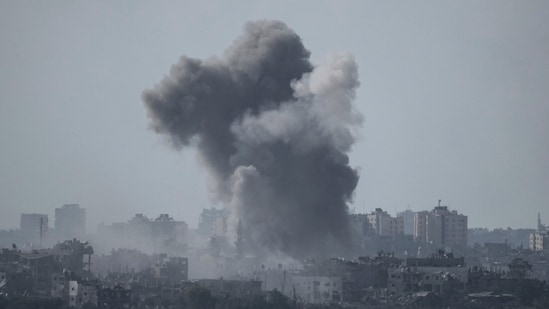
Smoke rises following an Israeli airstrike in the Gaza Strip, as seen from southern Israel, Saturday, Oct. 14, 2023. Israel has been striking targets throughout Gaza since a bloody, cross-border attack by Hamas militants killed over 1,300 Israelis on Oct. 7. (AP Photo/Leo Correa) (AP)
Juxtapose this war, which risks igniting the entire Middle East (again), with the Russia-Ukraine war, Azerbaijan’s Turkey-backed offensive in Nagorno-Karabakh, the Sudanese civil war, multiple anti-European coups in West Africa, the Sino-Indian standoff, the prospect of China invading Taiwan and the scale and scope of the current global crises becomes clear. That we’re living in a polarised world driven by ethnically-charged populist politics is known. But liberal internationalism’s hypocrisy has been so blinding, and its failures in Iraq and Afghanistan (but not just) so apparent that the latest wars raise the question, what did we miss, and what comes next? To answer these existential questions, one needs to focus on two simultaneously imploding orders—political and moral—that have collided in Gaza.
The end of the so-called United States (US)-dominated liberal international order has multiple beginnings. The invasions of Afghanistan and Iraq mark two such moments, with the 2007-09 recession triggering a sprint to the casket. Its death came with the birth of ultra-Right movements at home, and the rise of economically potent illiberal powers abroad — one as a friend (India), the other as a foe (China). The US’ trouble with a Russia-managed presidential candidate and China, or the European Union’s struggle with anti-migrant Right-wing tumult and Brexit, topped by collective ignominy over the Afghanistan withdrawal have all been after-effects (not causes) of the collapse of liberal internationalist consensus. Much of this was explained as a victory of realpolitik over moral-politik. But in reality, it was just a logical end of a morally bankrupt idea.
What we lost, then, is not the end of liberal internationalism. Many observers have written poetic obituaries of that. And if still in doubt, just ask a Gazan who’s been living for years in a US-backed Israeli open-air prison operated by an Iran-sponsored Islamist outfit to boot. Instead, what we missed was the birth of a conservative global order undergirded by Right-wing internationalism, illiberalism, and civilisational angst. To be clear, these aspects were known. What went under-appreciated is the fact that this order took birth within the so-called alliance of democracies itself, and is being raised in the same institutional cradles as its liberal predecessor. Traditionally illiberal, Beijing and Moscow have exploited and marginally enabled, not midwifed, these new realities.
The ongoing wars don’t mark the failure of a liberal order that’s already dead. They typify the struggles of this new conservative order with its tremendous disruptive energies. The onset of this order is evident in the unsubtle alliance between Zionism and Hindutva. It is no surprise that the most potent digital warriors serving Benjamin Netanyahu in his Gazan war are not Israelis, but Indian propagandists linked to the Hindu-nationalist canon. Europe’s impending Right-ward lurch and US President Joe Biden’s unceasing domestic struggles clarify where the pendulum is. This raises a different problem though. The conservative order is driven by puritanical visions and anti-liberal angst. But it hasn’t established clear norms to contain wartime excesses or manage peacetime etiquette for itself.
Such a lack of normative maturity and institutional strength of a conservative order might prove more costly than the failure of liberal internationalism. This is not to say that one must yearn for “benign dictators” (an oxymoron) or accept Right-wing internationalism as a fait accompli. But the need for accountability is critical, and it’s time to start asking for the same from those in power, both in domestic settings and internationally. One doesn’t need to be a liberal or an internationalist to understand that no system can last long without credible checks and balances. If conservatives globally take pride in privileging political honesty (admittedly, a contested concept) over correctness, then they need to seriously reflect on the antinomies of their own exclusionary excess. If liberals are paying the price for hypocrisy, the conservatives will find their binaries costly.
This brings us to the second implosion, i.e., of the moral order. One doesn’t expect moral uprightness from Hamas. But for the Israeli defence minister to call Gazans “human animals” is unacceptable. That such talk and concomitant actions are being treated as “understandable” or “justified anger” is worrisome. It confuses revenge and collective punishment with national defence, and risks opening the floodgates of similar violence elsewhere in the future. To be sure, all wars are brutal. But Hamas and Israel have set new benchmarks of gore. Don’t be surprised if militants elsewhere take inspiration from Hamas, and the responding State looks up to Israel and metes out collective punishment.
The erosion of public morality has empowered global conservatism in some ways. But as Gaza, Nagorno-Karabakh, and Ukraine show, such erosion could also stymie this order; which is more shrill than strong. What comes next is difficult to assess but easy to guess i.e., bloodshed and trauma, increased exploitation, violent polarisation, and large pockets of anarchy. Unfortunately, there is no quick fix to any of this. For now, all one can do is demand accountability and the application of international law uniformly, consistently, and unambiguously. If the US can’t do this, then other countries, including India, must. The Palestinians and Armenians deserve dignified livelihoods just as much as the Israelis and Azeris.
Avinash Paliwal teaches at SOAS University of London and is the author of My Enemy’s Enemy: India in Afghanistan from the Soviet Invasion to the US Withdrawal (New York: Oxford University Press, 2017). The views expressed are personal

 E-Paper