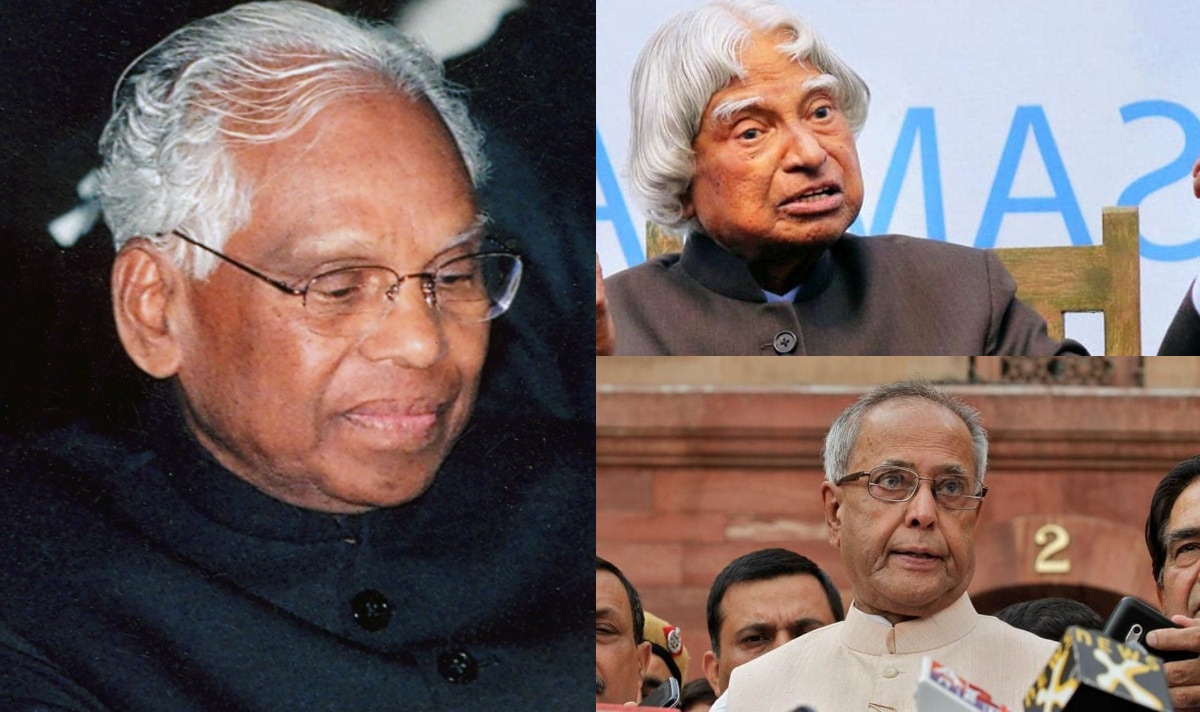
Distantly Close | A look back at Droupadi Murmu's illustrious predecessors
Most Presidents of the Republic were men of substance with a stamp of their own. As Droupadi Murmu is set to become India's next president, it would do us well not to judge the office by intermittent aberrations.
New Delhi: The myth that the Presidents of our Republic were mere “rubber stamps” of the executive must be busted. For our Constitution, while not envisaging an adversarial presidency, affords adequate room to occupants of the highest office to disagree or have a differing perspective from that of the council of ministers on whose advice they’re bound to act. While they cannot lead governments by their nose, they certainly can nudge them toward the constitutional scheme on seeing them go astray.
While Presidents cannot lead governments by their nose, they certainly can nudge them toward the constitutional scheme on seeing them go astray.
It is time to walk back in time as the country is on the verge of electing its 15th President — the choice being between the National Democratic Alliance (NDA)-proposed Droupadi Murmu and the Opposition’s Yashwant Sinha. As the campaign progresses, there indeed will be a debate, howsoever academic, on whether the Presidency is about social identity or experience-cum-merit or both. The first attribute seems to have gained precedence in recent years, starting from the election of Pratibha Patil, our first woman President handpicked by the Congress-led United Progressive Alliance. The trend which continued with her NDA successor Ram Nath Kovind, a Dalit, is reinforced by the candidature of Murmu, the first tribal woman who is certain to romp home on the strength of the Bharatiya Janata Party (BJP)-controlled ruling coalition’s numbers in the electoral college.
In the past, we have had Presidents with underwhelming records. But the non-application of mind of a few, or their tendency to sign on dotted lines, does not take away from the legacy of a majority of the Rashtrapati Bhawan’s 14 occupants since Independence. Barring a couple, most among them were people of substance. They had a mind of their own and yet found acceptance of the prime minister of the day.
That the equation has worked without major upheavals is a tribute to the Constitution the people gave themselves and those they elected. As our presidency isn’t an executive presidency, it is widely accepted that the PM must have the president of his choice to make the constitution work in word and spirit.
Exceptions to this consensus were our first President Rajendra Prasad and his 11th successor, APJ Abdul Kalam. They both weren’t the PM’s first choice; the former in Jawaharlal Nehru’s time and the latter during Atal Bihari Vajpayee’s tenure. An agreement was worked around the latter’s name after opposition from within the BJP to then vice-president Krishan Kant’s candidature and the lack of support from allies to PC Alexander, a one-time top aide of Rajiv Gandhi who had also served as the governor of Maharashtra.
A major reason for the compromise forced on Vajpayee was his coalition regime’s dependence for support on Chandrababu Naidu’s Telugu Desam Party. Together with the Samajwadi Party’s Amar Singh, Naidu zeroed in on Kalam after the elimination of Kant, his first choice for the RP Bhawan with which Vajpayee agreed.
As for Prasad, then the president of the constituent assembly, it is recorded history that Nehru wanted another equally tall freedom movement leader, C Rajagopalachari, who held the office of governor-general before the constitution of Independent India came into force on January 26, 1950. As dwelling further on it would be wading into contrarian versions of history, suffice it to say that Prasad eventually became President and swore Nehru in as PM on January 30, four days after himself taking office.
For the 12 years that he was the President, Prasad struck common ground and differed with Nehru on a host of issues, notably the Hindu Code Bill and the place of religion in politics which saw them standing apart on the desirability of the President’s presence at the inauguration of the rebuilt Somnath Temple (which Mahmud of Ghazni had ravaged in 1026 AD). The speech Prasad delivered on the occasion was proof of his willingness to respect the PM’s standpoint without giving up his own on the complex question of state and religion. A passage historian Ramachandra Guha quotes from Prasad’s address in his book India after Gandhi, reads: “I respect all religions and on occasion visit a church, a mosque, a dargah and a gurdwara.”
Presidency’s 1975 low point was an aberration
Sans Fakhruddin Ali Ahmed, who signed the 1975 proclamation of Emergency almost like a robot, earning in the process the low-brow sobriquet of being Indira Gandhi’s rubber stamp, most Presidents acquitted themselves with grace and an intellectual heft that was entirely their own. Very much in that category were the second president, S Radhakrishnan, Dr Zakir Hussain, VV Giri, Neelam Sanjeeva Reddy, R Venkataraman, Shankar Dayal Sharma, K R Narayanan and Abdul Kalam.
In fact, diplomat-academician Narayanan whose learning made incidental his Dalit credentials, broke new grounds by returning the government’s recommendation for the dismissal of two state governments: Kalyan Singh’s in UP in 1998 in Inder Gujral’s time and Rabri Devi’s in Bihar a year later when Vajpayee was the PM. He was also the one who cautioned the latter against his move to review the constitution. “Let us examine whether the Constitution has failed us or we have failed the constitution,” he famously remarked in his address on the Republic’s golden jubilee.
Setting an example of matured leadership, Gujral went on record to say that his government saw wisdom in the President’s action and wanted it to prevail in UP (by restoring Kalyan Singh). The Rabri regime came alive later with the government lacking the numbers to have her dismissal ratified in the Rajya Sabha. LK Advani too praised the explainer Narayanan put on the file while assenting to the invocation of article 356 in Bihar after the cabinet’s decision was sent to him the second time. The second referral had left the President with no option except to agree as per the constitution.
The Vajpayee regime also let the Presidency have its way on the question of posthumously conferring the Bharat Ratna on VD Savarkar. Vajpayee had mooted the latter’s name after accepting Narayanan’s suggestion to confer the honour on Shehnai maestro Bismillah Khan. He gracefully withdrew his proposal when the President sat on the file for several months. “The events defined the majesty of the Republic enhanced by the maturity of the leaders of the time,” recalled S N Sahu, who served as an OSD and press secretary to the President.
The pizza presidency and the one that contemplated sacking the PM
Of the remaining Presidents, the tenures of Patil and Kovind, the outgoing president were marked by an ‘acquiescence of silence’ in the face of tumultuous happenings. They spoke little, and did even less. The standing joke about Patil was that the only change she brought about as India’s first woman President was to make presidential chefs churn out pizzas with chickpea flour base. “At times, she came across as a sarpanch who let her husband call the shots,” recalled an official who served her Presidency. There are similar stories one desists telling about the present incumbent out of respect for protocol.
For his part, Giani Zail Singh, who began the seventh presidency by offering to sweep the floor to show his loyalty to Indira Gandhi, came dangerously close to violating the constitutional scheme of separation of powers, by contemplating Rajiv Gandhi’s dismissal on the advice of political eager beavers having his ear. Saner advice eventually prevailed, averting the constitutional overreach of the presidency sweeping out an elected regime.
To his credit, Singh, as the country’s first Sikh president, had acted with courage and sanity by swearing in Rajiv as PM (before his election as leader of the Congress Legislature Party) in the tumult that followed the assassination of his mother by her Sikh security guards in 1984. In so deciding, he averted a potential constitutional logjam amid widespread communal violence triggered by the sitting PM’s killing.
Pranab Mukherjee, a Bharat Ratna who accepted his mistake
“Mine will be a constitutional presidency,” declared Pranab Mukherjee on the assumption of office on July 25, 2012, as the Republic’s thirteenth President. In the five years that he occupied the high table, he faltered once and admitted as much to this writer in the twilight of his term. Asked about his decision the Supreme Court overturned, to dismiss the Congress’s Harish Rawat regime in Uttarakhand, he plaintively conceded that “it was a mistake.”
Mukherjee’s term overlapped governments of the Congress and the BJP. Without being the rubber stamp of either, he got along well with Dr Manmohan Singh and for more than three years thereafter with Narendra Modi, to whom he administered oath on May 26, 2014. He spoke on major issues facing the country, was openly critical of ruckus in parliament and never loath to discuss and disagree behind closed doors with the PMs and members of their ministerial council to evaluate, at times, the desirability/ constitutionality of their binding advice.
The wealth of experience he brought to the office was of immense help. For instance, in the March of 2016, he accepted, against his own judgement, the imposition of President’s rule in Uttarakhand but not without telling Arun Jaitley and the PM’s principal secretary, Nripendra Misra that they should await the outcome of the trust vote ordered by the Governor. That course of action would’ve been in line with the Supreme Court judgement in the SR Bommai case which laid the law that the test of a government’s majority has to be on the floor of the House.
In his book, the Presidential Years (2012-17), Mukherjee explained why he did not, in the first instance, return the file recommending President’s rule in the state. He deduced that it would serve no purpose except to make headlines: “I was clear that I did not want to add to the brewing controversy. (So) a day before Rawat was to prove his strength, President’s rule was imposed.”
As things turned out, the (dismissed) CM was asked by the Supreme Court, where the matter landed, to demonstrate his numbers on the floor of the Legislative Assembly. “Had the government taken the points I raised into consideration... it could’ve avoided the embarrassment of the Court’s obiter dicta,” recalled Mukherjee. The Centre had acted without being in receipt of any report from the Governor who actually had asked the CM to prove his numbers in the House. The President accepted the union cabinet’s recommendation because, according to the constitution, he had to act on the basis of the report of the governor or otherwise. The word ‘otherwise” could mean any other relevant authority and in the case at hand, it was the union minister for home.
As the state government in question was that of the Congress, it’s open to speculation whether Mukherjee was burdened by the thought of coming across as partisan if he were to return the file for reconsideration. The comeuppance, in the end, was as much of the office he held; the court quashing the proclamation bearing his stamp. The predicament that led him to err in the case of Uttarakhand seems plausible, more so because just the previous year, he had sacked the Arunachal Governor, JP Rajkhowa when he refused to resign after being severely indicted by the apex court for accepting a trust vote outside the state assembly.
Overlapping presidencies have their obvious pitfalls, exposing them to risks of being painted partisan or adversarial by the government or expediently compliant by their erstwhile parties. Mukherjee had the taste of both when he sacked Rajkhowa, dilly-dallied on Uttarakhand, accepted the Bharat Ratna from the Modi regime and addressed a Rashtriya Swayamsewak Sangh gathering.
His erudition helped him traverse the landmines, an illustration of it being his bipartisanism and commitment to political dialogue that had him hold forth on his Nehruvian principles in the RSS’s Nagpur lair. Identity matters. But merit’s a better bet for safeguarding the Constitution.
HT’s veteran political editor, Vinod Sharma, brings together his four-decade-long experience of closely tracking Indian politics, his intimate knowledge of the actors who dominate the political theatre, and his keen eye which can juxtapose the past and the present in his weekly column, Distantly Close

 E-Paper