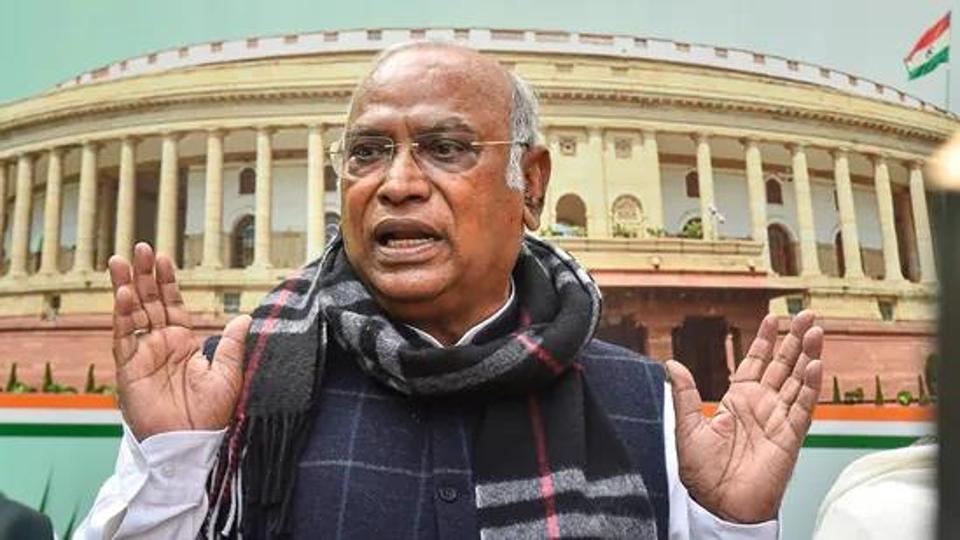
Distantly Close | Cong Prez Polls: The importance of being Mallikarjun Kharge
An immediate gain of his candidature is that it placed on the same page the G-3, the Gandhi trinity and their loyalists and the G-23, the pro-reform ginger group.
At 80, Mallikarjun Kharge is in the twilight of his political career. He isn’t a long-term challenge to younger colleagues who might have an eye on the Congress presidency to which he’s tipped to be elected. They know that he’d serve his time and walk into the sunset.
Perceived the front-runner now, Kharge was, for all practical purposes, the “third choice” for the president’s office after Gehlot and Kamal Nath. (PTI)
Albeit late in life, the veteran Dalit leader from Karnataka comes across as destiny’s child, his fate line somewhat similar to that of PV Narasimha Rao who never planned, yet got to be the party chief and prime minister by default, after Rajiv Gandhi’s untimely death in 1991. Another appropriate comparison could be with Inder Gujral, who, at age 78, woke up to be prime minister one day in 1997.
A compromise choice forced by circumstances — that’s what Kharge is and Rao and Gujral were ahead of him. The commonality of age, experience and a lack of mass base catapulted them to loftier heights. Being popular could be a disqualification in competitive politics. How else does one explain the underwhelming peer support for the charismatic, immensely gifted, and relatively younger Shashi Tharoor? Rahul Gandhi’s fellow Member of Parliament (MP) from Kerala is the other candidate in the October 17 organizational elections.
Crises-driven opportunity
The politicos who got lucky late in life, in fact, found resurrection in crisis situations. The septuagenarian Rao filled the vacuum left by Rajiv’s assassination at age 46; Gujral entered the scene as a technocrat trusted to run the government without upsetting the precarious power balance in the Congress-backed United Front. A consensus wasn’t possible at the time on either Mulayam Singh Yadav or Lalu Prasad essentially because they commandeered big constituencies in Uttar Pradesh and Bihar.
To stretch further the comparison wouldn’t be proper, for the office for which Kharge is in the fray hasn’t been much in demand lately. At least some, if not all Congress biggies who supported his candidature, did so to ensure a vacancy in the position to which they secretly aspire in the Rajya Sabha. There’d be intense lobbying now for the Leader of Opposition (LoP) slot Kharge has relinquished in conformity with the one-person-one-post principle to which Ashok Gehlot desisted adhering. The Rajasthan CM was the Gandhi family’s first choice for the presidency Rahul abandoned after the party’s 2019 drubbing.
All this does not take away from Kharge the importance of being Mallikarjun (the other name of Lord Shiva). Only time will tell whether he’d rid the enfeebled party of the poison of discord. An immediate gain of his candidature is that it placed on the same page the G-3, the Gandhi trinity and their loyalists and the G-23, the pro-reform ginger group. That made for good optics in Delhi as also in Karnataka, his poll-bound home state where Rahul Gandhi’s Bharat Jodo yatra set foot on the day he filed papers for the party presidency.
Gave up a post many wanted, to take up a job few desired
One can argue whether being the Congress president is a promotion for someone holding a constitutional office, which the LoP in the Upper House of Parliament indeed is, with its attendant protocol and perks. Given the sorry state of the Congress, Kharge apparently placed duty above position. What guided him could be his sense of history and the need to restore to the grand old party its relevance in a vastly altered polity.
It was in that vein a close aide of Kharge insisted: He left a job which others wanted to take up responsibility for which there weren’t very many happy takers. As LoP in the Rajya Sabha and before that in the Lower House, from 2014-19, his first-among-the-equals position vis-à-vis party contemporaries was a settled question. Unlike Gehlot, he never served as chief minister but had a former CM, Captain Amarinder Singh working as his deputy in the Lok Sabha. Others he led in the Lok Sabha and Rajya Sabha included the rump Congress’s crème de la crème: P Chidambaram, Digvijay Singh, Mukul Wasnik, Jairam Ramesh, Abhishek Singhvi and K C Venugopal, besides Sonia Gandhi and Rahul Gandhi themselves.
Having recently joined the Bharatiya Janata Party, the Captain had moved mid-way through the term to Punjab as CM. He preferred to be in his home state like other sons of the soil (Gehlot and Kamal Nath) who opted for the easy course, declining candidature for the Congress president’s office.
Having contested and won several direct elections to the state legislature and parliament, Kharge’s candidature found wide acceptability also because he’s an amenable old-school politician not known to throw his weight around. He believes in taking people along. Bar one occasion when he joined a breakaway faction led by the late Devaraj Urs in Karnataka in the 1970s, he stayed loyal to the party.
Perceived the front-runner now, Kharge was, for all practical purposes, the “third choice” for the president’s office after Gehlot and Kamal Nath. “But he’s the right choice,” insisted a party official: “That’s so because he’d wear lightly the de jure authority to work in tandem with de facto power which rests with the Gandhi family.” If not in Himachal or Gujarat, the first test of his leadership will be in uniting the warring factions to fetch the direly needed poll win for the Congress in Karnataka early next year.
Only then will he be right and truly home in the party office he’s seeking.
HT’s veteran political editor, Vinod Sharma, brings together his four-decade-long experience of closely tracking Indian politics, his intimate knowledge of the actors who dominate the political theatre, and his keen eye which can juxtapose the past and the present in his weekly column, Distantly Close

 E-Paper