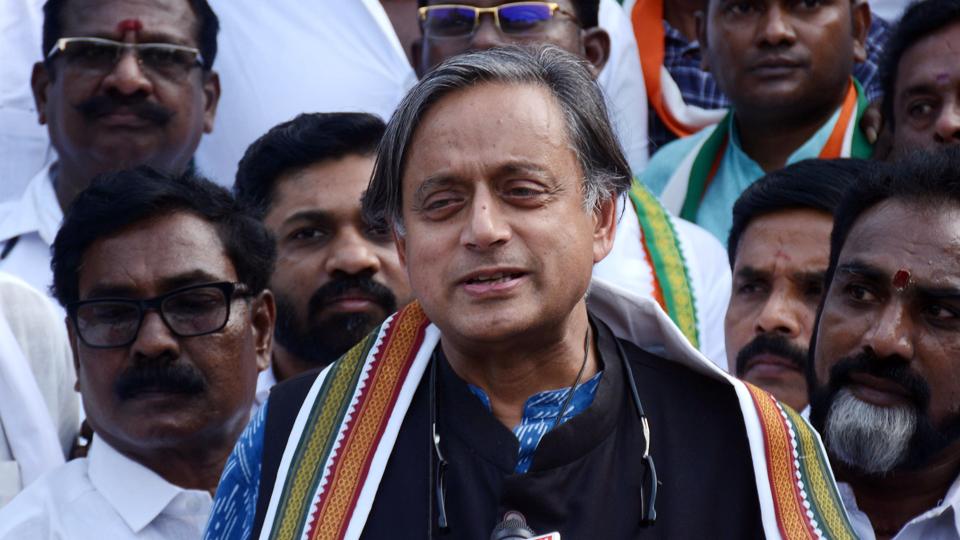
If he isn’t elected Congress president, Shashi Tharoor will come second in the two-man race. That for him will be no cause for celebration. Or consolation! For in a 2018 speech, when his alma mater, St Stephen’s stood second to Miranda House in the National Institutional Ranking Framework, he said he was thrilled for the college: “But I belonged to Stephen’s at a time when we didn’t celebrate being second at anything.”
As one who has travelled, so to speak, “first-class” through his academic career, attaining early professional highs, there couldn’t be two opinions about his suitability for either job. (ANI)
Tharoor became president of Stephen’s college union society in perhaps the first election he contested before graduating in 1975. His second bid for an organisational office came years later, in 2006, when it was Asia’s turn to lead the United Nations (UN). He ran for secretary general as India’s nominee, finishing second to South Korea’s Ban Ki-moon in straw polls before being vetoed out by the United States. Securing 10 votes against the winner’s 12, it was the only time he wasn’t embarrassed standing on a lower podium. The blushes then were for the Foreign Office.
A three-time MP now from Kerala, Tharoor then was the UN under-secretary-general for communications and public information. There are striking similarities in the manner he entered the fray then and is in the fray now (to be Congress president).
As one who has travelled, so to speak, “first-class” through his academic career, attaining early professional highs, there couldn’t be two opinions about his suitability for either job. His oratorical prowess, his internationalism, and his scholarship make for the substance few among his contemporaries can flaunt. Be it the UN or the All India Congress Committee (AICC), the trick is in the electoral college.
The UN bid that didn’t go far
Let’s take up first Tharoor’s bid to be the UN secretary-general. As detailed in a 2016 write-up he authored for Open magazine, the anatomy of his candidature, considering his own account, is at variance with what this writer gathered in interviews with Foreign Service officials then in the thick of things. While it is a fact that then Prime Minister (PM) Manmohan Singh zeroed in on Tharoor as the Indian nominee for the coveted UN position, the feedback he received from the foreign office wasn’t encouraging.
Three of the Permanent-5 UN Security Council members, who could veto any candidature, had already committed their support to South Korea. Singh was accordingly briefed when last-ditch attempts to turn things around were to no avail at a meeting foreign secretary Shyam Saran had in London with representatives of the United States (US), the United Kingdom, and France. From the standpoint of the ministry of external affairs, the matter thereafter stood closed. The PM too was in agreement at that stage.
But Tharoor apparently had better means to persuade Singh who, in what was seen as a U-turn, cleared his candidature against the MEA’s findings. The blindsiding of the foreign office upset many, conveyed as the diktat directly was to India’s Permanent Representative at the UN. The PM’s explanation to officials who mustered the courage to raise the matter was that Tharoor insisted on the country tag to figure in the UN Security Council “straw poll” to gauge individual prospects of candidates.
In the first poll in July 2006, Ban got 12 votes and Tharoor came second with 10 in a crowd that included from other Asian bidders a sitting president, a future president, a prince, a deputy PM, and a seasoned diplomat. One of his votes was China’s, he claimed in the Open magazine upon dilating on a meeting he had had, in his personal capacity, with Chinese foreign minister Li Zhaoxing to ascertain his country’s response to his potential candidature. “As we subsequently learned, China voted positively (without using veto) for all the Asian candidates, including me.”
Tharoor claimed being vetoed by the US. He wrote: We know the rest of the story from American sources, notably Surrender Is Not An Option, the no-holds-barred memoir published by the then US Ambassador to the UN, John Bolton, who disloyally revealed that his instructions from Secretary of State Condoleezza Rice were: “We don’t want a strong Secretary-General.” Bolton’s book confirmed that Wang Guangya (Chinese PR to the UN) voted for all the Asian candidates on the first ballot; China “abstained on my candidacy on subsequent ballots, but as it promised, it never used its veto against me. That was done by the US, which, Bolton reveals, backed Ban to the hilt and lobbied on his behalf with other UNSC members,” averred Tharoor.
The inference here is explicit. As India’s nominee, Tharoor lost to an American prop who, they felt, wouldn’t be difficult the way the outgoing UN secretary-general, Kofi Annan was on the Iraq question.
Will the Congress poll be an encore of New York?
Coming to the internal Congress polls, the contest sculpted by the diplomat-politician has lifted the election from being utterly drab to becoming an attractive drumbeat; the choice named Tharoor making it a tad more interesting and credible. Yet here too, it’s hard to miss the element of unilateralism in the Kerala leader’s candidature. Like the 2006 adventure, he went ahead with his plans on bouncing the question off Sonia Gandhi, without whose intervention, many informed people believe, he couldn’t have been India’s face in the UNSG contest.
The nagging question is, why have most among the so-called G-23 (a ginger group conceived over a 2020 dinner at Tharoor’s residence for internal party reforms) flocked around the 80-year-old party veteran Mallikarjun Kharge’s late candidature? The scenario is so very different from his full-throttle global marketing by the MEA even after being sidelined in the finalisation of his UN venture.
“The impression that we threw him under the bus is hugely misplaced,” insisted an important G-23 activist. He said Tharoor did reach out for support to a few in the group but made his candidature a fait accompli in response to suggestions for fielding a joint candidate. A leader with whom he spoke quoted him as saying: “Let there be a third candidate; I’ve decided to contest.” Another problem the pro-changers have with his self-driven approach is his lack of organisational experience. That’s one department where Kharge scores despite the many attributes which make Tharoor look like an urban icon.
HT’s veteran political editor, Vinod Sharma, brings together his four-decade-long experience of closely tracking Indian politics, his intimate knowledge of the actors who dominate the political theatre, and his keen eye which can juxtapose the past and the present in his weekly column, Distantly Close

 E-Paper