
 E-Paper



Distantly Close | Imran Khan and the army — When the player fights the umpire
Can Khan win against the ruling formation he derides as “imported and comprising tainted dynasts who looted” the country? The match is on. Only the umpire that’s the army knows it better, election or no election.


New Delhi: The public meetings addressed by Imran Khan in Peshawar and Karachi on being voted out as Prime Minister (PM) were huge by all accounts. Not just that. The crowds in hundreds of thousands were all ears for his partisan account of the events that led to his ouster.
But popularity is a risky trait in Pakistan for leaders seeking power in confrontation with the civil-military establishment, which is another name for the army and its pervasive props in the system. Former PMs Zulfikar Ali Bhutto (ZAB) and Benazir, his daughter, took that path and met with tragic ends.
Khan is walking the same knife-edge. He alluded to threats to his life in Peshawar but was upfront about it in Karachi: “People tell me that my life’s at risk; I tell them my being isn’t as precious as my country’s independence and its people’s freedoms.”
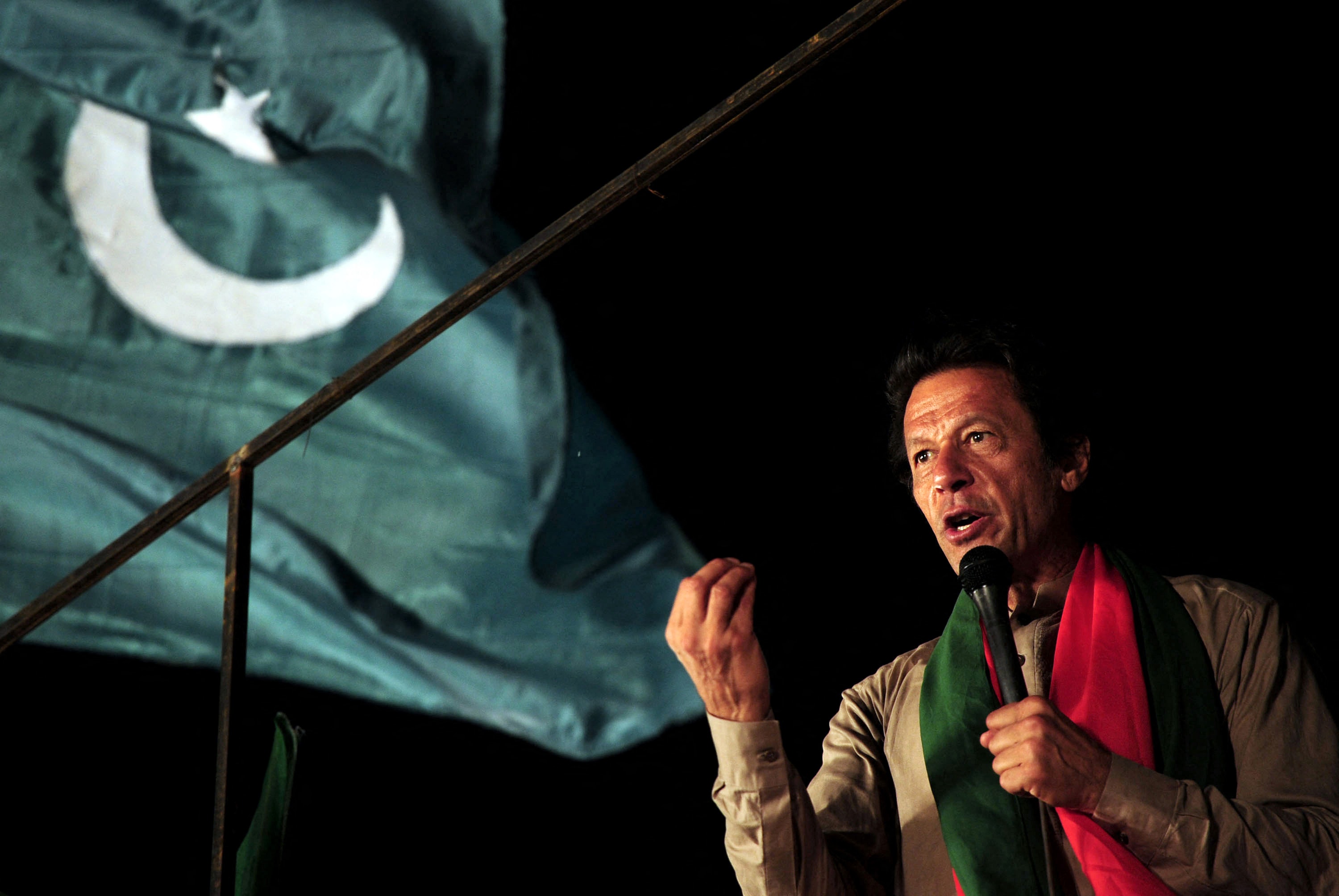
The Pakistan Tehreek-e-Insaf (PTI) leader is putting his audience on a heavy dose of emotional steroids. He cites Quranic verses to show himself as a believer to discredit the coalition regime that replaced his failed hybrid experiment in partnership with the Army.
Imran's ZAB-Benazir encore
The side-product of it is eerily similar to the times the Pakistan People’s Party (PPP)’s eternal elegy to ZAB resonated in the streets after he got the noose on General Ziaul Haq’s watch: “Ye baazi khoon ki baazi hai, ye baazi tum he harogey, har ghar se Bhutto niklega, tum kitne Bhutto marogey. (This is a gamble of blood, you will lose the gambit, a Bhutto will emerge from each home, how many Bhuttos will you kill.)”
In a strange role reversal, the party of the Bhuttos which then had the attention of Pakistan is now a declining force on the side of the establishment against Khan’s ZAB-Benazir encore.
The comparison is a tad out of place and would outrage no end the PPP puritans. But many among them conceded to this writer that their party is indeed a pale version now of its original copy, led as it is by Asif Ali Zardari and his son Bilawal Zardari who retains Bhutto as his middle name. Khan is deferential in his own way to the ZAB-Benazir legacy. He comes across as respecting history by largely keeping Bilawal out when taking pot-shots at his father who’s no model of probity.
The PTI leader’s political munitions are focused more on the Sharifs, especially Shehbaz, the new PM who was the army’s favourite even when his elder brother, Nawaz Sharif thrice occupied the office to Rawalpindi’s unease. The next elections — if held midway through as demanded by Khan or on completion next year of the life of the existing national assembly — will be a test of whether or not the PML (N) can retain the vast base it had under Nawaz Sharif in the key Punjab province which electorally decides the federal power centre. The same is true of the PPP’s historical hold in Sindh which isn’t always on the same political page as Punjab.
Khan is all set to take his anti-Sharif narrative to Lahore’s memorial to the Pakistan movement, the Minar-e-Pakistan, this coming Friday. In his lexicon that found huge traction at his Peshawar-Karachi pit-stops, they’re the fifth columnists who mortgaged Pakistan’s sovereignty to the Americans in return for power. Imran’s version: Washington was upset that he went to Russia in defiance of the Joe Biden administration’s advice to the contrary to his national security advisor.
To make his message simpler for the masses, Khan likens his adversaries to Mir Jafar, a military general who, during Nawab Siraj ud-Daulah’s 18th-century rule in Bengal, conspired with the East India Company to himself become the Nawab, laying in the process the basis of British colonial rule in the subcontinent. The latter-day Jafars are the Sharifs and their cohorts, including the Zardaris; the Americans the neo-colonialists before whom they have prostrated.
“They’re part of an international conspiracy against Pakistan,” Khan told his frenzied audience in Karachi. “I want friendship with all countries but will accept the slavery of none.”
Second war of Independence
In a repeat of what Khan’s critics and the Sharifs faced when the PTI was in power, the former Premier’s rallies were played down by most of the electronic media in Pakistan, barring a few including ARY News. Besides putting at rest all doubts about Khan’s cult following, the gatherings were curated as Pakistan’s second war of independence against the US and the West.
As he arrived at Karachi’s Bagh-e-Jinnah, which is home to the Pakistani Qaid’s resting place, a stage manager declared that the awaam (people) were with their kaptaan (Imran) to save Pakistan the way they were with Jinnah to gain Pakistan: “Jis tarah log Jinnah ke saath Pakistan banane me shamil thei, ussi tarah aaj Pakistan ko bachane me kaptaan ke saath hain."
The intonation was but an extension of the PTI catch-phrase that presents its leader as Pakistan’s saviour: “Kaun bachayega Pakistan, Imran Khan, Imran Khan....” The social media is awash as much with the deposed PM’s portraits as with Jinnah and Faiz Ahmad Faiz, the revolutionary poet who authored that universal anthem of protest, Hum Dekhengey. Translated to English, the operative lines of the poem that has riveted people across generations read: “From the abode of God, when the icons of falsehood will be removed/ When we, the faithful, who have been barred from sacred places, will be seated on a high pedestal/ When crowns will be tossed, when thrones will be brought down.”
The hero worship Khan ostensibly enjoys is way more bloated than what is his due as a politician. The government he ran for three-and-a-half years had a lot to explain, including the economic decline he presided over and the individual freedoms he curtailed. For that reason, the emotions he rides could be his biggest liability the way it was for ZAB, Benazir and even Nawaz Sharif in the absence of support from the institutions that matter. While Khan is at war against what he calls America’s diktats, the army is ambidextrous in the interest of balance on the sensitive issue.
The harsh reality of Pakistan is that civilian regimes there last at the pleasure of the Rawalpindi-based army brass. The PML-N headed coalition isn’t on sure footing. But it has the Supreme Court’s mandate and the fauj’s patronage which Khan expended by seeking to lead Pakistan the way he captained the cricket team in his heydays.
Desperate to regain the Army's support
As politics isn’t cricket, Khan’s unilateralism of his cricketing years has him out on a limb vis-à-vis the powerful army and the apex court. While the former withdrew, so to speak, its affection, the latter revived the no-trust vote he had negated in utter disregard of the Constitution. The big question is whether the crowds rooting for him can help him regain the fauj’s trust?
In realpolitik terms, Khan comes across as isolated in the sea of humanity that surrounds his persona. His call to the people to carry Pakistani flags at his rallies was a bid to reach out to the army. What was left unsaid was articulated by former interior minister Sheikh Rasheed who pointed to the “forest” of Pakistani flags in Karachi to swear allegiance to the army: “Pakistani fauj hum aapke saath hain. Dekho, Pakistan ka jhanda Imran Khan ke saath khada hai. (Pakistan Army we are with you. See. Pakistan’s flag is with Imran Khan.)”
Elected several times to parliament from Rawalpindi, Rasheed has ancient ties with the army brass dating back to his days as a footsoldier of the Sharifs through the 1990s. A proof of the PTI’s desperate bid to get into the establishment’s good books was his overture to the fauj and Khan’s own repeated attempts to disabuse the army of reports that he harboured plans to sack their chief, Qamar Javed Bajwa, on the night he faced the trust vote. “What criminal past did I have for the court to open in the middle of the night,” he asked his audience. “It’s something that pains me no end....”
The Court had gone into session to undo any adventurist move to change the army’s leadership ahead of November 2022 when Bajwa retires. In 1999, Nawaz Sharif was overthrown by a military coup when he tried that with Gen Pervez Musharraf.
So, the spectre on display has played out many times in Pakistan. Regardless of their clout with the people, nothing works for the politicos until the uniformed men lay out the guard of honour. Like Khan, ZAB had mass appeal, and so did Benazir.
Will the denouement be any different this time? Can Khan win against the ruling formation he derides as “imported and comprising tainted dynasts who looted” the country? The match is on. Only the umpire that’s the army knows it better, election or no election.
HT’s veteran political editor, Vinod Sharma, brings together his four-decade-long experience of closely tracking Indian politics, his intimate knowledge of the actors who dominate the political theatre, and his keen eye which can juxtapose the past and the present in his weekly column, Distantly Close
vinodsharma@hindustantimes.com
The views expressed are personal


