
 E-Paper



Ecostani | Congress manifesto ticks off social justice, jobs, empowerment, but offers little on effective implementation
The party has promised to convert all contractual workers to regular ones, fill up 30 lakh vacant posts in the Central government, and a national MSP law

 Prefer HTon Google


The Congress party last week presented a pro-poor and welfare oriented manifesto for the 2024 Lok Sabha polls, promising payouts to poor, higher wages for workers and mandatory paid internship. But, it did not provide a roadmap to implement the promises considering Central government’s limited fiscal ability for such socialist dreams.
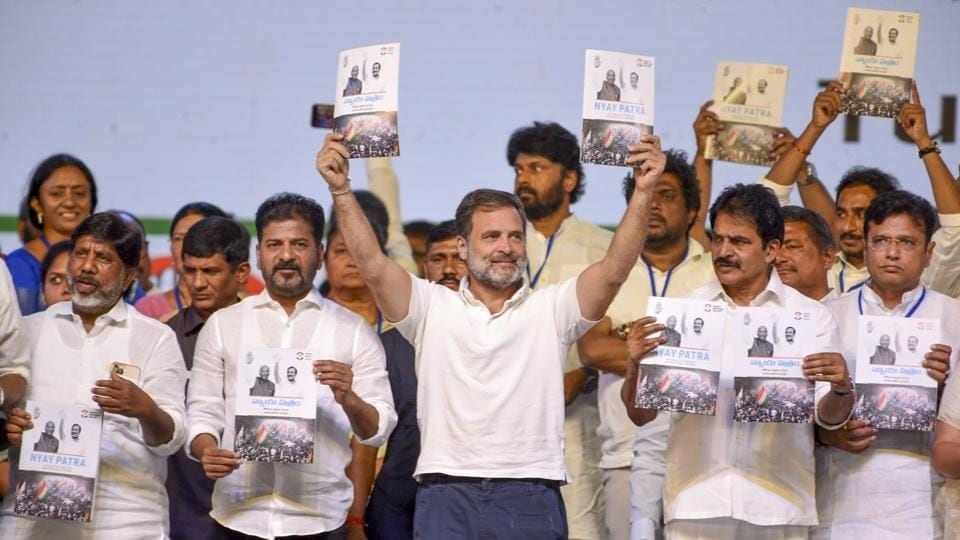
On April 5, the Congress made a “welfare versus polarization” election pitch with a focus on 25 guarantees — a concept the party introduced in Himachal 2022 elections and the BJP copied subsequently — targeting women, youth, workers and backward classes. It promised to adopt a “Nav Sankalp Economic Policy” with a vision of work, wealth and welfare.
The Grand Old Party had promised 50% reservation for women in government jobs, Constitutional amendment to remove the 50% cap on reservation, conducting a caste census and extending the 10% economically weaker section (EWS) quota to all castes against the present scheme of limiting it to non-SC/ST and OBCs, who are already covered under reservation policy, and extending the reservation to private educational institutions through a new law. To check polarization, the party has promised a “diversity commission”.
The party has also vowed to transfer ₹one lakh to every poor Indian household, even though the exact measure of poor is not known since 2011 when the last social economic survey was done. While the ruling Bharatiya Janata Party (BJP) claims that they almost eradicated poverty, the opposition claims that the number of poor has increased.
The government is yet to release the complete consumption survey data, which measures the amount of consumption based poverty (India does not measure poverty on basis of income as most countries do), even though economists claim that periodic labour surveys indicate the rural distress has increased in the past five years. The last poverty estimation was done in 2012 and before the National Democratic Alliance came to power in 2014, estimation used to be done every five years. The government has also not done a national census, which also provides a measure of economic status of residents, though was scheduled for 2021. In absence of credible data, it is difficult to believe the government or opposition claims on poverty.
The Congress has also promised national minimum wage of ₹400 even for MGNREGA workers, whose average wage is ₹250 per month and a one year internship for all graduates with stipend of ₹one lakh. It has also promised creating an authority to distribute excess government land to the poor, second land reform. A law under Article 15(5) of the Constitution to provide for reservation in private educational institutions for SC, ST and OBC students, the party said. It also promised to provide reservation to women in legislative bodies in first assembly round of polls in 2025, instead of 2029 as states by the BJ- led Central government.
For jobs, the party has promised 50% reservation for women in Central government from 2025, converting all contractual workers into regular ones and filling up 30 lakh vacant posts in Central government. However, the manifesto is silent on restoration of the Old Pension Scheme (OPS), which the party governments in Chhattisgarh, Rajasthan and Himachal had implemented. To woo the middle-class, the party promised easy to implement and moderate Goods and Service Tax, although it has not spoken in personal income tax rates.
The party has also promised a national Minimum Support Price (MSP) law that will not allow anyone to buy below the MSP, incentive for crop diversification and covering farm under MGNREGA. The Commission for Agricultural Costs and Prices (CACP) will be made a statutory body, the party said. And, a body to review need of farmers for loans and their financial condition and freedom to farmers to sell their produce even outside Agriculture Produce Marketing Committees.
For senior citizens, it has announced to increase the monthly pension to ₹1,000 per month and restore travel concession to senior citizens. The party also promised universal health mission enabling all modern health facilities in government hospitals, cashless health insurance of ₹25 lakh per annum for a family and health expenditure to be increased to four percent of the total government expenditure by 2028-29, plus hardship allowance for doctors to work in remote areas and hiring more Asha workers.
However, the Congress manifesto is silent on how it would implement the announcements on these payouts to people, fill 30 lakh Central government jobs and introduce mandatory MSP for all produce — all of which will have huge financial implications on the exchequer.
It also fails to spell out the time-frame for implementing various promises such as removing 50% cap on reservation and providing free universal health. The fiscal impact of the Congress promises can be huge considering that the Central government paid ₹75,000 crore for MGNREGA in 2023-24, even though many states claimed that the fund provided was inadequate due to high job demand. Paying ₹one lakh per poor family, as per 2012 poverty estimation, could cost the government more than ₹one lakh crore. Filling all vacant posts would have a huge recurring implication. Considering all this, the Congress needs to explain how it will implement its “social justice” promises.
Chetan Chauhan, national affairs editor, analyses the most important environment and political story in the country this week


