
 E-Paper



Ecostani: Health of our oceans should be prioritised
France has asked countries to ratify the High Seas Treaty before the Nice summit but most countries are not enthusiastic about it

 Prefer HTon Google


The capsizing of the Liberia-flagged cargo vessel MSC ELSA 3 carrying plastic pellets in several containers off the coast of Kochi in Kerala is indicative of how plastics can impact marine biodiversity.
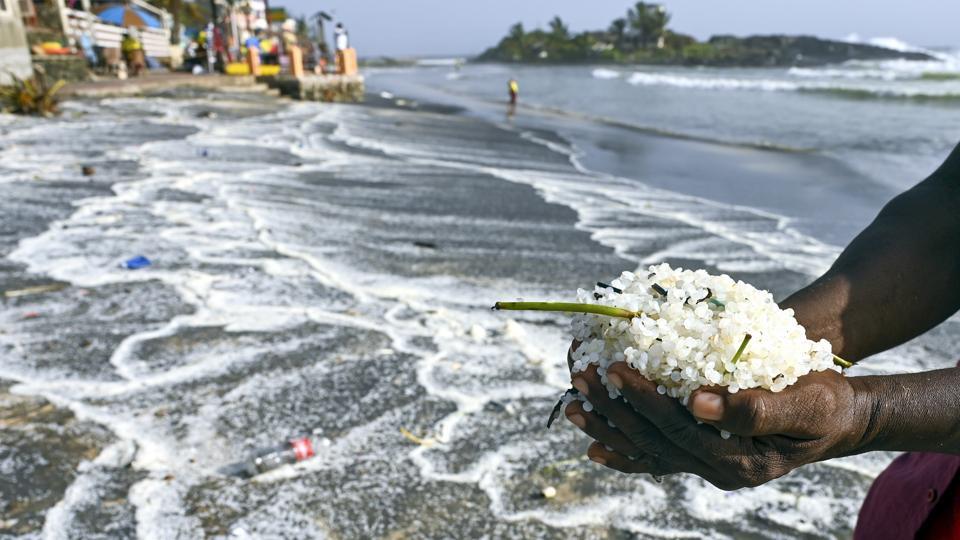
Relief workers found it difficult to collect plastic pellets spread across the coast from Kochi to Thiruvananthapuram from the containers that had drifted towards the coast, pushing the state government to declare the incident as a “state-specific” disaster.
The Kerala government declared a compensation of Rs 1,000 per day for fishermen, who were not able to venture into the Arabian Sea, for fishing following the accident. The nurdles, a foundational material in the manufacture of a wide range of plastic products and white in colour, are believed to have broken out from the containers found on the coast.
The cargo vessel, on its way to Kochi port from the Vizhinjam International Seaport, had developed a 26-degree starboard list and subsequently sank around 14.5 nautical miles from the Kerala coast on the morning of May 25. While all the 24 foreign crew members were rescued in joint operations by the Indian Navy and the Indian Coast Guard (ICG), dozens of containers from among the 643 onboard the vessel were scattered in the sea. Over 50 of them, mostly empty, have since then drifted to Kerala’s coast. At least 12 containers, filled with dangerous goods such as calcium carbide, and another filled with rubber chemicals continue to be under the sea, along with the ship’s debris.
Plastic in our oceans
Plastic is the most common pollutant in oceans and countries across the world are trying to combat it. According to different studies, plastic leaks into the ocean from thousands of sources from all over the world every day. Increasing consumption combined with improper waste management in many countries has made plastic pollution a worldwide problem, causing damage not only to the environment but also to human health and economies.
It is estimated that humans produce over 400 million metric tonness of plastic annually, which is roughly the weight of all humans on the planet. Of these one million tonne ends up in the seas. Scientific studies say that most of the plastic from the less developed world ends up as litter in oceans. During storms and extreme rainfall, which is increasing because of climate change, plastic gets washed into waterways, most of which is then transported to rivers and eventually to the seas. Closer a city is to the river and river to the sea, the probability of plastic reaching the sea is high. As per a 2011 study, 1,000 coastal rivers account for 80% of plastic in seas.
Studies say that the plastic in seas can cause entanglement and ingestion, which was found in 914 megafaunal species, of which more than 100 are endangered. From all kinds of fish to turtles, seals, crustaceans, micro-organisms and many other forms of life, the damage caused by plastic pollution to marine animals is increasingly visible as we learn more about this problem, scientists say.
“It is alarming that around 5% of marine catch from coastal waters contains plastic waste”, said Sunil Mohamed, Chair of the Sustainable Seafood Network of India and former principal scientist at the ICAR-Central Marine Fisheries Research Institute (CMFRI).
Countries have been negotiating for years on how to deal with plastic problems including in the seas. In March 2022, the United Nations General Assembly passed a resolution seeking for an internationally binding agreement for dealing with plastic pollution including marine environment.
The Scientists’ Coalition for an Effective Plastics Treaty, a voluntary international body of over 400 independent scientists with expertise on the harm plastic pollution causes to human health, society, economies, and the environment, has been providing global plastics treaty negotiators with synthesised and summarised robust scientific evidence to support fully informed decision-making.
In 2023, a breakthrough was achieved with the countries agreeing on The High Seas Treaty, a historic deal for ocean governance.
It provided the first-ever legal framework to protect biodiversity in the high seas — the two-thirds of the ocean that lie beyond national jurisdiction. But for the treaty to take effect, it needs to be ratified by at least 60 countries. To date, fewer than 30 have done so, which includes India. September 20, 2025, is a deadline to ratify the treaty.
France has asked countries to ratify the High Seas Treaty before the summit but most countries are not enthusiastic about it. Enforcing the treaty is key in meeting the Sustainable Development Goal numbering 14 providing for protecting 30% of the oceans by 2030, also called 30 by 30, can be achieved or not.
Experts explain that lack of political will and international finance to clean up oceans, which face the brunt of climate change, are reasons that the High Seas Treaty has not been adequately ratified. Without the treaty, the SDG target will not be achieved.
A political declaration is expected at the end of the Nice conference to be held this year. It will be the most significant environment conference after climate talks in Paris in 2015, which could push the High Seas Treaty and other frameworks to protect the ocean marine life.
According to experts, the declaration will serve as a signal to governments, investors and civil society that ocean health is a political priority, and it helps mobilise support for new initiatives. At Nice, France is looking for a “real” international pact for the conservation and sustainable use of oceans.
Whether that happens will be known on June 13.


