
 E-Paper



Ensuring rooftop solar for every household
Batteries for bigger roofs, a flatter tariff ladder, transparent fixed charges, and smoother consumer journeys would ensure rooftop solar advances energy equity

 Prefer HTon Google


After years of stop-start progress, India’s rooftop solar (RTS) campaign has finally gained momentum. Since the launch of the PM Surya Ghar Muft Bijli Yojana in February 2024, registrations have crossed 17.1 million, installations have passed 1 million households, and annual residential capacity has increased from barely half a gigawatt (GW) to nearly three gigawatts (on an annual energy basis — that is, discounting solar’s daily downtime — a 1 GW solar plant can supply electricity to roughly 1.2-1.3 million Indian households for a year). The scheme has clearly unlocked demand. The next step is to ensure supportive policies not only sustain this growth but also spread its benefits equitably.
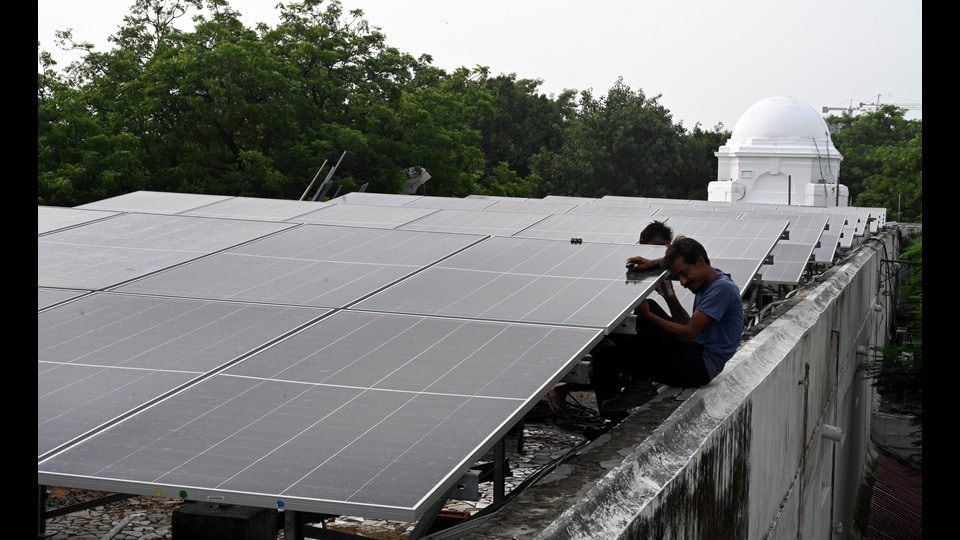
Why a consumer-first RTS push matters is simple: households care about bills, reliability, and hassle-free service. Net metering, slabbed tariffs, and how we collect fixed grid costs shape all three. Done right, policy can make RTS feel like an everyday appliance — useful, predictable, and fair. Done wrong, it becomes a subsidy that rewards big roofs and bigger bills while shifting costs onto everyone else.
First, pair bigger roofs with batteries. Systems larger than 5 kWp often generate more mid-day power than a home can use. Without storage, surplus is pushed to the grid and “withdrawn” at night, turning the grid into a near-free virtual battery. As adoption scales, those daytime injections can stress local feeders, and evening withdrawals raise distribution company’s (Discom) procurement costs. Storage flips that script. With a home battery, households shift solar to the evening — when their own demand is higher and supply is costlier for the grid. Because RTS-plus-storage raises upfront costs and stretches paybacks, meaningful, targeted subsidies are essential. Offering elevated subsidies only for systems that integrate storage would nudge larger RTS adopters toward configurations that help both consumers and the grid.
Second, shorten the tariff ladder. Under telescopic slabs, every unit a high-consumption household offsets with solar is valued at a higher tariff. After they adopt RTS, their grid purchases often fall into cheaper slabs — so they retain outsized gains. Meanwhile, modest users — who already pay lower tariffs or receive free units — see weaker solar economics. Compressing slab rates so that each kilowatt-hour saved is worth roughly the same amount would make RTS work for middle- and lower-income homes. Karnataka’s flat energy charges show this can be done without unsettling consumers.
Third, fix how we pay for the grid. An electricity bill has two parts: a fixed charge and a per-unit energy charge. Yet most network costs are still bundled into the per-unit tariff. As RTS lowers sales, Discoms under-recover fixed costs — even though solar homes still depend on the grid for reliability, especially in non-solar hours. A clear, transparent fixed charge that reflects the true cost of the network would spread the burden evenly, whether or not a family installs RTS. Without this, unrecovered costs shift to non-RTS users — often those least able to shoulder them.
Fourth, make net metering smarter and time-aware. Households should keep the right to self-consume their own power. But exported units need not be credited at the same value as evening imports. Valuing exports closer to wholesale or regulator-set rates, while charging imports at the applicable tariff, better aligns incentives and reduces cross-subsidy distortions. Layer on simple, residential time-of-day pricing — discounts during solar hours and surcharges in the evening — so the rupees match real system costs. Over time, dynamic price signals can reward “solar-aligned” usage (running loads in the day) and storage that shifts energy to peaks, helping consumers and the grid.
Fifth, keep smoothing the consumer experience that is making RTS take off: easy vendor discovery, predictable approvals, timely metering, and simple, accurate bills. The unified portal has lowered friction; let’s double-down on clean workflows and clear communication, especially for first-time adopters and smaller systems that rely most on the subsidy.
None of this changes the core message: Right-sized RTS is good for households. But today’s rules can turn a win for one group into a loss shifted to others. The PM Surya Ghar Muft Bijli Yojana has proved it can spark demand; the policy refinements above make sure the benefits spread evenly. Batteries for bigger roofs, a flatter tariff ladder, transparent fixed charges, time-aware metering, and smoother consumer journeys would ensure rooftop solar advances energy equity — spreading benefits fairly across all households rather than concentrating them among the affluent. When we reach one crore installations, it should stand not just as a capacity milestone but as proof that India’s clean energy transition can deliver for consumers across every income level.
Sharath Rao is fellow and Niteesh Shanbog is research analyst at the Centre for Social and Economic Progress (CSEP). All views are personal


