
 E-Paper



Foreign Hand | In Glasgow, Modi sent a signal of change to his government
The 2030 targets will now force government and industry to accept there will be no exceptions, that they must treat climate as an organising principle around present and future activities

 Prefer HTon Google


India surprised itself and the world by announcing a set of extraordinarily ambitious carbon targets during the United Nations Framework Convention on Climate Change’s Committee of Parties 26 (COP26) summit in Glasgow.
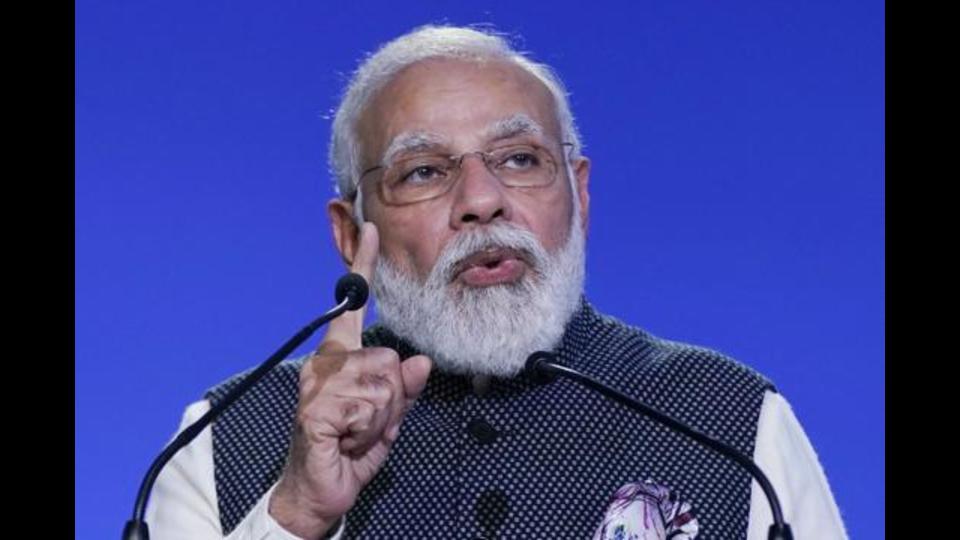
Becoming net-zero by 2070 wasn’t half of it, the medium-term goals will be far more challenging. Prime Minister Narendra Modi promised that, by then, half of India’s electricity capacity would be renewable, non-fossil electrical capacity would be ramped up to 500 GW, the country would see a 45% reduction in the emission intensity of GDP and emit one billion less tonnes of carbon than presently forecast.
A lot of these are inter-related. Do one and you are well on your way to doing the other. More notably, if India achieves its 2030 targets, then reaching net-zero by 2070 or earlier will be quite feasible.
No one can publicly complain about ambitious carbon emissions. In India, both the Right and the Left are conscious of climate. If anything, polls show supporters of Modi’s Bharatiya Janata Party to be slightly more worried about the consequences of global warming than those on the liberal-Left. Nonetheless, many eyebrows would have been raised by the announcements.
There was considerable noise in India in the run-up to Glasgow, much of it saying the country should ignore calls for it to announce a net-zero target. And rightly so. Most of these calls emanated from the developed world, had no blueprint to explain how India should get there, denied climate equity or differentiated responsibilities, and came close to being green imperialism.
A number of studies commissioned by the Indian government had concluded net-zero could be economically and socially enormously disruptive. Talk of foreign financial and technological support was largely seen as a pie in the sky given the fate of the original, piddly $ 100 billion fund promised at the earlier Paris COP21. Indian ministers were already warning their counterparts that, at best, New Delhi might consider a peak carbon year at some far off date.
Instead, Modi not only decided to embrace net-zero, he also embraced some stiff targets that are only nine years away. He said he “expected” the West to come forward with $ 1 trillion in green finance but asked for this for the whole developing world. While Modi has had an almost missionary zeal about the need to tackle climate crisis going back to his days as Gujarat chief minister, he is not one to adopt targets just to win international brownie points.
At the heart of his Glasgow commitment, I would argue, is a belief that it would help force the Indian system to accept drastic changes to the economy that would help position India at the forefront of the 21st century economy.
India could have said we have to continue to burn coal and oil, and most definitely gas, for another two or three generations. Given the poverty levels in the country, a sound case could be made for being allowed to do so. But it would have meant imposing on the country the sort of economic isolation that India placed on itself during the Nehruvian years.
For example, carbon adjustment tariffs are on their way. Once in place, India’s recent successes in engineering exports would have evaporated as “green steel” and similar low-carbon products become the global norm. Even service exports would be affected. One could easily envisage a future when digital products that used data centres powered by thermal power plants would be shunned. Trillions of dollars of global investment funds are now being redirected to environmentally benchmarked assets and projects. India would have lost out on this shift just as it is beginning to garner a sizeable share of foreign institutional investments.
The real damage, however, would have been in long-term plans to revive the manufacturing base of India. Huge swathes of the global economy, from the obvious such as automobiles and power generating equipment to the less apparent like chemicals and electronics, have begun turning green. This is not only in terms of the energy they consume, the processes that they use, but in some cases, in the technologies applied and very products that are made. The most striking example is a car. An electrical vehicle has less than 20 components in its electrical motor. A traditional internal combustion engine has 200 plus. India’s vaunted automobile component industry is doomed if it doesn’t retool for a climate friendly future.
India needs to be a key hub for the new green economy that is starting to appear on the horizon. The government is allowing this inchoate vision to pop up in many of its economic programmes, whether it is moving trains to green energy, putting solar parts under Atmanirbhar Bharat, power sector reforms, and even in the small print of the Quad agreements. The 2030 targets will now force government and industry to accept there will be no exceptions, that they must treat climate as an organising principle around present and future activities.
The changes required of India will be gut-wrenching. Almost all vehicles will have to become electrical in the next half century. About a quarter of Indian industry will have to be fueled by green hydrogen. The most difficult task will be that over half of power production would have to become renewable. India cannot assume development assistance or charity will pay for this. These tasks are well beyond the scope of such funding. It must therefore also make much of its economy, with the debt-ridden power sector top of the list, much more attractive to private capital.
More than the world, Modi has sent a clear signal to his own government. Many departments have not taken his past climate talk seriously. The power ministry, under RK Singh, has already done excellent work on laying out a green hydrogen pathway. Other ministries, notably coal and environment, have preferred to assume green is just a fashionable colour and not a signal for transformation. More than anything else, that will now have to change.
The views expressed are personal


