
 E-Paper



Grand Strategy: The bigness trap of India’s strategic community
For most of our thinkers and analysts, the large world out there has become merely a set of questions about ourselves: what does this mean for India

 Prefer HTon Google


On Friday August 8, Saudi Arabia, Pakistan and Turkey signed a joint defence agreement in Mecca. An attack on one is to be treated as an attack on all three, it said. As is to be expected, India’s commentariat had its opinions, and almost all of it was about Pakistan.
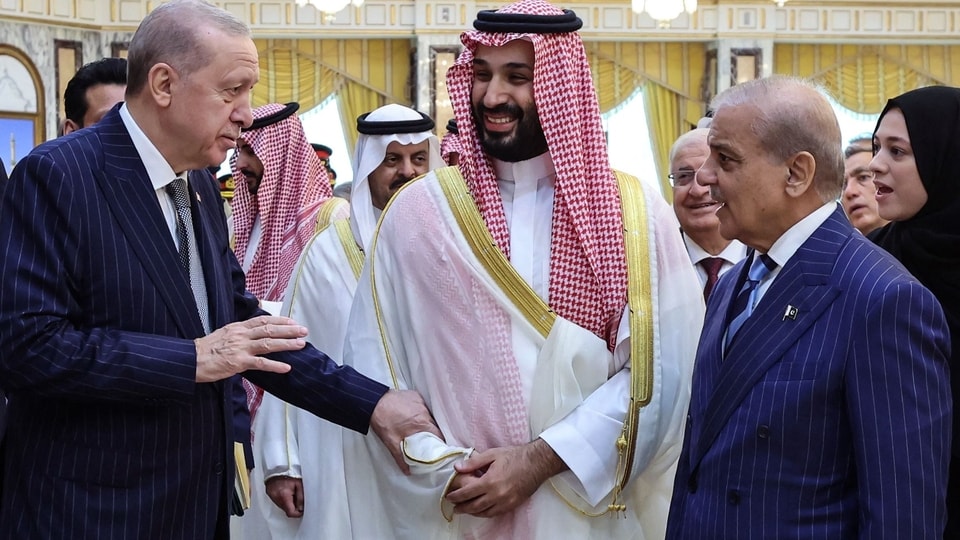
Turkey did get some airtime but almost entirely as Pakistan's enabler, the supplier of drones, the country we should have nothing to do with. Which is to say that even when a third state entered the analysis, it was filtered through Pakistan. Saudi Arabia found negligible mention, for, that is a country we don’t really want to upset for obvious reasons. We know which side of the bread is buttered.
Our analysis did not take on board the fact that Turkey has its own regional ambitions, an economy under strain, ongoing quarrels with Egypt and the Emirates on the question of Sunni leadership, and that it has reasons of its own for wanting a foothold in Gulf security which may have nothing to do with us. But that was nuanced. We saw a supplier of Pakistani equipment, and an unfriendly Erdogan – and we made up our mind. And moved on to the next issue.
There were several unasked questions. How was this decision actually taken inside the Saudi system, and who argued against it? What does Erdogan gain domestically from standing in Mecca beside the Crown Prince? How do the roughly nine million Indians in the Gulf read the whole thing from their vantage point? I can think of very few people in this country equipped to answer any of that with authority. In other words, we had a great deal to say about an agreement signed by three states, two of which we hardly studied.
Actually, the knowledge gap is just one part of it. The other is the widespread habit of arriving at consensus and treating that consensus as some incontrovertible proof. A certain dominant view forms in seminar halls and social media, which hardens through repetition, becomes the default commonsense, and is then offered to the government on public platforms as knowledge and policy prescription. If actual policy resembles the prescription, it is cited back as confirmation that the view was sound. Policy made against it is charged as a departure from good sense.
Mine is a complaint about our strategic ecosystem, and I am part of it – the ecosystem, and problem.
Some of this echo-chamber thinking is a product of sociological factors. Our strategic community is small and closed, built rather like an agraharam. Much of the access to the ecosystem comes through lineage. You are taken seriously because of where you served, or whose student you were, which clubs you are a member of, or simply who you know. What our strategic community produces is largely commentary, then commentary on the commentary, then commentary on that second-order commentary, until nobody can say whose original thought is being tracked in such commentary. Very few of us have any incentive to disturb the categories we inherited, because the categories are what we are certified in – category is what gets you the access.
So consider what we actually know. At best Pakistan, China and America. In the wake of the last 18 months, I would question even that. Beyond those three familiar names, we are bound to struggle.
Nine million Indians live in the Gulf and I cannot point you to a serious Indian body of work on Gulf domestic politics. Latin America, the Sahel, Central Asia, the party systems of Southeast Asia: absent. We unhesitatingly hold forth on the world with such eloquent ease even though we study a small corner of it and understand even less.
As stated above, our disagreements are usually settled by consensus (except of course when it is deeply political), a consensus dictated by an inbuilt hierarchy which everyone is aware of, rather than against anything evidence and logic. Consensus makes for good democracy. It makes for poor knowledge, let alone wisdom.
Here is where our country’s bigness comes in which is a serious cognitive issue.
A large country such as ours produces so much internal conversation and debate that it feels complete in itself. There are always so many of us in the seminars, conferences, panels, debating, reading books, reviewing them, on social media and so on that the conversation seems self-sufficient. In fact, you can spend an entire career inside this country’s foreign policy intellectual bubble not once looking outside of it, and feel and be considered accomplished. Bigness lets us mistake our reflection for the world. The internal market for our analysis absorbs everything we produce.
We can generate infinite discussion about the world without ever needing to leave the country, learn a foreign language, or spend two years in an inhospitable country. There is a more sinister dimension to it: Not only do we not study our neighbours, sometimes we criticise those who do it. Can you, for instance, imagine an Indian scholar spending a few months in Pakistan for research?
Small states, on the other hand, cannot afford such an illusion.
Singapore, a city of six million, hosts an institute on Southeast Asia because Singapore's survival depends on reading its neighbours accurately. The small Gulf states employ people who understand Indian politics in great depth, since their labour economies require it. Being small forces you outward whereas being large permits you to stay in and call it depth. Our strategic thinking has fallen into the “bigness trap”.
Our bigness which should have made us intellectually curious has made us self-referential instead. For most of our thinkers and analysts, the large world out there has become merely a set of questions about ourselves: what does this mean for India, for our rise, for our standing and so on. While they are legitimate questions, if we don’t go beyond those questions, we will end up with a very good understanding of what we want, not what others want or are. Countries stop being countries and become variables in a certain equation we have: That is how a state of 85 million people with 400 years of regional statecraft gets noticed in Delhi as (merely) a drone exporter to Pakistan.
If all we want is just enough security, we can live like this indefinitely.
What needs to be done is unglamorous and slow, not the stuff of 007 thrillers. Resources need to be kept aside for area studies and language training and for long fieldwork. Recruitment from outside the strategic community’s own baradari is a must, including anthropologists, economists and reporters who have lived in Jakarta or Lagos or Riyadh and can tell you who matters there and why. Why not treat the nine million of ours in the Middle East as a knowledge asset rather than a remittance figure?
And it will be 15 years before any of that shows results – so we get started now.
The late K Subrahmanyam spent a career telling Indian scholars to shed inherited shibboleths and look at the world as it is; but our scholars have mostly quoted him instead of listening to the essence of his argument.


