
 E-Paper



Just Like That | Notes on hangovers of the past and an institution of the future
On our special relationship with the British as seen through the ‘superiority’ of the English language; and a recent trip to NIIT in Rajasthan, whose campus was particularly impressive.


The coloniser and the ruled
Recently, when Queen Elizabeth passed away, and later, when King Charles was coronated, Indians sat glued to their TVs watching the live telecast of the proceedings. A great deal of discussion centred around Charles and Camilla, and Diana, and other shenanigans of the royal family — not excluding Harry and Megan.
There is a special relationship between the coloniser and the ruled, that far outlasts political independence. Some years ago, I accompanied Gaj Singh, the affable erstwhile Maharaja of Jodhpur, to the small hamlet of Ossian in Rajasthan, some 60 kilometres from Jodhpur, in the middle of the desert, where a luxury tented resort was run by some plucky entrepreneur. Since the route was off the main highway, the road was rutted and uneven, and the countryside was mostly deserted, except for the occasional village lit up by a few naked bulbs. Suddenly, in the near wilderness, I saw a large hoarding: LORD WILLIAM BENTINCK HIGH SCHOOL—DAY AND RESIDENTIAL.
The remnants of British rule are difficult to erase. Bentinck was the first Governor-General of India in 1834-35, but his name was still emblazoned almost 200 years later, on a school in a village where I can guarantee that almost nobody knows who he was, or could pronounce his name correctly!
The “superiority” attached to English is a lingering legacy of colonialism. Of course, English medium education is sought out because it promises better job prospects and equips one with a global language of communication. But partly it is also because we attach a social status to the speaking of English and harbour a sense of inferiority about our own languages.
The Kenyan Nobel Laureate Professor Wangari Mathai once told me that it was only the colonial rulers who truly understood the importance of a language. That is why it was the first thing they took away from us. The invidious manner in which knowledge of English operates as a tool for social exclusion, albeit now in a more reduced way, has amusing manifestations.
A young upper-crust Indian, educated in England and the United States, told me of this experience on a visit to India some years ago. “I had gone to a bookshop, and then thought I’d have a coffee at a trendy café next door. I was quite shabbily dressed, in battered chappals with a messed-up kurta over my jeans, and the hostess at the entrance spoke to me in Hindi: ‘Kahan ja rahe ho? Idhar coffee bohat mehngi hai’. (Where do you think you are going? The coffee is very expensive here). I asked her in Hindi how expensive it was. She said: 'Teen sau pichiasi rupay ka ek cup'. ( ₹385 rupees a cup). I then asked her in English: ‘How much is pichiasi?’. She paused, and noticing the way I spoke English, and noticing, too, that I was anglicised enough not even to know the Hindi numerical, her demeanour changed. Replacing her dour expression with a smile, she welcomed me in.”
We live in a more linguistically egalitarian society today. But something in former Prime Minister Atal Bihari Vajpayee’s quip remains true: “It is a myth that the British left because of our freedom struggle”, Atal ji once said. “They left because they could not bear anymore the massacre of the English language!”
NIIT University Neemrana
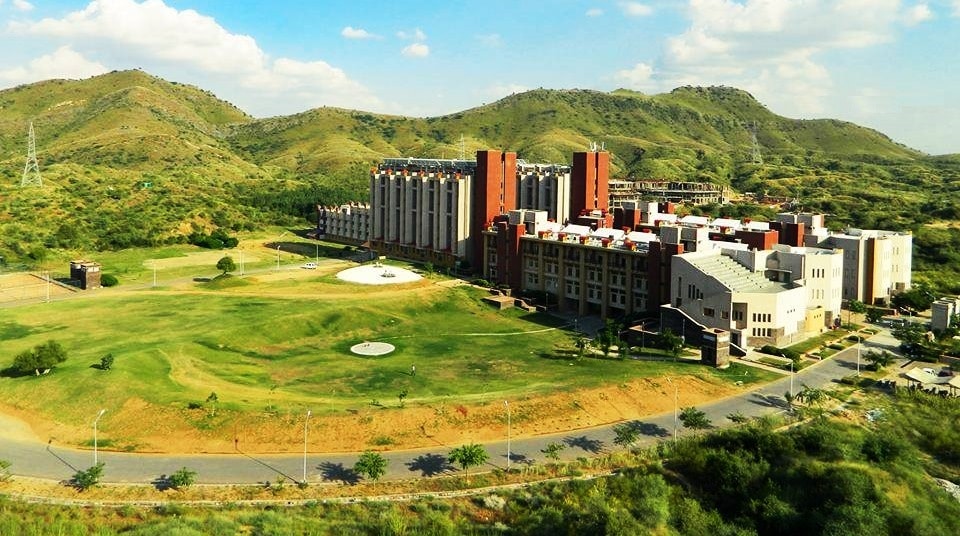
I was invited last week to deliver the 14th Annual Day Lecture at the NIIT University in Neemrana in Rajasthan, about a two-hour drive from Delhi. The University was founded in 2009 by Rajendra Pawar, Chairman of NIIT Ltd and NIIT Technologies Ltd. The University offers undergraduate, postgraduate and doctoral programmes in Computer Science, Electronics, Biotechnology, as also an MBA in Finance and Banking. Pioneeringly, it has also launched a master’s course in Cybersecurity. It is now ranked among the top 50 Indian universities of the future.
I was particularly impressed by the campus, which is spread over 100 acres. Originally, the land was barren, but over the years it has been greened very successfully, with rolling lawns and large trees. It also has a very innovative system for cooling and heating, where air from ducts some 10 metres below the ground is circulated through the buildings, keeping them cool in summer and warm in winter.
Rajendra Pawar, whom I have known for several years now, founded NIIT in 1981 with Shiv Nadar and Vijay Thadani. He has led several ICT industry initiatives, and has played a significant part in shaping India’s IT policies. What has always impressed me about him is that outside his specific domain expertise, he is passionate about improving the standard of education, and has an eclectic interest in a wide range of subjects, from philosophy to literature.
Not surprisingly, the topic he gave me for the lecture, was rather different from the routine. It was: “Who are We? Identity: Timeless and Contemporary”. I enjoyed speaking on this theme — extempore as always — and was delighted by the animated question-answer session that followed.
Pavan K Varma is author, diplomat, and former Member of Parliament (Rajya Sabha).
Just Like That is a weekly column where Varma shares nuggets from the world of history, culture, literature, and personal reminiscences with HT Premium readers
The views expressed are personal


