
 E-Paper



Keeping Up with UP | An atmosphere of development has taken over the state
Ahead of the Global Investors Summit, emotions and pride are at play as the state woos NRIs and small local investors. With this, a new era in UP politics may be beginning.


In an interview to Hindustan Times, Uttar Pradesh (UP) chief minister Yogi Adityanath recently mentioned a “handsome investment” by a non-residential Indian (NRI) born in UP.
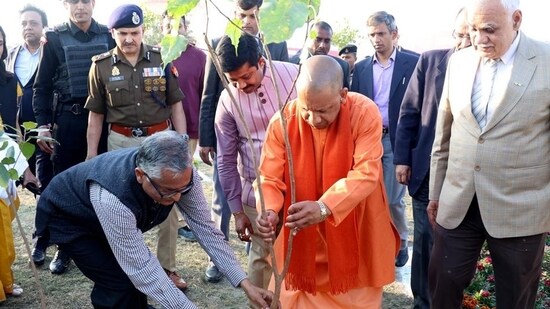
As someone who has been hearing about investments by UP’s diaspora for several years, my curiosity piqued. But the chief minister refused to disclose his name, and with a mysterious smile, he said, “His birthplace is UP and he wants to invest in the state where he was born and brought up. He met me and has offered to invest handsomely. You all will meet him soon.”
UP is holding a three-day Global Investors Summit from Feb 10-12, before which official delegations visited 21 cities in 19 countries and 8 states, signing Memorandums of Understanding (MoUs) to the tune of ₹17.33 lakh crore. UP has a strike rate of 75%. The government is confident that the investment intentions will see the light of day (Of ₹4.68 lakh crore worth of MOUs signed in 2018, about ₹4 lakh crore are in the execution state).
Emotions and pride are at play as the state woos NRIs and small local investors. It is for the first time the state has rolled out a red-carpet welcome for local investors, once considered a neglected lot who ran from pillar to post to get government clearances.
Beyond just being invited, their applications are being considered and district magistrates, along with Bharatiya Janata Party (BJP) Members of Legislative Assembly (MLAs) and Members of Parliament (MPs) have opened the doors for them as they attempt to lure maximum investment intents in their respective areas. This also comes with the aim of getting rewarded by the chief minister.
This appears to be working for two reasons: One, the unprecedented investment buzz that is taking over the state in a move to change political discourse. Two, the presence of a clearance desk, watched over by Yogi Adityanath himself — changing the system of discouragement and delay to one of openness and opportunity.
Yogi has gone a step further and has been found refraining from controversy by choosing not to comment on politically sensitive issues. The most recent is the row over Ramcharitmanas, a Hindu epic poem which scholars have found to be derogatory to women and Dalits.
This has forced even Yogi's staunchest critics to reconsider their views on the state and its administration, for an investment of even ₹1 crore in a village or district will create several jobs in a state roiled by political controversy and Hindu-Muslim rhetoric. Changing this perception of the state will be crucial a year ahead of the crucial 2024 general election. And Yogi knows this approach is likely to pay dividends.
The Kashi Story
Kashi is setting the trend for burgeoning tourism, attracting investments for temple cities such as Ayodhya and Mathura.
About 7.5 crore pilgrims thronged Kashi in 2022, the effect of which was seen in local investors signing about 40 MoUs amounting to ₹11,500 crore. The investors are expecting a windfall in Prime Minister Narendra Modi's Kashi and the chief minister’s home district of Gorakhpur, where Yogi has been spending a lot of time. Proposals to set up 20 five-star hotels, malls, the Ganga Putra river cruise and wellness resorts in Kashi have been submitted.
People aware of the developments claim that the government will further announce a corpus for the NRIs to invest, as many of them, though emotionally linked to their home state, require logistical support to turn their intentions into projects.
Some of them even quote the example of one Sanjeev Rajora, who belongs to Bulandshahr, but is settled in the United States (US). He visits the state every year to monitor existing schemes or launch new ones for the development of his village.
Based out of California, Rajora mentioned the increasing traction of the Matra Bhumi scheme of the state government. As many as 2,000 investors from the US have shown interest in the scheme in which the contribution will be a ratio of 60:40 (the government will contribute 40). The investments will be in the form of school buildings, stadiums, libraries and so on. Soon, the state will set up the Foreign Contribution Regulation Act (FCRA) account. According to Rajora, hundreds of NRIs attended a meeting convened by the chief secretary.
In 2019, the Union government, in collaboration with the state government, organised Bhartiya Pravasi Divas, which the then minister of state for NRI Swati Singh claimed, attracted thousands of NRIs. Many then showed their intent to invest in the state, which the chief minister has been diligently pursuing.
Pitching development
Earlier, in 2018, ahead of the first Investors Summit, Swati Singh spoke about the “adoption of a ‘sister town’ concept to forge better ties with the countries having NRI population from UP”. A sister town or twin town is a legal and social agreement between towns and provinces in different geographical areas to promote cultural and trade ties.
Other governments pitched development agendas too. The Samajwadi Party government led by Akhilesh Yadav organised UP Pravasi Diwas — a three-day long extravaganza — in Agra in January 2016 and honoured 16 NRIs with Pravasi Bhartiya Ratna Puraskar. (Yogi also plans to honour NRIs at the summit.)
When in power, Akhilesh also created a dedicated NRI department in Udyog Bandhu, and launched an exclusive website as a single point gateway for the NRIs along with a 24*7 call centre. Incidentally, both are hyper-functional.
Way back in 2003, a directory of NRIs was prepared by the government. In 2007, Mayawati brought political stability, but her agenda was different: The promotion of Dalits’ dignity. So, she focused on increasing their presence in public memory by building parks in their names and recognising several Dalit scholars for their contribution to discourse.
However, as the state remained engrossed in the divisive politics of caste and religion, most governments made little headway. Even Yogi's government, until recently, saw the state mired in one controversy after the next on the lines of religion, pushing the development agenda to the back-burner for far too long.
It has taken over two decades for UP to begin to change its public perception by displaying an appetite for development and investments — both local and global. However, it would be wise not to count chickens before they hatch, because these investments — MOUs — will need to be converted into projects.
The chief minister says he has a plan. Only time will tell what comes to fruition.
From her perch in Lucknow, HT’s resident editor Sunita Aron highlights important issues related to the elections in Uttar Pradesh
The views expressed are personal


