
 E-Paper



Myanmar faces a fragmented future
Five years after the coup and a protracted civil war, the junta and pro-democracy rebels have failed to consolidate power

 Prefer HTon Google


On February 1, 2025, Myanmar’s civil war entered its fifth year. Since the tatmadaw waged a coup, life in the country has changed for all. The legitimate National League for Democracy-led government was never allowed to come to power despite winning the 2020 elections. Its leaders and supporters were arrested and a state of emergency was declared for a year. A new government, the State Administrative Council (SAC), was formed by the military. It was led by a senior general, Min Aung Hlaing (MAH), the commander-in-chief of army. MAH soon declared himself as the Prime Minister of Myanmar, a position that does not exist under the 2008 Constitution. Elections were promised within a year.
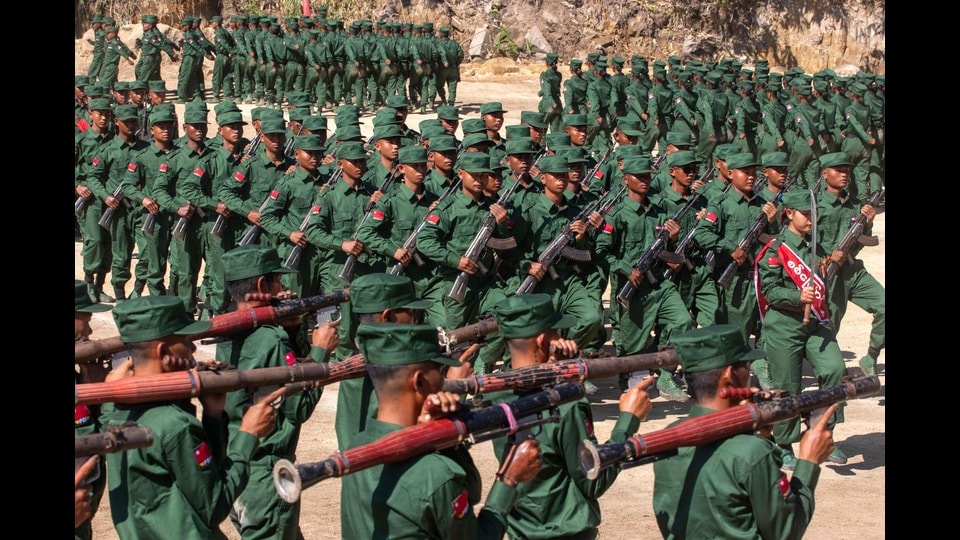
In 2025, elections in Myanmar are under speculation, opposition leaders and anti-junta supporters continue to remain arrested and attempts to find solutions to the civil war continue to be made by external players, without much success. The people of Myanmar continue to suffer. As the junta uses age-old tactics of burning down villages, aerial bombings, and executions to be in control, the number of internally displaced persons (IDPs) in Myanmar has crossed 3.3 million.
In the last two years, diminishing control over power and territory by the tatmadaw stands out. The 1962 coup by General Ne Win and the 1988 uprising that eventually led to a military coup, were both marked by post-coup power consolidation by the tatmadaw. After the coup in 2021, things have been different. People’s resistance has found more viable structure and strength. The People’s Defence Forces (PDF), created by the National Unity Government (NUG) in exile, helped effectively respond to the military crackdown. This gave steam to the Civil Disobedience Movement (CDM) which was joined by the youth in large numbers, mostly frustrated by a slip back from democracy. In parallel, many ethnic armed organisations (EAOs) took the opportunity to push back the tatmadaw from territories they have long fought for. Myanmar National Democratic Alliance Army (MNDAA) and Ta’ang National Liberation Army (TNLA) in Shan, Arakan Army (AA) in Rakhine, and Karenni Army (KA) in Karenni are just a very few examples. Interestingly, many EAOs came in open support of the PDFs, such as the Kachin Independence Army (KIA). Various such combined fronts against the tatmadaw were an early sign of a protracted civil war in Myanmar. Unlike in the past, reportedly, the conflict spread to at least 321 of 330 townships across Myanmar.
Tatmadaw as an institution has fallen short on crucial aspects. In terms of strength, the numbers have fallen from an estimated 400,000 to just about 70,000 fighting personnel in 2024. Many have deserted and defected, reportedly due to a lack of basic pay and insurance, among other reasons. There is also a loss of morale and a lack of battlefield skills among tatmadaw soldiers. In terms of leadership, MAH is still the top person in the military, and is now also the acting president of Myanmar. But, rumours of an internal coup in August 2024, hints that not all is well. In 2023, both MAH and Soe Win, the number two in the military, had close escapes in Naypitaw, exposing the vulnerability of their defence. More striking is the inability of the tatmadaw to hold its territories. Operation 1027 in October 2023, by the three Brotherhood Alliance (3BHA) comprising MNDAA, TNLA and AA, was a turning point in this regard. This was followed by gains made by EAOs through Operation 1111 in Karenni state, 90% of which is no more under tatmadaw’s control. An interim executive council has also been set up there, showing how new governance systems are being devised. By early 2024, reportedly EAOs and PDFs were in control of 50% of Myanmar’s territory. In the last year, further gains include the capture of strategic townships as well as two military command posts, in Lashio and in Ann.
If the junta is failing, will the civil war come to an end? The civil war has no easy end. The number of parties in this civil war are multiple. One report pegs the number of new non-state actors participating in the war since 2021 at 2,600. There is even in-fighting between EAOs, like MNDAA and Shan State Progressive Party (SSPP) for example, which are both part of the Federal Political Negotiation and Consultative Committee (FPNCC). FPNCC, established in 2017 to negotiate with SAC, comprises only seven EAOs. Even the 3BHA have different views on things. At the behest of China, in 2024, TNLA called for a ceasefire. MNDAA followed suit recently. But AA is preparing for a full war with the military at Sittwe, one of the last crucialareas in Rakhine under the tatmadaw. Therefore, the picture is very fuzzy.
What can be expected now? First, a fragmented Myanmar may not be a surprise. The ethnic states, especially bordering India and Bangladesh have largely fallen out of the junta’s control. Announcement for separate states or a confederation of some sort shall be up in the cards, particularly in Rakhine. Yet, many bet on the junta remaining in power, in the Bamar heartland. Second, if piecemeal elections are held in 2025, as being pushed by the junta, it will be used as a ground for legitimising the SAC’s rule further. This means the state of emergency, that was extended for the seventh time last week, since the coup, is not going to end this year. Third, if China out of all external players manages to get parties to the negotiating table, at best a new military government may replace SAC. But, this will open the possibility of negotiating another new constitution for Myanmar and yet another process of nation-building shall begin. In short, Myanmar should be in much for focus this year than it already is.
Shrabana Barua, associate professor and director of Nehginpao Kipgen Center for Southeast Asian Studies at OP Jindal University. The views expressed are personal


