
 E-Paper



Policies and People | Mumbai-Doon: Why this green warrior is on a 2000-km yatra
Padma Vibhushan and Padma Shri awardee and well-known environmentalist Anil Joshi is on a seven-state, 40-day cycle yatra, and he has one message: India must find the right balance between pragati (development) and prakriti (nature)

 Prefer HTon Google


Earlier this month, Maharashtra governor BS Koshiyari flagged off a unique cycle yatra from Mumbai to Dehradun. Led by Padma Vibhushan and Padma Shri awardee Anil Joshi, several cyclists will be on the road for 40 days with one key message: Development is good and necessary, but it must take the environment into account.
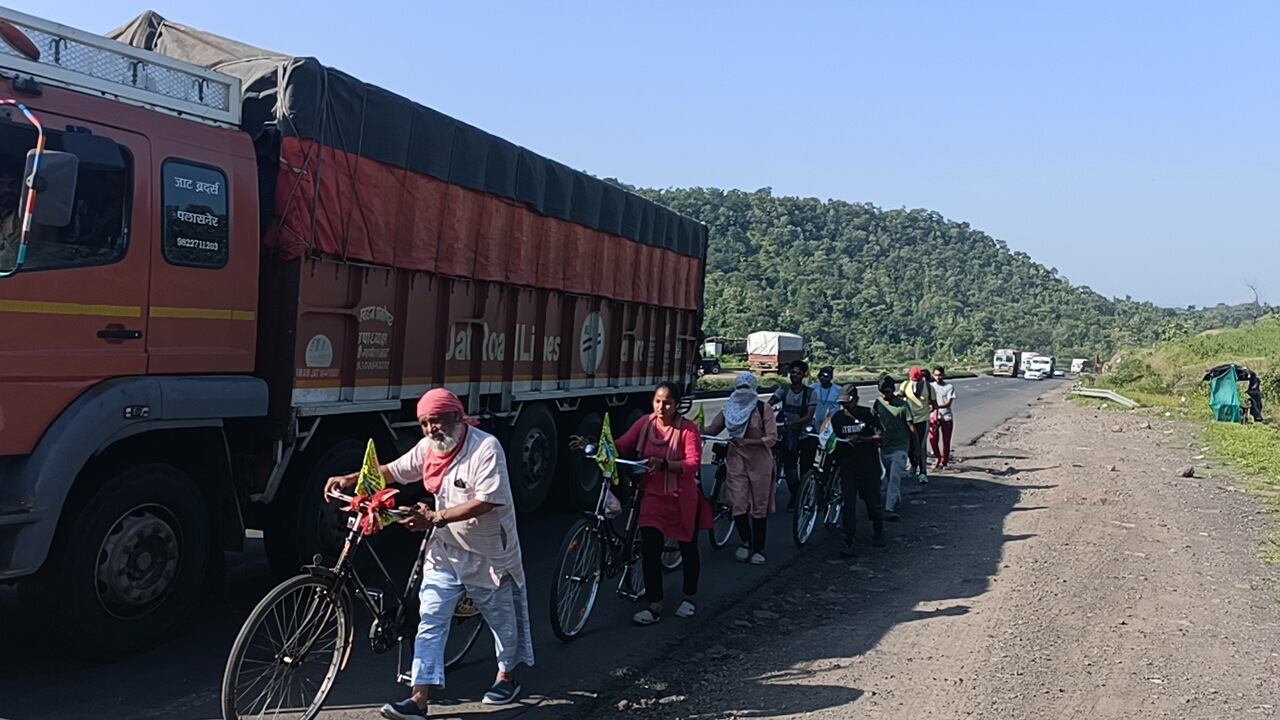
Joshi has been a premier voice in the environment and sustainable development field for the last 35 years. He and his team members of the Dehradun-based Himalayan Environment Studies and Conservation Organisation (HESCO) have successfully ensured sustainable development in several villages of the Himalayas. Their innovative and ecologically-sound solutions have yielded positive results and have brought the organisation and its members, especially its women members, national and international recognition.
Spreading the message
In late September, I met Joshi in New Delhi. The 67-year-old was in high spirits. The detailed planning for the cycle yatra was complete, and Joshi was eager to hit the road. Moreover, the environmentalist was brimming with ideas on what should be India's sustainable growth path.
"The climate crisis is clear proof that the western model of development has failed. In my mind, prakriti (nature) and pragati (development) cannot be at loggerheads. We have to find the right balance between the two; development has to be inclusive," Joshi said. "This is the reason why I am cycling from the financial capital of India, Mumbai, to the ecological capital of India, Uttarakhand. We would like to sensitise people from the sea to the Himalayas about India’s vast natural resources, ecosystems and ecology and restore our lost connection with nature."
Gross Environment Product
While this cycle yatra is yet another bold attempt by Joshi to spread the message of sustainable development, the environmentalist has been talking about Gross Environment Product (GEP) for a decade.
"After Independence, we were obsessed with the western approach and forgot that in an agrarian country like ours, where more than 70% of people draw their livelihoods from agriculture, our subsistence pattern is different from others. Agriculture is an inclusive product of forests, rivers and soils, and therefore, constant monitoring of the health of the three is important. India must junk the model of using the Gross Domestic Product as an indicator of economic growth, and opt for Gross Environment Product (GEP)," he added.
"The government must take the periodical status of soil, water, forest, and air... these are not a part of our GDP. Take the example of the poor quality of air, soil and water; they do not have any mention in GDP. On the other hand, the number of chemical factories, water and air purifiers, and water bottle business are booming businesses and are a part of good GDP. This is so wrong," Joshi added.
He also spoke about the 2013 Kedarnath tragedy and the glacial disaster of 2021, adding that enough has happened to awaken the authorities to the dangers of a mad race for development showing utter disregard for the environment and ecology. "A preventive mechanism has to be developed. Rainwater conservation, water recharging mechanisms have to be put in place. Relocating populations living along riverbanks, especially those within 100 metres from rivers, also deserves serious consideration to ensure their safety."
The cycle yatra stops at different towns and cities along the way, and Joshi is meeting a broad spectrum of people — the general public, students, scientists, think-tank members and politicians — to garner their support for GEP and ecologically sensitive development. On Tuesday, Joshi met students of the Julal Bhilajirao Patil College and said: "If the country had followed the path of Gandhi, it might have been in better balance, but unfortunately, that did not happen."
Last year, Uttarakhand, where Joshi is based, announced that it would initiate the valuation of its natural resources in the form of GEP. However, there has not been any news on how they want to proceed with it or dovetail it in their planning systems.
In a video message ahead of the yatra, Uttarakhand chief minister Pushkar Singh Dhami spoke about the importance of Joshi's cycle yatra and the issues he raises. "Prime Minister Narendra Modi has also sent out a strong message on the importance of ecology and that it is equally important as the economy. We must appreciate the strong link between mountains and seas. Rivers emanate from the mountains and monsoons come from the seas. In this country, we may have different states but when it comes to nature and natural resources, we are one," the CM said.
Follow Joshi’s yatra here: https://twitter.com/AnilPJoshi
The views expressed are personal


