
 E-Paper



Promise of Vizhinjam, a blue economy vision
India needs a maritime modernisation plan that will look beyond “port-led development” to address other shortcomings in the sector

 Prefer HTon Google


On October 15, the Chinese flagged specialist merchant ship, Zhen Hua 15, arrived in India’s new Vizhinjam port, bringing giant cranes from Shanghai, to be installed for dockside cargo handling. The Chinese vessel, being the first to dock in Vizhinjam, marked the port’s inauguration, which was described by Kerala’s chief minister, Pinarayi Vijayan, as, “a significant milestone” and “game-changer for Kerala’s infrastructure development”.
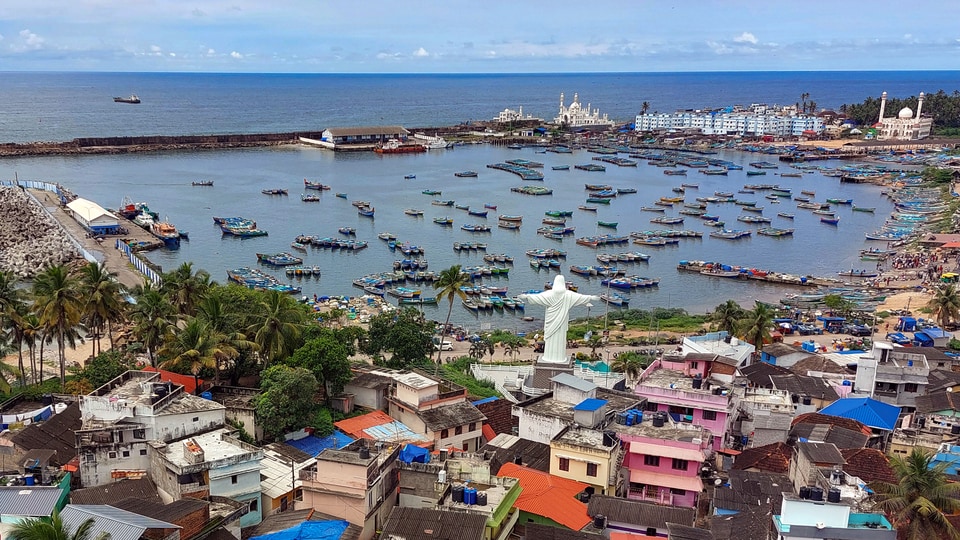
The Vizhinjam port project was awarded to the Adani Group in 2015 with a target completion date of 2018, but delays imposed by various factors have seen a slippage of at least five years in the completion of the project’s first phase. With a dredged depth of 20 metres, Vizhinjam is being advertised as “India’s first deepwater port” that can not only berth the largest merchant ships but also cope with a huge quantum of container traffic. But its real significance lies elsewhere.
Currently, most container ships avoid calling at Indian ports due to depth restrictions, poor infrastructure, and high tariffs. A full 25% of India’s export-import (EXIM) cargo is, therefore, shipped, first to nearby foreign ports like Colombo, Singapore and Klang, and then trans-shipped to its destination; a process both expensive and inefficient. Located in close proximity to international east-west shipping lanes, Vizhinjam could become a key trans-shipment hub, and obviate the need for India’s EXIM cargo to be sent to foreign ports.
In a larger context, ignorance about its rich potential, combined with indifference has led to egregious neglect of the maritime sector. While India’s merchant ship-building industry is moribund, the merchant ship fleet grows at a snail’s pace, seabed exploitation has yet to take off, the fishing industry is backward, and human resources for all these are lacking. Nations that were lagging behind India in many maritime indicators have surged ahead in the past few decades because of the vision and dynamism they have demonstrated.
Reverting to the port sector, the less time a ship spends in port the more efficient and competitive the port is considered. Therefore, ports with shorter turnaround times attract more ships. By this criterion, Norway with 697,000 annual port calls is rated No 1, China with 260,000 port calls is at No 3, and neighbouring Indonesia with 181,500 port calls at No 7, but India does not figure in the top 20 nations. In the list of 50 best container-ports worldwide, 18 are Chinese (seven of them amongst the top 10) while India has only two, at No 35 (Nhava Sheva) and No 39 (Mundra). There must be lessons, in the fact that unloading of the Zen Hua 15, in Vizhinjam, was reportedly delayed by five days, due to “technical reasons.”
Notwithstanding these discouraging indicators, a vague perception has persisted in the government that the port sector does have an important bearing on India’s economy. It is this perception that has helped keep alive, in different avatars, the “Sagarmala Programme”, whose vision, according to the ministry of shipping Annual Report for 2022-23, is “port-led development in the country” by reducing logistics costs for both EXIM and domestic trade “with minimal infrastructure investment”. Tracing the trajectory of this project provides interesting insights into the workings of our politico-bureaucratic mindsets.
The first version of Project Sagarmala was announced in August 2003 by the Vajpayee-led National Democratic Alliance (NDA) government. The stated objective of this plan was to ensure that all major ports would be connected to the then proposed grid of highways — the “Golden Quadrilateral” — through a network of expressways. The project was, however, abandoned within months, due to early general elections in February 2004.
The United Progressive Alliance (UPA) government that won office in 2004 replaced Sagarmala with the “National Maritime Development Programme” (NMDP) in 2005. While the stated aim of the NMDP-2005, much like that of Sagarmala, was to “develop India’s maritime sector”, it was confined to modernisation of port infrastructure and enhancement of railroad connectivity to these ports.
The progress of the plan, however, remained tardy, and in 2011, the UPA government abandoned the NMDP-2005, replacing it with a new 10-year plan titled “Maritime Agenda 2010-2020” (MA-2020). While the Sagarmala-2003 and NMDP-2005 were focused mainly on port modernisation and enhancing railroad connectivity, MA-2020, ostensibly, had a much broader scope, and envisaged an outlay of ₹5 lakh crore to declare some extremely unrealistic targets such as multiplying ship-building capacity by five times and enhancing cargo throughput in Indian ports by four times in just 7-8 years. The breathtaking ambition of MA-2020 remained stillborn since it was overtaken by the next plan before it could achieve anything.
The NDA government that came to power in 2014, terminated MA-2020, and revived the Sagarmala project. The 20-year Sagarmala-2015 is also focused on modernising ports and enhancing connectivity in the country to transform the maritime sector. The five pillars of “port-led development” envisaged by Sagarmala-2015 are port modernisation, port connectivity, port-led industrialisation, coastal community development, and coastal shipping/inland water transportation. This version of Sagarmala holds out more hope because it has a structured, progress-monitoring framework, including a website, titled Sagarmala Project Tracker, which shows that by 2022, out of 241 “port modernisation” projects, 89 had been completed while 151 were under implementation or development.
Sagarmala-2015 still has 12 years to run and its progress will, no doubt, be watched with great interest. However, we must not lose sight of the fact that since 2003, India has seen four “maritime modernisation” plans bearing different names. In their quest for populism, through catchy slogans, successive governments have discarded their predecessor’s agenda and created new programmes, containing essentially the same flaws. This stop-start process has not only delayed capability accretion, but also prevented the emergence of a long-term, coherent plan for India’s long-neglected maritime sector.
There is clearly a need for the formulation of an overarching vision document which places the maritime domain in context and goes well beyond “port-led development” to address other, grave shortcomings in our maritime sector. Today, there is a dire need to bolster the merchant shipbuilding industry, build a large and diverse shipping fleet, create a mechanised ocean-going fishing fleet and plunge into serious seabed exploitation. The document must, however, be enabled to survive regime changes.
All these are aspects of the “blue economy” which, as China has demonstrated, have a critical bearing, not only on a nation’s economic future, but equally, on its holistic maritime security and international standing. The corresponding administrative structures which will enable change and effective implementation of maritime reform should include a ministry of maritime affairs, and a national oceanic administration with cross-ministerial participation.
Arun Prakash is a retired chief of naval staff. The views expressed are personal


