
 E-Paper



Terms of Trade | India’s labour market is broken
What’s common between burning trains, delayed flights, and a professor who returned his salary?


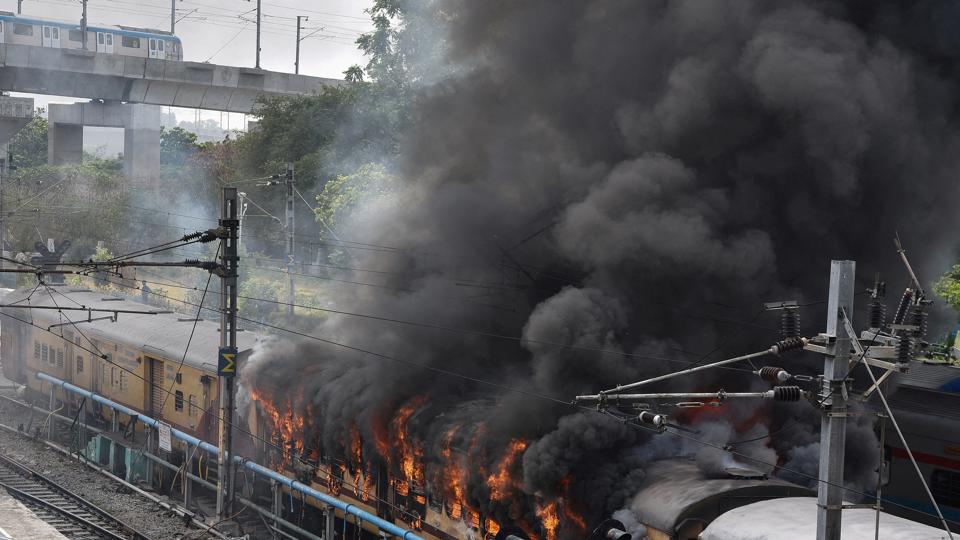
Last month, when the government announced the Agnipath scheme for recruitment into the armed forces, widespread protests broke out across many states. These protests mutated into violence in many places and mobs of protestors took to the destruction of public property including burning trains.
Last week, India’s biggest private airline Indigo suddenly found itself saddled with large-scale flight delays. If there is one thing which people associate with the Indigo brand, it is punctuality. The reason for the delay was a large number of Indigo staff suddenly reporting sick and not turning up for work. The actual reason, it later emerged, was not some surprise epidemic within the airline’s ranks but employees bunking work to appear for job interviews for other airlines.
This week an assistant professor of Hindi at B R Ambedkar University in Bihar, took an unprecedented and radical step of returning two years’ worth of his salary to the university because none of the 1100 students who were enrolled turned up for classes. Because he did not do any teaching, the professor described his remuneration as unethical and, therefore, returned it. While questions have been raised about whether the professor actually returned his salary or pulled off a stunt, the fact that this act of his struck a chord, speaks volumes about the state of higher education in most state universities in India.
These seemingly disconnected stories of burning trains, delayed flights and a professor who cannot live with his unearned salary, when read together, point towards what can be described as a broken labour market in India.
The asymmetry in the labour market
Why did the Agnipath scheme trigger such a strong backlash? What has changed between the Agnipath scheme and the older model of recruitment into the armed forces? As far as the job-seeker is concerned, the earlier model gave one of the last significant avenues of securing longer-term employment and assured post-retirement social security benefits. Both of these have been significantly diluted under the new scheme.
While a soldier’s job can hardly be described as a life of comfort, it does promise a minimum level of economic security to the soldier and his family in a context where the next best option could be disguised unemployment on shrinking family farmland. The pool of job-seekers who have been trying for entry-level armed forces jobs do not really have job-market skills which will make them competitive in other white-collar professions. What is important to keep in mind is that the lack of such skills is not necessarily a reflection of the intellectual capabilities of these candidates (more on this later).
Indigo is not the first formal sector company which is having to deal with a tight labour market in India at the moment. Anecdotal accounts from IT and many other high-value services suggest the same thing. Attrition rates have been high and retaining talent has become extremely difficult as companies are competing with each other to attract the best human resource.
Unsurprisingly, salaries have gone up. One of the biggest reasons for intra-sector attrition is that these jobs are extremely specialised in nature and in the short-run, there cannot be any meaningful addition to the pool of labour ready to be hired. Of course, if IT companies and airlines continue to hire like this, one can expect more engineering colleges and flight training schools to come up.
The unequal access to education
What explains the dualism of thousands of angry young men who are ready to take to arson at the prospect of a reduction in already scarce, secure but low-income, blue-collared jobs and the short supply of workers to be hired for relatively high-skilled jobs in the Indian economy?
The answer to this question is to be found in the fundamental asymmetry in the nature of education available to the young men and women in this country.
Data from the latest available National Statistical Office (NSO) survey on education shows that in 2017-18, 76% of Indians enrolled in higher education (graduate or higher level degree programmes or diplomas of the same level) were pursuing what can be described as vanilla courses such as BA, BSc or BCom degree. Most such teaching happens in state universities, where the curriculum has not been upgraded for years, teaching and research resources are extremely inadequate and there is hardly any accountability.
To go back to the story of the professor who returned his salary, it is eminently believable that there are many more college and school teachers in India who are more than happy to draw their salaries without having to do any teaching. Given the fact that what is taught in the classrooms is very unlikely to help students get a job, lack of interest in learning is not exactly a surprising thing.
Lest one assumes anything else, it is important to clarify that the choice of enrolling in a mediocre and obsolete course or educational institution is often tied inexplicably to the students’ ability to pay for education. While most of India’s public universities offer poor education, they are cheaper compared to what it takes to finish a vocational degree from a private university.
Once again, data from the NSO survey is conclusive. The share of students who were enrolled in a humanities programme was 63% for the bottom 10% by monthly per capita spending. This number was just 22% for the top 10%. To be sure, some of the best educational institutions, both in the academic and professional realms, are still public institutions, but they only admit a minuscule fraction of the annual student turnover.
Where inequality gets reinforced
Is there a larger point in the inequality in access to education creating this asymmetry in India’s labour market?
This is pretty much the story of the Indian economy today where the fortunes of a relatively small but numerically significant section of the economy are firmly tied to what can be described as not just the Indian but the global modern economy, whereas an overwhelming share of workers are trapped in what can be described as a low-level-equilibrium-trap where their primary concern is to somehow seek subsistence-level earnings.
A substantial element of India’s economic policy is made keeping in mind the modern sector of the economy, which is increasingly growing its material share without expanding its human footprint.
The only way to bridge this asymmetry in the labour market is to significantly improve the quality and quantity of education in the country. The case for doing this is even stronger because, as of now, India might actually be headed in the reverse direction due to pandemic-inflicted losses in learning at all levels of education.
Every Friday, HT’s data and political economy editor, Roshan Kishore, combines his commitment to data and passion for qualitative analysis in a column for HT Premium, Terms of Trade. With a focus on one big number and one big issue, he will go behind the headlines to ask a question and address political economy issues and social puzzles facing contemporary India.
The views expressed are personal


