
 E-Paper



Terms of Trade | Is there economic anger among Indian voters today?
The Opposition could exploit India’s structural economic fault lines to inflict damage on the BJP, but does it have a leadership which can sell this narrative?


The 2024 general elections are less than six months away. In less than two weeks from now, polling for the last round of state elections before the Lok Sabha elections will begin in Chhattisgarh and Mizoram.
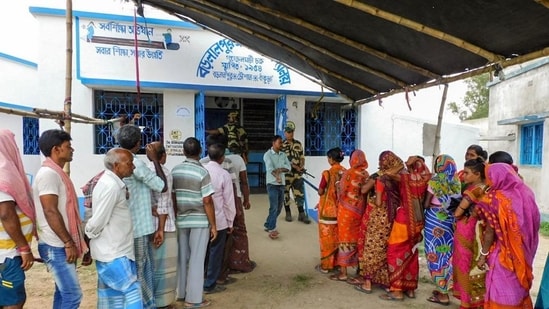
While a lot of political commentators are describing these state elections as the semi-final before the grand finale of 2024, the characterisation is a bit erroneous. The simple reason for this is that the 2018 winner of this so-called semi-final – the Congress, which won the states of Rajasthan, Madhya Pradesh and Chhattisgarh – performed badly in these states in the 2019 Lok Sabha elections.
There is no point predicting election results for either the forthcoming state elections or next year’s national polls. Instead, let’s focus on and analyse economic data, which will help us answer a different – but equally important question –a question that will matter a lot in the forthcoming elections: Is the Indian voter an economically angry lot right now?
Lest there is any confusion about what the column is trying to argue, let me state at the outset that an overwhelming majority of Indians are very far from being economically secure, let alone comfortable, in their lives. The biggest proof of this came during the pandemic when the government announced free food grains over and above the normal Public Distribution System (PDS) quota for 800 million people. When the government finally withdrew the additional food entitlements, it waived off the nominal charges for entitlements under the PDS.
The question which needs to be asked, as far as the relation between economy and politics is concerned, is the following: Does economic precarity automatically lead to economic anger?
Few people would disagree that the most tracked economic numbers in any country are GDP growth, employment and inflation. The first is important because it tracks overall economic momentum in the economy. The second matters because it can be bad even in the case of high growth, leading to a situation where the fruits of growth are shared by a small minority. The third matters because it can either mean an overheated economy or a realignment of terms of trade between different economic agents.
Let us look at these numbers during the term of the Narendra Modi government. GDP growth collapsed towards the end of its first term and went into the contraction zone during the pandemic but seems to have stabilised in the vicinity of 6%-6.5% for now. This number is close to the IMF’s potential growth rate of 6% for India.
The employment situation, at least in purely quantitative terms of Labour Force Participation Rate (LFPR) – defined as the share of the population either working or looking for work – and unemployment rate seems to have improved between the first and the latest Periodic Labour Force Survey (PLFS) which were conducted in 2017-18 and 2022-23.
Inflation, while it is unlikely to gravitate towards RBI’s actual target of 4% until the 2024 elections, has perhaps peaked unless there is a major oil shock on account of the volatile situation in the aftermath of Hamas’s attack on Israel in West Asia. The other important aspect vis-à-vis inflation is that agricultural prices, at least for key crops such as cereals, are actually doing well which is likely to tilt the terms of trade in favour of farmers despite aggressive price control measures by the government.
Does all this mean that the 2024 elections are going to be a cakewalk for Narendra Modi and his party? The safest way to answer this question will be that, if the current conditions prevail, the incumbent government is unlikely to face significant cyclical headwinds in the elections.
This is not an insignificant fact. Crude oil staying at over $100 per barrel for three years before the 2014 general elections played a major role in destroying the Congress’s political fortunes. The current government, on the other hand, has been pretty lucky with the commodity price cycle for most of its tenure.
But economic headwinds need not be cyclical alone. Today’s BJP is a hegemonic political force in India. Among the key factors which propelled its 2014 victory was the promise of major economic transformation and significant improvement in living standards for people at large. One can say with a reasonable degree of confidence that this has not happened in the last nine years.
One can come up with reasons beyond the BJP’s control or of its makings such as the twin balance sheet crisis or the pandemic to explain why things could have been better. But that is not going to change the condition of the modal voter in the country. This is exactly why the BJP is now aggressively selling a long-term vision of imminent economic prosperity by the end of 2047 in the form of the “Amrit Kaal” narrative.
This brings up the other important question: Will the BJP face structural economic headwinds in the next elections? There are plenty of pockets from where such headwinds could emerge. Indian agriculture continues to be mired in a structural viability crisis. Quality employment generation continues to be a problem, especially for India’s educated young workers. Although there is no hard data to back this claim, there is good reason to believe that small businesses are increasingly being squeezed by big capital foraying into sectors where it did not operate earlier.
Can the Opposition exploit these fault lines to sink the BJP in the 2024 elections? Once again, there is no point predicting what will happen in the future. However, one can list two factors which are likely to mute the impact of these factors vis-à-vis the BJP’s electoral prospects.
The first is that these factors except the big capital’s entry into what used to be an informal economy, predate the BJP’s hegemonic rise to power. This means that there is warranted scepticism about a change in guard leading to their resolution. This is perhaps an assertion that will provoke a lot of people, but it is worth putting it out here.
Cyclical factors such as inflation or failed monsoons have perhaps always played a bigger influence on India’s electoral outcomes than structural factors. That India has never faced a severe macroeconomic crisis such as countries in Southeast Asia or Latin America or a shock therapy such as the Soviet Union and some of its satellite states, have played a major role in this fact.
The second follows from the first. The Opposition would want to exploit India’s structural economic fault lines to inflict damage on the BJP, but does it have a leadership which can sell this narrative to the electorate with some credibility? Who is the face of the unemployed youth or the crisis-ridden farmer in the Opposition’s leadership?
This merits an even more provocative assertion: Is there a significant difference in the economic background of candidates who contest elections from the BJP and Opposition parties today?
Of course, the economy is not the only factor which decides elections in India. Religion and caste play an equal if not a more important role. In fact, the Opposition seems to have decided on making caste census and proportional reservations its biggest election plank in 2024.
Whether or not this works will only be known when the results are out. But the questions raised here should give us some food for thought about the tenuous relationship between economic precarity and political anger in Indian democracy.
India’s Opposition will have to undergo a protracted creative destruction -- where a significant section of its leadership can critique the present economic order with credibility -- to harness India’s economic fault lines to create political tailwinds for itself.
Every Friday, HT’s data and political economy editor, Roshan Kishore, combines his commitment to data and passion for qualitative analysis in a column for HT Premium, Terms of Trade. With a focus on one big number and one big issue, he will go behind the headlines to ask a question and address political economy issues and social puzzles facing contemporary India.
The views expressed are personal
 ABOUT THE AUTHORRoshan Kishore
Roshan Kishore is the Data and Political Economy Editor at Hindustan Times. His weekly column for HT Premium Terms of Trade appears every Friday.


