
 E-Paper



The extraordinary life of Padma Desai
From conservative India to Harvard economics and beyond, Desai was a trailblazer in a world dominated by men. Her legacy will inspire future generations

 Prefer HTon Google


To be the wife of Jagdish Bhagwati in a man’s world, and to be known as Padma Desai, was no ordinary challenge. But Padma was no ordinary woman. Born with a razor sharp intellect, iron will and steely tenacity, she set out to break the mould, and so she did. Though she passed away on April 28 at 92 in her New York City home, her example will live on, inspiring future generations.
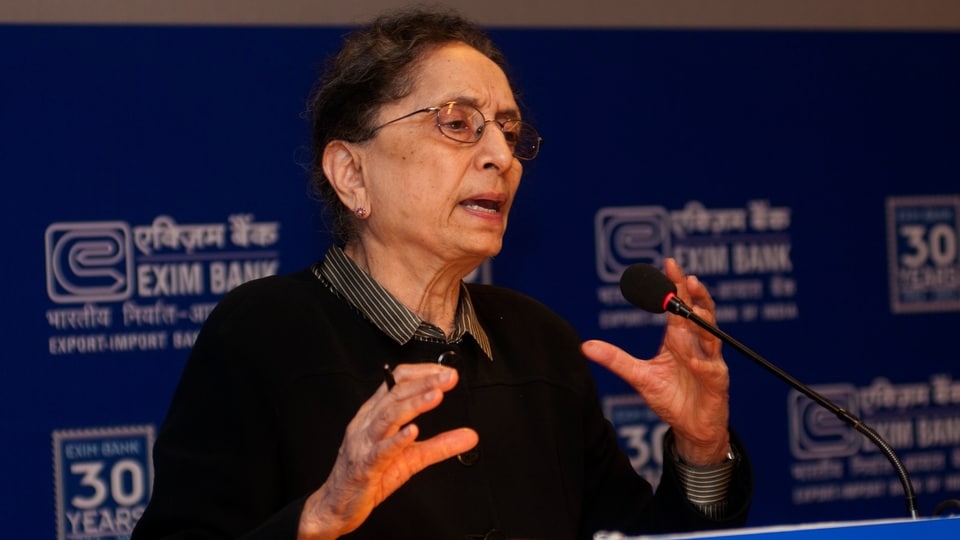
What are the odds that a girl born in 1931 in Surat in a conservative middle-class family would take a boat halfway around the world to the United States of America at the age of 24? Yet that is what Padma did. The first 10 days of the journey brought her to France, where she got to meet Le Corbusier, the architect who designed Chandigarh. She then proceeded to New York City and then to her final destination, Harvard University in Cambridge, Massachusetts.
In between, Padma completed her Bachelor’s and Master’s degrees in economics from Bombay University. In BA, she stood first in the university. While studying, she also entered into a relationship with a man whom she married, but only to discover that this was a bad mistake that would haunt her for two decades. Temporary respite came when her efforts translated into a fellowship from the American Association of University Women and opened the door to Harvard.
Once at Harvard, Padma worked hard. Neither the loneliness that inevitably comes with a foreign land nor taunts by sexist American men that economics was beyond her and that she should try out Hollywood instead could dent her resolve. She completed her PhD in just four years, ahead of most of her classmates. In the interim, in 1956-57, good fortune brought Jagdish to Cambridge, Massachusetts as a visiting student at MIT from Cambridge, England. The two met at a gathering of the International Student Association, where Padma was serving chicken curry. It was love at first sight for Jagdish. “You were beautiful and were serving my favourite food,” he confessed to her years later.
Padma returned to India in May 1959 and told her disloyal husband of her decision to leave him. She spent the next decade fighting him unsuccessfully for divorce. What made it all bearable was the appointment as an associate professor at the Delhi School of Economics (DSE), beginning in 1959 and the return of Jagdish to Delhi the following year. He had already announced his intention to marry her. He first joined the Indian Statistical Institute but moved to DSE in 1963. The two ended up with offices next to each other though the prospects for marriage remained distant in the absence of Padma’s divorce.
It was during these years that the duo began working on their magnum opus Planning for Industrialisation. To this day, there exists no work on India’s economy covering the years 1951-68 that comes even close to this gem. It remains a model for the meticulous assembly of the evidence, its critical examination and systematic policy recommendations. The book made a powerful case for the abolition of investment licensing in all but a few sectors, the replacement of import licensing by tariffs and a more flexible exchange-rate regime. Though all these reforms and more were implemented in one stroke in 1991, at the time, the book found virtually no takers.
With Padma’s divorce nowhere in sight, she and Jagdish decided to move to the US, where they eventually got married and were blessed with a daughter. Jagdish joined the economics faculty at MIT, and Padma became a research associate at the Harvard Russian Center. The two spent 1968-80 in Cambridge, Massachusetts and then moved to Columbia in New York City, where they remained.
During approximately five decades between Harvard and Columbia, Padma had a burst of scholarly activity. She quickly emerged as one of a handful of leading experts on the Soviet (later Russian) economy. She published 70 professional articles and more than 15 books. As the collapse of the Soviet Union approached, she became one of the most sought-after speakers on US television and, more broadly, on the Washington-New York lecture circuit. At one point, when her scathing critique of the shock therapy espoused by Jeffrey Sachs led the latter to retort that you cannot cross a chasm in two separate leaps, she retorted that you cannot do so in a single leap either unless you are Indiana Jones, and so the wiser course is to drop a bridge.
Padma’s specialisation in the Russian economy was no accident. She had begun learning Russian during her days as a student at Harvard to fulfil her lifelong ambition to read Dostoevsky in the original, which she did. She could speak Russian fluently and sometimes embarrass her co-passengers in elevators in Moscow by suddenly revealing that she could follow their snide remarks. Three days before she passed away, when her hospice care happened to send a Ukrainian nurse, relentless till the end, she entered into a 45-minute-long conservation in Russian with her. Do svidaniya, Padma, my budem skuchat po tebe (Goodbye, Padma, we will miss you!)
Arvind Panagariya is professor, Columbia University
The views expressed are personal


