As India steps into the fourth year of the Covid-19 pandemic, two images still haunt the national consciousness: The bodies of victims at packed crematoriums in the second wave, and migrant workers walking to their homes during the first. While the debate on an accurate estimation of deaths will continue, there needs to be a firmer estimation of how many migrants returned to their host destinations after the 2020 lockdown was lifted.
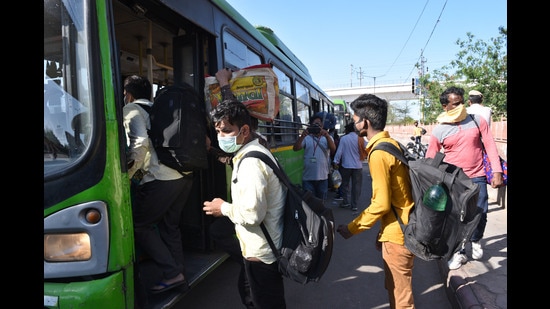
The popular narrative after the lockdown created an impression that migration patterns in rural and urban areas have changed drastically. However, PLFS does not support this narrative. (Ajay Aggarwal/HT PHOTO)
The last migration survey was conducted by the National Sample Survey (NSS) in 2007-2008 and the 2011 Census. Happily, we now have an NSS report on migration covering July 2020 to June 2021 as part of the Periodic Labour Force Survey (PLFS).
PLFS data show 28.9% of the population are migrants, defined as persons who have changed their usual place of residence (where they have stayed or intend to stay for more than six months). In the 2007-8 NSS, this was 28.5%. The two surveys use identical definitions, and show no significant change in the share of migrants. Even the rural-urban breakup does not show any significant change. The percentage of migrants going up from 26.1% to 26.5% in rural areas and the urban figure going down from 35.4% to 34.9% suggest that net migration from urban to rural areas was very small.
This contradicts the trend of increasing urban migration recorded in the Census or the Economic Survey (2017). However, PLFS was spread over a year, with a moving reference period, unlike the Census, the latter being a snapshot on a date. As a result, a returnee migrant in a village intending to stay for over six months would be counted as a migrant in a rural area even if he or she moved back to the pre-Covid urban destination before or after completing six months.
The snapshot of urban migrants on June 30, 2021, would thus give a higher figure than the average figure of 34.9%, which reflects the situation in the middle of 2020-21. The June 2021 figure would be larger than December 2020, assuming positive net rural-to-urban migration from January to June 2021. There is, thus, no evidence of any massive net return migration from urban to rural areas.
Undoubtedly, Covid-19 migration patterns were different from anything seen before. Migrants who reported they shifted after March 2020 but also said their present residence was their usual past place of residence can give an idea of return migration. PLFS data shows around 50% migrants who shifted after March 2020 were returnee migrants. The corresponding figure for migrants coming before the pandemic is below 10%. Among the rural male migrants, 82% were returnee migrants, while this was 34.7% for rural women. Notably, around 56% of all rural male migrants who came after March 2020 reported their intention to move out as soon as the situation improved; this was only 21% for rural female migrants. This would indicate that with the easing of pandemic restrictions, particularly after mid-2021, most pandemic-forced migrants returned to their previous places. The percentage of migrants in rural areas would thus be significantly less, and that in urban areas would be more by the end of 2021, compared to the figures recorded in the survey. This further confirms national-level migration rates in future NSS surveys will not be seen as very different from those in the past.
Information on duration since leaving the last usual place of residence is unfortunately not collected in PLFS. But one specific question did identify those who migrated after March 2020, in an attempt to understand the pandemic’s impact on migration. Those who reported migration after March 2020 would mainly be pandemic-forced migrants, because normal migration was rendered insignificant due to the lockdown. While 12.4% of male migrants in rural areas reported migrating since April 2020 till June 2021 (covering 15 months), the annual figure was 9.3% in 2007-08. Extrapolating the number assuming uniform distribution over months, one can take migrants during a comparable period in 2007-08 would be 11.3%; this too suggests no dramatic increase in the net migration rate in the pandemic year.
The lockdown impacted interstate migrants more severely than those coming from within the state, as many of the latter could support themselves and stay put. Among rural male migrants, 53%came from urban areas of other states. But for the pandemic’s impact, the share of interstate migration would have been lower, as observed in the 2007-08 survey. Using survey results, we find among rural migrants coming after March 2020, roughly 2.1 million were from urban areas of other states. The number of migrants in urban areas coming from the rural areas of other states is around 1.26 million. One may infer that a substantial segment among the interstate return migrants did not go back to their urban destinations until June 2021.
The popular narrative after the lockdown created an impression that migration patterns in rural and urban areas have changed drastically. However, PLFS does not support this narrative. Instead, it suggests there were significant movements of people after March 2020, but this was reversed soon due to economic compulsions. There is a significant rise in interstate return migration from cities to rural areas and a segment among them, particularly women, might not have gone back.
The impact of the pandemic is likely to be an aberration complicating migration studies. But studying it is important, especially because it offers key lessons on adaptation and mitigation, how to deal with future shocks, the changing composition of migrants in India, and its socioeconomic impact. A more nuanced methodological and definitional approach in PLFS or subsequent migration surveys could provide more specific answers.
Amitabh Kundu is currently Adjunct Fellow at the Research and Information System for Developing Countries, New Delhi. PC Mohanan is former chairman, National Statistical Commission.

 E-Paper