
 E-Paper



Why did Akhilesh Yadav praise Jinnah?
The only reason that can explain the strategy is the Owaisi factor. Owaisi is slowly but surely making inroads in the minority community

 Prefer HTon Google


It is now a well-established political theory that elections in a democracy, especially in India, are won and lost more on emotional issues than the standard parameters of development, economy and law and order. With the advent of the Bharatiya Janata Party (BJP), emotions have only sharpened and got polarised.
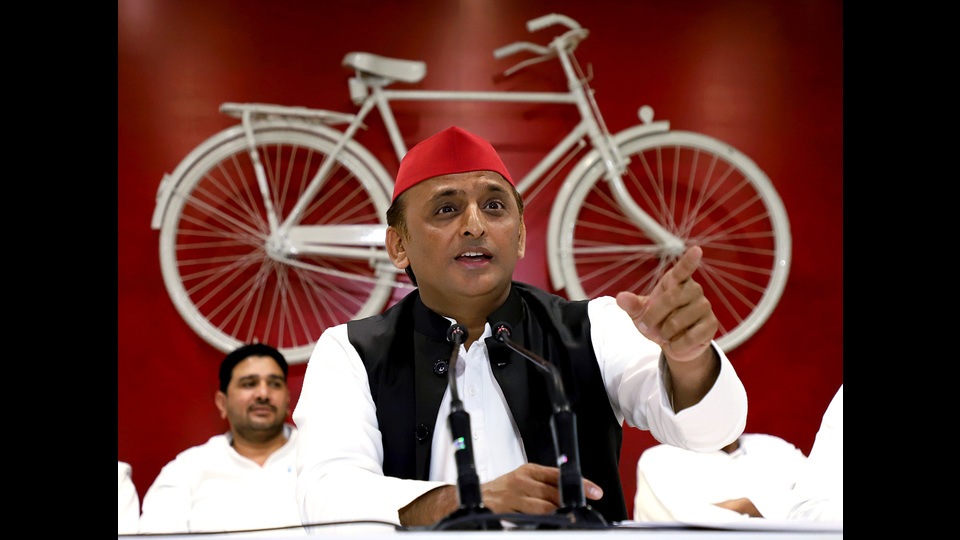
Understandably, the opposition in the poll-bound state of Uttar Pradesh was apprehensive that the ruling party would come up with some emotive and polarising plank just before the voting due sometime in February-March 2022.
Hence, when Akhilesh Yadav chose to kick off his electoral campaign by praising Mohammad Ali Jinnah, the entire political ecosystem was taken by surprise, including his own voters who are finding it difficult to defend the rhetoric in public and private discussions. Even the BJP was caught off-guard for the moment but it is a safe bet that the issue will keep recurring in the political debate for the next five months.
Jinnah’s enigmatic personality has been restricted to his role in the partition which led to the creation of Pakistan, and rightly or wrongly, his genius has been channelised down solely to the “two nation theory”, which expounded that Hindus and Muslims are two different nations and cannot exist together.
Any attempt to see the man beyond his established credentials has not gone down well with the Indian public. Adventurism by stalwarts such as LK Advani and Jaswant Singh in this regard only ended up landing them into political wilderness.
Hence, it was bewildering to watch Akhilesh Yadav credit Jinnah with independence from British clubbing him with giants like Mahatma Gandhi, Jawaharlal Nehru and Sardar Patel. It is evident that this was not a slip of tongue as he went on to defend his stand telling the journalists to “read the history books again” in a subsequent press conference.
Now, anyone conversant with the political scenario in the country instinctively would tell you that Akhilesh Yadav was playing to his Muslim vote bank — even if it is not clear why any politician thinks Indian Muslims have any sympathy for Jinnah. But if one was to assume this was the motive, it is still intriguing, for Muslims in the state are already solidly behind the Samajwadi Party as all other ‘secular parties’ are not even in the race.
Notwithstanding the Priyanka Gandhi bravado, the Congress stands decimated in the state and the only other claimant for the minority vote, the Bahujan Samaj Party, seems a non-starter and is heading for an electoral disaster unless Mayawati manages to come up with a political understanding with the BJP in the coming assembly polls.
In spite of being labeled as the drawing-room politician, the Akhilesh Yadav-led coalition is the only political force which can put up any challenge to the ruling dispensation in the state. Ironically, he was never placed so comfortably viz a viz the minority vote, which right now finds him as its only hope to send packing a government the community believes is “anti-Muslim”.
And that is why political pundits are finding Yadav’s new-found obsession with Jinnah not only uncalled for, but also inexplicable.
The only reason that can explain the strategy is the Owaisi factor. Dubbed as the B-team of BJP and seen as “Vote-Katwa” (the divider of secular vote), Asaduddin Owaisi is slowly but surely making inroads in the minority community, especially the younger lot. As he himself mentioned in an interview, Muslims in UP love him but believe that a vote for AIMIM is in effect a vote for BJP.
Nevertheless, he has been quick to capitalise on the feeling of the community which believes that it has been let down by Akhilesh Yadav on a number of occasions, especially when the Samajwadi party seemed to desert Azam Khan as he was hounded by the Yogi government. Pictures of a visibly sick and frail Azam shook the community, which had a lot of faith in the arrogant persona of the leader who didn’t even hesitate to call Mulayam Singh names during the brief period he fell out with the party. Muslims believe that Akhilesh Yadav abandoned Azam just when he needed him the most.
Muslims also believe that Yadav didn’t bother hitting the streets even as men from the minority community were being targeted in the name of cow vigilantism. They call him a good chief minister but a weak opposition leader who, unlike his father, is afraid to stand with them fearing a backlash from the majority community.
Owaisi, on the other hand, is seen as a bold leader who is not shy to flaunt his Islamic credentials but is also willing to stand with the community in their hour of need. A segment of the minority believes that the politics is too polarised presently for the secular forces to beat BJP and they are actually voting for a strong opposition. And they find Owaisi much stronger to take on the government as compared to Akhilesh Yadav.
This is the comparison which is giving nightmares to Akhilesh. If an increasing number of Muslims get convinced that SP cannot deliver, they may well desert him and walk over to the charismatic barrister from Hyderabad, who is fast emerging as the first ever pan-Indian Muslim leader post-partition.
Desperation seldom ever leads to sound decisions. If Akhilesh Yadav thought that he could hit the election trail eulogising a controversial figure from history and move on to regular issues, he has a lesson in politics coming his way. The debate has just begun.
Anupam Mishra is a Prayagraj-based journalist and editor
The views expressed are personal


