
 E-Paper



Why the suspension of MPs may need to be reconsidered
If India is the mother of democracy, it becomes an obligation to ensure that conditions are created for the smooth functioning of Parliament

 Prefer HTon Google


A fairly large number of members of the Rajya Sabha (23) were suspended last week for obstructing the proceedings of the House. Earlier, the Lok Sabha suspended four members for the remaining period of the session for the same reason (but revoked it on Monday). Of course, the period of suspension is much shorter in the Rajya Sabha but it is unusual for the House to suspend members in such large numbers. Former Lok Sabha speaker Somnath Chatterjee had famously declared that he would never suspend a single member because he didn’t want Parliament to emulate some of the state assemblies where suspension was a regular feature. Though members are suspended to enforce discipline, there is no empirical evidence that such action improves conduct in the House. Instead, suspensions often aggravate the situation and harden the attitude of some Members of Parliament (MPs).
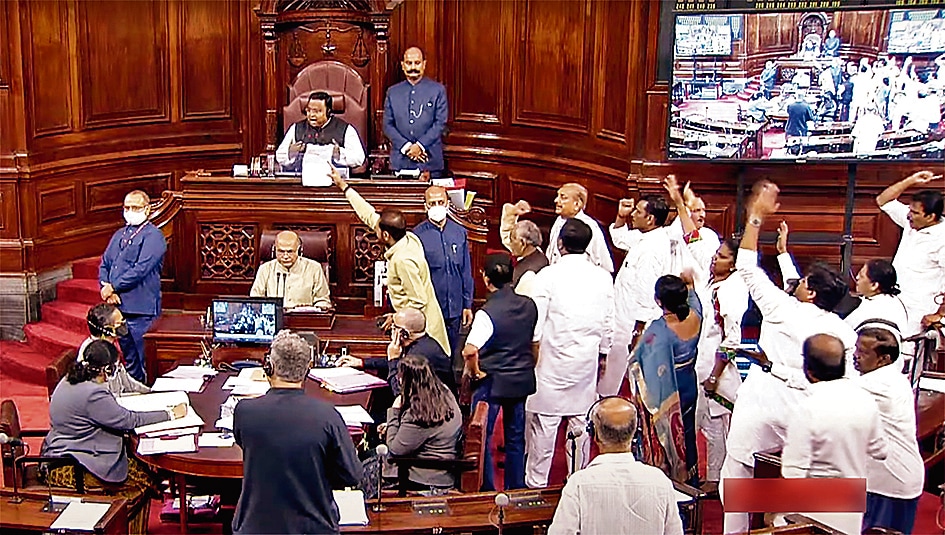
Usually, Opposition MPs protest when they feel the government is refusing to discuss various issues of public importance. But in this case, the government publicly said it was prepared for a discussion on price rise and other issues. This seems to suggest that part of the problem is that a clever arrangement of government business crowds out such discussion. It is the government that has to find time for such non-government business. Sometimes, because of the large volume of government business, it may not be possible to accommodate non-governmental business such as discussions on issues of public importance. If a government does not want too many discussions in the House and incurs adverse publicity, it will quietly increase the legislative business in a session, effectively ensuring little or no time for such discussions. So, while the government can go on assuring the Opposition of debates, in reality, the transaction of government business might ensure that no time is available for much of the non-governmental business, such as a discussion on public issues. Moreover, some issues may be outrightly rejected by the government in the name of sensitivity. Thus, a lack of time and refusal by the government to allow debates precipitate a strong reaction from the Opposition. The continued harassment of Opposition leaders by investigative agencies, the toppling of governments, and other political issues become further irritants in the relationship between the government and the Opposition. This, added to the fact that the government has a comfortable majority in the House and adopts what the Opposition considers an imperious attitude, creates a kind of helplessness, triggering obstructions.
In its early years, Parliament used to function smoothly because governments would try to accommodate the urgent demands of the Opposition for debates on important issues as much as possible. Democratic impulses and a strong urge to strengthen the system made it possible for leaders and parties to understand each other and accommodate their needs. Jawaharlal Nehru made it a habit of being present in the House when leaders of the Opposition spoke. Atal Bihari Vajpayee once said that Nehru congratulated him in the lobby of the House after he launched a searing attack on Nehru. In fact, Nehru wanted the Opposition to be given more time so that they could have their full say in the House. This was the early phase of Parliament – characterised by more civilised interactions and discourse.
What ails Parliament today is the complete breakdown of trust between the government and the Opposition. The initiative for restoring that trust should certainly come from the government. Failure to do so can only prolong this crisis. The helplessness of the people in the face of their Parliament atrophying is a sign of the imperfection of our democracy. The frequent suspension of MPs in large numbers, though permitted by the rules, is also a manifestation of that imperfection. As a matter of fact, the rule does not compel the Chair to suspend a member. It simply says such a course of action can be taken only if the Chair deems it necessary. The rule further says that if there is grave disorder, the Chair may adjourn the House for a short period. It does not say that members in large numbers should be suspended. It can also be argued that the rule for summary suspension of members in the Lok Sabha’s Rule Book, in substance, violates Article 100 (1) of the Constitution, which mandates that every question shall be determined by a majority of votes of the members present and voting. Summary suspension is done without seeking the vote of the House.
The unseemly scenes of members rushing to the Well of the House, tearing up papers and throwing them at the Chair, thrusting placards in his face are unacceptable in a civilised democracy. Such actions detract from the genuineness of the cause of the Opposition. Being slighted or stonewalled by the government is not sufficient justification for showing disrespect to the Chair.
Viewed from every angle, the large-scale suspension of MPs misses the “largeness” of the largest democracy in the world. If we claim that India is the mother of democracy, it becomes an obligation to ensure that conditions are created for the smooth functioning of Parliament. The people of India expect this from the political class.
PDT Achary is a former secretary-general of the Lok Sabha
The views expressed are personal


