
 E-Paper



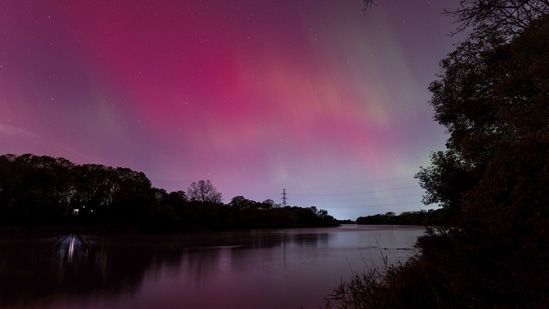
‘Greatest show on Earth’: Northern Lights bring a medley of colours far south than normal
Last night, the Aurora Borealis was at her absolute best, painting the night sky over various regions in myriad hues.
Published on: Oct 12, 2024 11:32 AM IST


Share via


Copy link

1/7
 View Photos in a new improved layout
Published on Oct 12, 2024 11:32 AM
Aurora Borealis, or as they are also known, northern lights, illuminate the sky in Haldimand County, near Caledonia, Ontario, Canada. (REUTERS)
2/7
 View Photos in a new improved layout
Published on Oct 12, 2024 11:32 AM
Another in a series of unusually strong solar storms hitting Earth produced stunning skies full of pinks, purples, greens and blues farther south than normal, including into parts of Germany, the United Kingdom, New England and New York City. (REUTERS)
3/7
 View Photos in a new improved layout
Published on Oct 12, 2024 11:32 AM
“It was a pretty extensive display yet again,” said Shawn Dahl, a space weather forecaster at the U.S. National Oceanic and Atmospheric Administration's Space Weather Prediction Center. (REUTERS)
4/7
 View Photos in a new improved layout
Published on Oct 12, 2024 11:32 AM
Chase and Waldo the donkey, animals at TEAD Therapeutic Riding Centre, eat hay as the Aurora Borealis, or as they are also known, northern lights, illuminate the sky near Hamilton. (REUTERS)
5/7
 View Photos in a new improved layout
Published on Oct 12, 2024 11:32 AM
NOAA issued a severe geomagnetic storm alert on Wednesday after after an outburst from the sun was detected earlier in the week. Such a storm increases the chance of auroras — also known as northern lights — and can temporarily disrupt power and radio signals. (REUTERS)
6/7
 View Photos in a new improved layout
Published on Oct 12, 2024 11:32 AM
The sun sends more than heat and light to Earth — it sends energy and charged particles known as the solar wind. But sometimes that solar wind becomes a storm. The sun's outer atmosphere occasionally “burps” out huge bursts of energy called coronal mass ejections. They produce solar storms, also known as geomagnetic storms, according to NOAA. (AP)
7/7
 View Photos in a new improved layout
Published on Oct 12, 2024 11:32 AM


