
 E-Paper



Photos: Hong Kong’s borderlands, a doorway to the past
More than two decades after Hong Kong returned from British to Chinese rule in 1997, a long border fence still threads between mainland China and the city today. Far from the marches and salvos of tear gas and petrol bombs over the past half-year of anti-government protests that have convulsed Hong Kong, the residents in this border realm have borne witness to both rapid urbanisation as China booms, as well as the preservation of a slower pace of life.
Updated on: Jan 7, 2020 2:37 PM IST


Share via


Copy link

1/10

 View Photos in a new improved layout
Updated on Jan 7, 2020 2:37 PM
Andrew Kwok returns home from fishing to his farmhouse in Lok Ma Chau village in Hong Kong. Shenzhen’s high rise building can be seen in the distance. More than two decades after Hong Kong returned from British to Chinese rule in 1997, a long border fence still threads between mainland China and the city. (Kim Kyung-Hoon/REUTERS)
2/10
 View Photos in a new improved layout
Updated on Jan 7, 2020 2:37 PM
A woman and child look through the border fence in Shenzhen towards Hong Kong. Far from the marches and salvos of tear gas and petrol bombs over the past half-year of anti-government protests that have convulsed Hong Kong, residents in this border realm have borne witness to both rapid urbanisation as China booms, as well as the preservation of a slower pace of life. (Tyrone Siu/REUTERS)
3/10
 View Photos in a new improved layout
Updated on Jan 7, 2020 2:37 PM
Mr. Lam, now in his 80s, lives in a house without mobile phone reception, where he farms and catches crabs. A narrow sliver of water separates him from mainland China. He recalls living in a wooden cabin along the ‘Shenzhen river’ with his family 70 years ago. There were only “old and broken” sheds on the far shore back then, he told Reuters, gazing into the distance. (Kim Kyung-Hoon/REUTERS)
4/10
 View Photos in a new improved layout
Updated on Jan 7, 2020 2:37 PM
Lam’s wife tends to vegetables she has grown in her field. About 30km long, this boundary meanders between fish ponds, farmland, sleepy villages and grassy hills on the Hong Kong side, with the gleaming skyscrapers of Shenzhen on the other. Shenzhen, once itself the rustic backwater, has risen into China’s vision of a digital, high-tech future. (Kim Kyung-Hoon/REUTERS)
5/10
 View Photos in a new improved layout
Updated on Jan 7, 2020 2:37 PM
A mirror reflects people going through immigration checks at Lo Wu Immigration control point in Hong Kong. Over past decades of political upheaval in China, waves of mainlanders flooded across the border into Hong Kong, seeking peace and a better life. Mr. Lam still remembers the flashlights of the British-run police piercing the dark as they chased illegal immigrants making a dash for freedom. (Kim Kyung-Hoon/REUTERS)
6/10
 View Photos in a new improved layout
Updated on Jan 7, 2020 2:37 PM
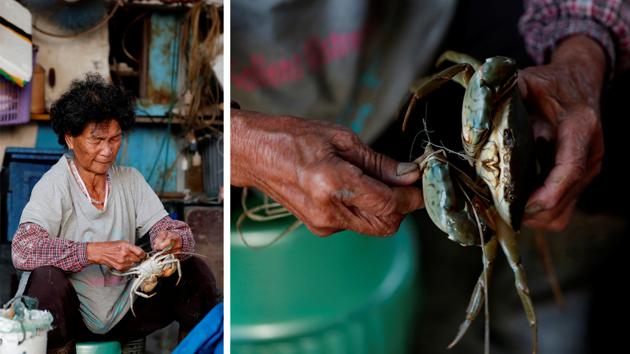
Leung Wong-hing wraps straw around a crab which she caught with her husband earlier that day in Shenzhen Bay, at her house in Hang Hau village in Hong Kong. Andrew Kwok, an old fish farmer living in the area, recalls those who drowned making the perilous crossing. “There were a lot of them, hundreds of dead bodies in the river,” he told Reuters. (Kim Kyung-Hoon/REUTERS)
7/10
 View Photos in a new improved layout
Updated on Jan 7, 2020 2:37 PM
Shenzhen River, the border river that divides Hong Kong on the left and Shenzhen city on the right. The flickering, lonely torches have now been replaced by a vibrant mega-city with a million flashing lights. The living quality for people on both sides may have converged, but a gulf remains. For these two peoples, it remains a struggle to reconcile shifting eras, values and dreams. (Tyrone Siu/REUTERS)
8/10
 View Photos in a new improved layout
Updated on Jan 7, 2020 2:37 PM
Merrin Ke (bottom, right), a Hongkonger born to mainland parents, poses for graduation pictures with her classmates in Hong Kong. Ke, 23, grew up in Shenzhen but got her master’s degree from Hong Kong’s Polytechnic University. She had flitted easily between both sides up until recently, when she moved to Shanghai. (Tyrone Siu/REUTERS)
9/10
 View Photos in a new improved layout
Updated on Jan 7, 2020 2:37 PM
Merrin Ke boards a train to the Hong Kong-Shenzhen border, in Hong Kong. “I think the situation in Hong Kong is quite sensitive now, which is easy for people to have conflicts due to different political stands. That’s why I’ve decided to leave Hong Kong to work and get away from the intense environment.” (Tyrone Siu/REUTERS)
10/10
 View Photos in a new improved layout
Updated on Jan 7, 2020 2:37 PM


