E-Paper



Pickleball courts emerge as luxury housing’s new selling point to woo young buyers, expanding from rooftops to basements
Real estate developers are converting rooftops and basements into pickleball courts, making the sport a key lifestyle differentiator in premium housing projects

 Prefer HTon Google


From underused rooftops and podium slabs to vacant plots and even basements, real estate developers are repurposing low-utility areas into pickleball courts as the sport gains traction among young homebuyers. What began as a niche recreational activity has become a marquee amenity in both premium and mid-segment housing projects, reflecting a broader shift in buyer preferences toward active, community-driven living, experts say.
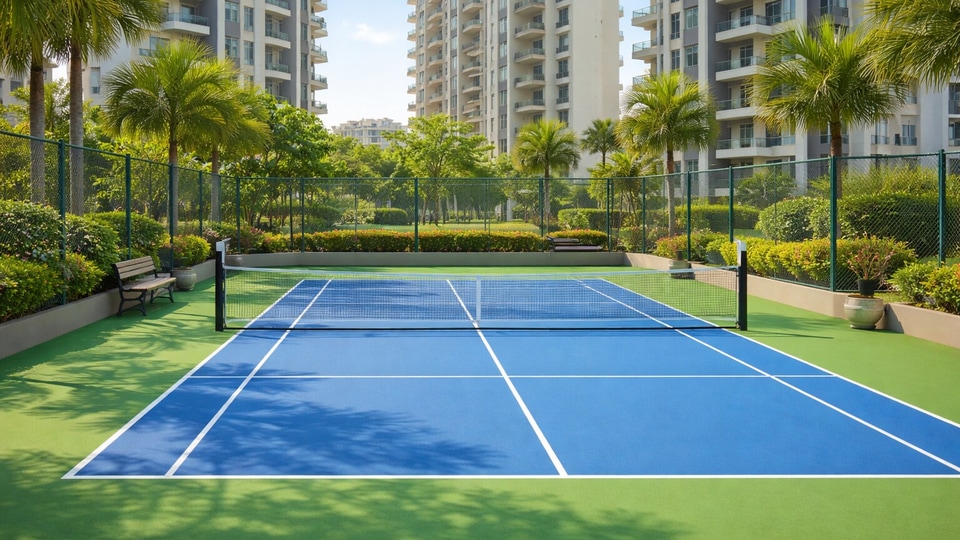
Invented in 1965 on Bainbridge Island, Washington, by Joel Pritchard, Bill Bell and Barney McCallum, the sport was declared the official state sport of Washington in 2022. Today, it is played in over 80 countries and has seen sharp growth in India, particularly in metros such as Mumbai and Bengaluru, Gundeep Singh, founder of proptech company Simplease, wrote on LinkedIn.
“Developers are now positioning pickleball courts as a key differentiator rather than just another amenity. The bigger takeaway is that amenity relevance now has a shelf life, pushing builders to design flexible spaces that can evolve every 5-10 yrs, since what works today may not matter a decade from now,” Singh wrote.
Real estate experts say that while pickleball has not yet broadly replaced tennis or squash, its compact footprint and lower cost make it a more practical choice in many gated communities. “Some courts (notably outside India) are even converting tennis spaces to pickleball due to usage patterns; this efficiency appeal is influencing developers here too,” Ritesh Mehta, Senior Director, Residential Advisory Services, India, at JLL, told Hindustan Times Real Estate.
Recently, Hiranandani Group’s Niranjan Hiranandani said Regalia Business Parks’ association with the CXO PickleBall League underscores how pickleball is emerging as a platform to bring business leaders together beyond boardrooms. The company is currently constructing a pickleball court as part of the Eastbridge project in Regalia Business Park, Vikhroli.
From branding experiment to lifestyle essential
Real estate experts say pickleball is steadily moving beyond being a marketing novelty for developers.
“Our association with the CXO PickleBall League, powered by Regalia Business Parks and Grav8 Sports, with Saina Nehwal as Brand Ambassador, reflects this vision of blending business, sport and wellness to build meaningful professional connections,” Hiranandani said.
“Pickleball is not yet a baseline amenity in mid-segment housing, but it is increasingly used as a lifestyle differentiator in premium and luxury projects,” Mehta said. In cities like Mumbai and Bengaluru, he noted, developers are positioning it as a signal of active, modern living rather than merely ticking an amenities checklist.
At Bengaluru-based Brigade Group, the sport is transitioning from a premium add-on to a broader value proposition. “It started as an amenity in premium developments and is now fast becoming standard in larger townships and even mid-segment projects,” Viswa Prathap Desu, COO – Residential, said. He pointed out that while a pickleball court alone may not close a sale, buyers increasingly ask for sporting infrastructure during site visits.
Anil RG, Managing Director of Concorde, said the company introduced courts at the project Concorde Abode 99 nearly four years ago, well before the current surge in popularity. That early adoption, he said, demonstrated strong resident engagement. “Like gyms and yoga decks once did, pickleball is moving toward becoming an integral part of active, community-focused living,” he observed.
Similarly, Sarthak Seth, CSMO at Tata Realty and Infrastructure Ltd., described pickleball as part of a broader ecosystem of active lifestyles. Newer projects, he said, are integrating courts at the design stage rather than retrofitting them later, citing their project Varnam Phase 1 in North Bengaluru as an example.
Also Read: Housing society swimming pools: Should you pay a premium for an amenity that you might never use?
Space efficiency and higher return on investment in ‘awkward’ areas
Experts say that pickleball courts are delivering value by activating podiums, rooftops, basements and leftover plots. Singh pointed out that 'awkward' places, which once struggled to justify their cost, are reshaping how value creation is viewed in real estate assets.
One of pickleball’s strongest advantages is spatial efficiency. A standard court measures 44 by 20 feet, significantly smaller than a tennis court, making it easier to integrate into dense urban projects.
“Pickleball hasn’t replaced tennis or squash outright,” Mehta said, “but its compact footprint and lower cost make it a more practical choice in many gated communities.” Internationally, some underutilised tennis courts are already being converted to pickleball, a trend that is influencing Indian developers as they evaluate usage patterns.
Experts say the sport is particularly suited to activating spaces that previously struggled to justify their cost, such as podium decks, rooftop terraces, or irregular leftover plots.
“At Prestige Group, we focus on embedding such features within landscaped podiums or dedicated wellness zones, ensuring they complement the design language rather than disrupt it. In a city like Bengaluru, where space optimisation is crucial, we work closely with our architects to ensure every leisure space, including a pickleball court, contributes to the overall aesthetic and social fabric of the development,” Praveer Shrivastava, Senior Executive Vice President – Residential, said.
Developers are also paying attention to acoustics and layout at the planning stage, moving away from ad-hoc retrofits toward purpose-built integration.
Pickleball can become a key differentiator among developers in key micro-markets
Including a pickleball court in a residential project can positively influence buyer perception and interest. Still, experts say it is not powerful enough on its own to guarantee faster sales or project success. While data linking pickleball to faster sales velocity remains limited, most developers agree it enhances project positioning in competitive micro-markets.
“Sales velocity depends on multiple factors, but forward-looking amenities like this strengthen buyer engagement,” Anil RG, Managing Director, Concorde, said. “In competitive micro-markets, such forward-looking amenities often strengthen buyer engagement and help projects stand out, particularly among younger, wellness-conscious homebuyers.”