
 E-Paper



A Nobel for illuminating life’s asymmetry
And achieving a feat of chemical synthesis not seen for 4bn years


 Prefer HTon Google


ASK A CHEMIST to describe human hands, and the odds are she will say that they are chiral. What is meant by this is that although a left hand may be a perfect mirror image of a right hand, there is no amount of rotation of the one that will transform it into the other. Many molecules essential to life share the same property, capable of existing in two forms that should, at least theoretically, exist in the universe in equal quantities. And yet biology is ruthlessly selective. When it comes to living organisms, amino acids are generally left-handed; sugars are right-handed.
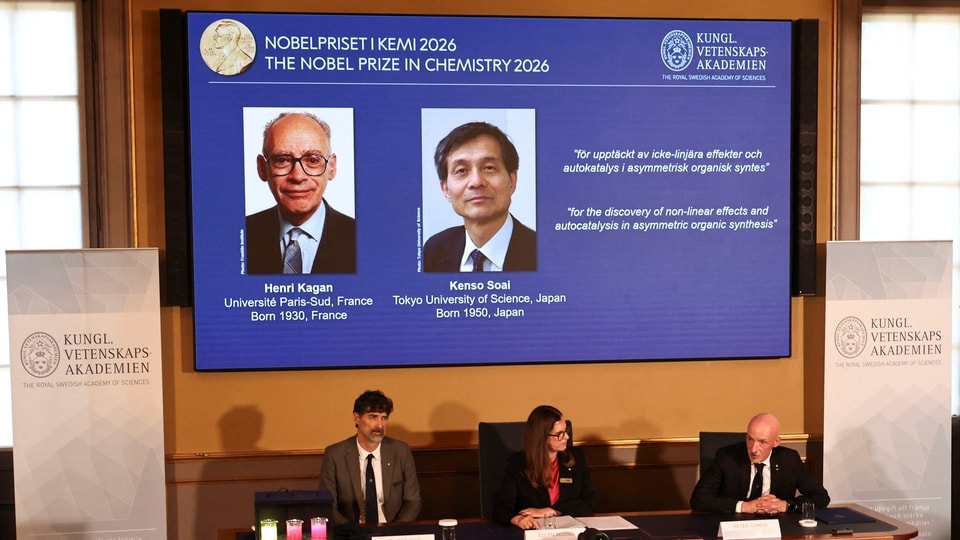
It is for progress towards understanding how such asymmetry might have come about that Henri Kagan, of the University of Paris-Saclay, and Soai Kenso, of the Tokyo University of Science, were awarded this year’s Nobel prize in chemistry. As a member of the prize committee explained on Wednesday, Dr Soai’s discovery of a reaction that spontaneously produces asymmetric outputs was an earthly innovation unparalleled since the emergence of life 4bn years ago.
Chemists had been able to selectively produce molecules of a given chirality before. All such reactions, however, depended on a chiral catalyst, often made up of an unequal mix of left- and right-handed molecules. The working assumption was that the ratio of left- to right-handed molecules in the reaction’s products would match the ratio in the catalyst itself. This posed a problem: if the reaction could only match the asymmetry of the catalyst, how could the large-scale asymmetry seen in organic molecules emerge?
In 1986 Dr Kagan refuted that working assumption. In experiments, he showed that a chiral catalyst in which left-handed molecules were three times as abundant as right-handed ones produced a solution with a six-fold imbalance. This showed that chiral catalysts could produce solutions with greater asymmetry than they themselves possessed.
The effect discovered by Dr Kagan was powerful but not self-sustaining. Insert one such catalyst into a solution, in other words, and it could deliver only a one-time boost to its chirality. How, then, could the near-total symmetry of inanimate matter be transformed into the near-total chirality displayed by life?
It was Dr Soai who bridged the gap. In work published in 2003, he demonstrated that solutions with a minuscule imbalance of chiral molecules could be engineered so as to produce catalysts with increasing chirality. This self-amplification could produce rapid change. Repeating a reaction only three times, for example, allowed Dr Soai to go from an almost perfectly balanced solution to one that contained more than 99.5% of one chiral molecule—a 630,000-fold increase in the asymmetry of the solution.
The Soai reaction, as it is now known, is not the way that life’s chirality emerged. For one thing, the reagents that Dr Soai used were artificial and could not have existed 4bn years ago. But researchers are continuing to look for biologically relevant equivalents. Such a discovery may one day prove worthy of a Nobel prize of its own.


