
 E-Paper



Behind the ISL’s perfect bio-bubble
Here’s a look at how India’s premier football league ran a complicated bubble structure without a misstep for the duration of the season that was played entirely in Goa.


It took 18 bio-bubbles in 14 hotels and nearly 70,000 RT-PCR tests—the gold standard of Covid-19 detection—on 1635 people, meaning they were tested nearly 50 times (every three days for over five months), to pull off the seventh season of the Indian Super League (ISL).
The number of positive tests? Zero.
Here’s a look at how India’s premier football league ran a complicated bubble structure without a misstep for the duration of the season that was played entirely in Goa, spending Rs17 crore on tests and related costs—like buying 26,000 N95 masks, according to a media release.
Nearly 200 vehicles from outside Goa were sourced for teams and league staff to ensure bubble compliance, said a league official. The official, who didn’t want to be named as he is not authorised to speak to the media, said he drove back to Mumbai in the car he was assigned on entering the bubble in December.
Also read: The European connection in ISL dominance
There were four tiers in the bubble which included one hotel in Mumbai where a broadcasting team was based. Players and match officials were in tier 1; league staff in tier 2; club operations officials and other vendors in tier 3; groundstaff and others in tier 4. The tiers were insulated from each other.
“So, everyone including housekeeping and drivers of team coaches, restaurant staff catering to one tier stayed in the same bubble,” said the official. Unlike the Indian Premier League which had outsourced creating the bubbles in UAE, there was no external agency involved in Goa, said the official. The eight-team IPL ran from September 19 to November 10 last year and recorded 14 positive cases before they were isolated and the rest of the tournament managed to stay secure. ISL7 had 11 teams and began on November 20, ending on March 13.
Also read: From bit player to key forward, the rise of Bipin Singh
Based on recommendations of its medical team, the league recced around 20 hotels in Goa and gave the teams a list to choose from. The teams were spread over 10 hotels—FC Goa and Bengaluru FC shared one as did Chennaiyin FC and Odisha FC—and a hotel each was dedicated for officials of the league, match officials, operations units of all 11 clubs and the broadcasters. Each hotel had an isolation ward where team doctors could monitor patients. On testing negative, the person could re-enter the bubble after a fortnight’s quarantine.
That was the protocol followed for Mandar Rao Dessai when he rejoined Mumbai City FC after his father’s death. “We have lived very hard moments. One player lost his father and (had to) come back to the hotel and do a quarantine for 14 days alone in a room,” said Mumbai City FC coach Sergio Lobera in an interview posted on the team’s Twitter handle on Saturday. The team’s goalkeeping coach lost his mother and returned from Spain and had to be quarantined, said Lobera.
Kerala Blasters coach Kibu Vicuna’s mother died in December but the coach chose to stay in Goa (he was later sacked during the season).
To deal with cabin fever, SC East Bengal had psychologist and consultant for Premier League clubs Nicola McCalliog on Zoom calls from Manchester. Teams also set up recreation rooms—FC Goa had an F1 simulator in theirs—and allowed players and staff to have families in the bubble.
“I have been lucky to have my wife so we have got something to talk about apart from football,” said ATK Mohun Bagan striker and Golden Ball winner Roy Krishna at Friday’s media conference.
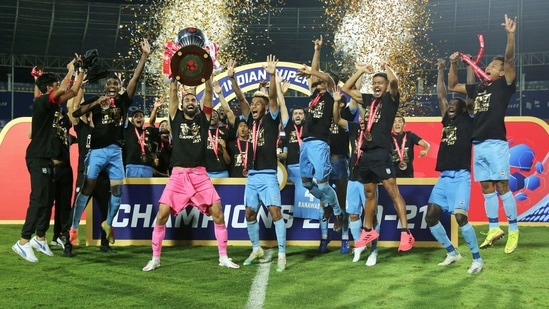
Also read: Late Bipin Singh goal hands Mumbai City FC maiden ISL title
Liston Colaco, the Hyderabad FC midfielder, has his family living an hour away but for the first time in his 22-year-life couldn’t meet them for nearly six months.
“What I miss most is the food cooked by my mother. Rice and fish curry,” he said.
Bagan’s Sandesh Jhingan said his central defensive partner Tiri spent a lot of time on video calls with his son. Along with Bagan coach Antonio Lopez Habas and his technical staff, Tiri reached Goa on October 4. Before leaving home, Tiri had posted on Instagram that this “has been the most difficult farewell of my life.”
In a separate interview, Hyderabad FC coach Manuel Marquez said: “We are playing good football and fighting for the top four till the end of the competition. I can imagine how difficult it is for teams in worse positions than us.” With a number of young Indian players, Hyderabad FC narrowly missed out on a semi-final berth.
“It’s hotel, training session, training session, hotel, hotel, stadium, stadium, hotel. Now we cannot swim, cannot go to some parts of the hotel…the monotony is very difficult. You play every four or five days and maybe in another team in this kind of situation, you will give the players two days off. But two successive days off in a hotel is nonsense. It is better for instance one day off, train, another day off in the same week,” said Marquez.
Keen to get his new team to play his way, Lobera said he tried to take advantage of being 24x7 with players by doing a lot of meetings and video sessions.
Marquez said he and his squad got through because of team spirit. Deep fraternal feelings were also spoken about by Lobera—“you are playing with your teammate but you are playing with your brother who has lived with you for five months,” said the Mumbai City FC coach before the final.
On Monday, asked how he celebrated the ISL title, Lobera said: “With our family here. And now, ready to take a flight to Spain and enjoy with my other family there.”


