
 E-Paper



How Spain 2026 evolved beyond 2010 champions without abandoning their footballing identity
Spain 2026 evolved beyond the 2010 champions with more goals, greater width, deeper options and the same possession-first identity that shaped an era of glory.

 Prefer HTon Google


Spain’s two World Cup-winning teams were separated by 16 years, different generations and radically altered tournament formats. Yet their campaigns carried some striking parallels.
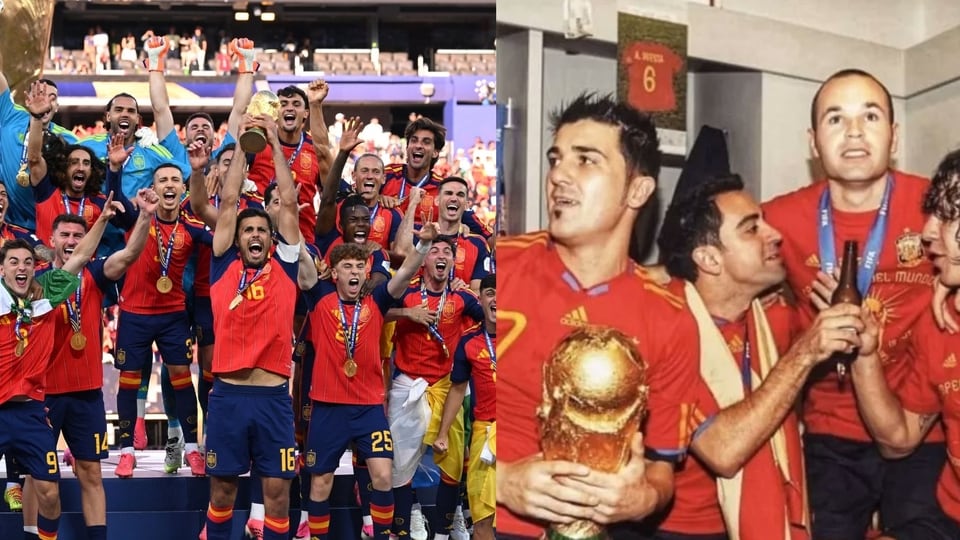
Both entered the World Cup as reigning European champions. Both began unconvincingly. Both gradually became almost impossible to score against. Both defeated Portugal 1-0 in the knockout rounds, and both won the final 1-0 after extra time, with substitutes playing decisive roles against opponents reduced to 10 men.
The similarities, however, largely end with the results. Spain’s 2010 champions represented the purest version of possession football. The 2026 winners were its modern evolution: quicker, wider, more physically aggressive and tactically flexible.
Two difficult starts followed by complete control
Spain’s 2010 campaign began with a stunning 1-0 defeat to Switzerland. Vicente del Bosque’s side dominated possession but failed to translate control into goals, immediately placing the tournament favourites under pressure.
They recovered by beating Honduras 2-0 and Chile 2-1 before progressing through four consecutive knockout matches by the same 1-0 scoreline. Portugal, Paraguay, Germany and the Netherlands were each defeated without Spain conceding once.
The 2026 team also stumbled in their opening match, drawing 0-0 with Cape Verde. Luis de la Fuente’s side then responded more emphatically, beating Saudi Arabia 4-0 and Uruguay 1-0 before beginning a five-match knockout run.
Austria were dispatched 3-0, Portugal edged 1-0, Belgium beaten 2-1, and France defeated 2-0 before Spain overcame Argentina 1-0 after extra time in the final.
The expanded format meant the 2026 champions played eight matches rather than seven. They finished unbeaten, scoring 14 goals and conceding only once. Spain’s 2010 side scored eight and conceded two, with their eight goals remaining the fewest by any World Cup winner.
Possession remained the foundation, but its purpose changed
The 2010 team used possession primarily as a form of protection. Sergio Busquets and Xabi Alonso sat beneath Xavi Hernández, while Andrés Iniesta moved infield from the left. Spain patiently circulated the ball, denied opponents opportunities to counterattack and waited for defensive structures to weaken.
Their football was intricate and remarkably secure, but often narrow and cautious. The double pivot gave Spain defensive stability while reducing the number of players attacking the penalty area. They dominated matches without regularly producing large volumes of clear chances.
Spain 2026 retained the same technical foundation but attacked with greater speed and width.
Rodri dictated play from midfield, but he was surrounded by more mobile options. Pedri, Fabián Ruiz and Dani Olmo could operate between the lines, while Lamine Yamal, Álex Baena and Nico Williams stretched defences from wide positions.
Mikel Oyarzabal frequently dropped from centre-forward into midfield, creating numerical superiority and opening space for wingers, full-backs and advancing midfielders.
The distinction was clear. Spain 2010 wanted to pass opponents into submission. Spain 2026 could do that, but could also counter-press, attack one-on-one, release their full-backs or accelerate vertically through a compressed midfield.
Also Read: Spain end Argentina's reign as Ferran Torres strikes in extra time to win World Cup after 16 years
David Villa’s goals against a more collective attack
Spain’s dependence on David Villa in 2010 was enormous. He scored five of their eight goals, including the winners against Chile, Portugal and Paraguay. Their attacking construction was collective, but their finishing was heavily concentrated around one player.
Only Villa, Iniesta and Carles Puyol scored for Spain during the tournament.
Oyarzabal also scored five goals in 2026, but Spain were far less reliant on him. Pedro Porro, Mikel Merino, Yamal, Baena, Fabián and Ferran Torres also found the net, while Saudi Arabia contributed an own goal.
Merino scored decisive late winners against Portugal and Belgium. Porro struck against Austria and France. Ferran came from the bench to win the final.
That distribution made the 2026 champions harder to contain. Opponents could not simply restrict one forward and expect Spain’s attacking output to collapse.
Different defensive methods, similarly ruthless results
Spain’s 2010 defensive unit was more celebrated individually. Iker Casillas captained the team behind Sergio Ramos, Gerard Piqué, Puyol and Joan Capdevila. Casillas saved a penalty against Paraguay and produced the defining stop of the final when he denied Arjen Robben.
The 2026 defence lacked the same collective reputation but produced superior tournament numbers.
Unai Simón kept seven clean sheets in eight matches behind Porro, Pau Cubarsí, Aymeric Laporte and Marc Cucurella. Spain conceded only once, against Belgium.
Their defensive strength began much higher up the pitch. De la Fuente’s side pressed immediately after losing possession, defended with an aggressive line and prevented opponents from progressing cleanly into attacking areas.
Spain 2010 defended through possession, compactness and elite last-line interventions. Spain 2026 defended through territorial control, coordinated pressure and rapid recovery.
Which Spanish champion was better?
Spain 2010 remain the more historically significant team. They won the country’s first World Cup, ended decades of international underachievement and formed the central chapter of an unprecedented Euro 2008, World Cup 2010 and Euro 2012 treble.
Their midfield also possessed a level of pure passing control that even the 2026 side could not completely reproduce.
But Spain 2026 produced the more complete World Cup campaign. They remained unbeaten, scored six more goals, conceded one fewer, won an additional knockout match and possessed greater variety in attack.
The first champions were the masterpiece that transformed Spanish football. The second were the upgraded machine that proved the same philosophy could survive, adapt and become even more complete.


