
 E-Paper



Why Cristiano Ronaldo's aura limits Portugal while Lionel Messi liberates Argentina
Despite the star names, Portugal have often looked less than the sum of their parts. Meanwhile, Argentina have performed like a collective.

 Prefer HTon Google


For nearly two decades, Cristiano Ronaldo and Lionel Messi have defined modern-day football. Their rivalry is also probably the greatest in the sport's history. The pair have rewritten history countless times and broken records. But as they approach the twilight of their careers, their national teams are in opposite directions. It isn't due to their greatness, but because of the environments around them.
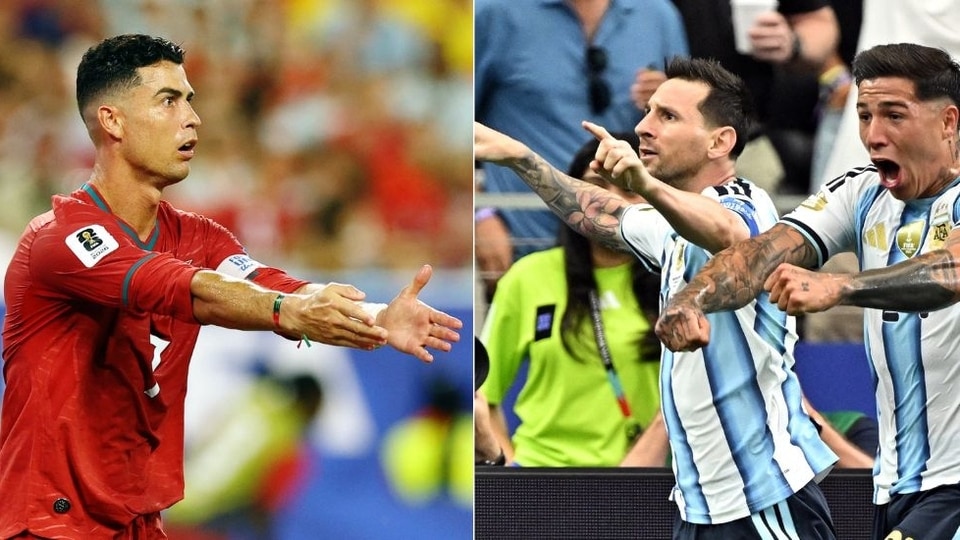
But fans have a different perspective. When Portugal struggles, the blame falls on Ronaldo. When Argentina flourish, Messi is hailed as the difference.
It isn't just Cristiano Ronaldo's fault
But the reality is very different. At the ongoing World Cup, Ronaldo is once again under scrutiny and fans and former players have also accused Roberto Martinez of his over-reliance on the veteran. Although Ronaldo was Portugal's highest-rated attacking player in the FIFA Power Rankings for the group stage, it is also due to Martinez's usage of the former Real Madrid player as a lone striker. But it isn't just Ronaldo's fault; the bigger disappointment has been their midfield.
On paper, Portugal has one of the best midfield units in Bruno Fernandes, Bernardo Silva, Joao Neves and Vitinha. They are technically gifted and can control games. Despite their quality, they have struggled in this World Cup. Portugal drew 1-1, and it was goalless against Colombia. Their only win in the group stage came against Uzbekistan in their debut World Cup campaign. Ronaldo managed a brace in a 5-0 rout.
In the group stage, it looked like Portugal were too focused on making Ronaldo their centrepiece, and were not performing as a collective. There was also a rift in the past between Ronaldo and Fernandes, stemming from the former's exit in his second Manchester United stint. It was visible in viral videos from Portugal's training sessions during the 2022 World Cup.
Against DR Congo, Portugal often bypassed Ronaldo during their build-up, relying more heavily on the flanks. Whether that reflected tactical instructions or natural chemistry is difficult to say, but it limited his influence.
Ronaldo also has high standards. If his teammates don't perform well, he lets them know, which could come across as egoistic for some. Managers also know that dropping Ronaldo invites criticism from fans and experts. These factors can influence how a team plays. Even opposition defenders know they can challenge Ronaldo now, given his age and lack of pace.
Argentina are an interesting contrast
For years, Argentina were accused of depending too heavily on Messi. That changed under Lionel Scaloni. The former player took a different route in his strategy. Instead of building every attack under their skipper, he built a team that can function independently of him, too. It was shown in Argentina's 2024 Copa America triumph. Messi was substituted off in the second half due to an injury, and his team clinched a 1-0 victory in extra time, courtesy of Lautaro Martinez.
Scaloni has built a team that includes top players such as Enzo Fernandez, Alexis Mac Allister, Julian Alvarez, Rodrigo De Paul, Emiliano Martinez, and Thiago Almada. They have clearly defined roles, which allow Messi to influence games without having to track back to defend. Unlike in the past, Messi also doesn't carry every single attacking responsibility. Although he is still the team leader, he looks freer and is not expected to solve every problem on his own.
It has once again been shown in this World Cup as Argentina topped their group. Messi scored a hat-trick in the opener, followed by a brace in the second fixture. Then in the third match, he came on as a substitute and converted a free-kick, taking his tally to six goals.
Legends don't win matches; World Cups are usually won by teams
Portugal can reach that level too. The squad is packed with players performing for elite European clubs. Fernandes was arguably Manchester United's talisman in their resurgence last season. Meanwhile, Vitinha and Joao Neves are PSG's spine in their back-to-back European success. Bernardo Silva is still one of the best creative midfielders, and Rafael Leao is an electric winger. Meanwhile, the defence is also filled with stars, especially Nuno Mendes, who is arguably the best left-back in the world right now.
Despite the star names, they have often looked less than the sum of their parts. It suggests that the issues run deeper, whether Ronaldo starts or sits on the bench.
Portugal's biggest challenge is not moving on from Ronaldo; it is a little too late to do that, especially in the middle of a World Cup campaign. It is about having a system that allows him to complement the team rather than become the focal point around which everything revolves. Legends don't win matches; World Cups are usually won by teams.


