
 E-Paper



India vs Pakistan: Familiar foes rekindle romance of hockey’s great rivalry
India's narrow win over Pakistan brought back the essence of the historic rivalry, the fierce spirit and nostalgic memories of the past

 Prefer HTon Google


Relief.
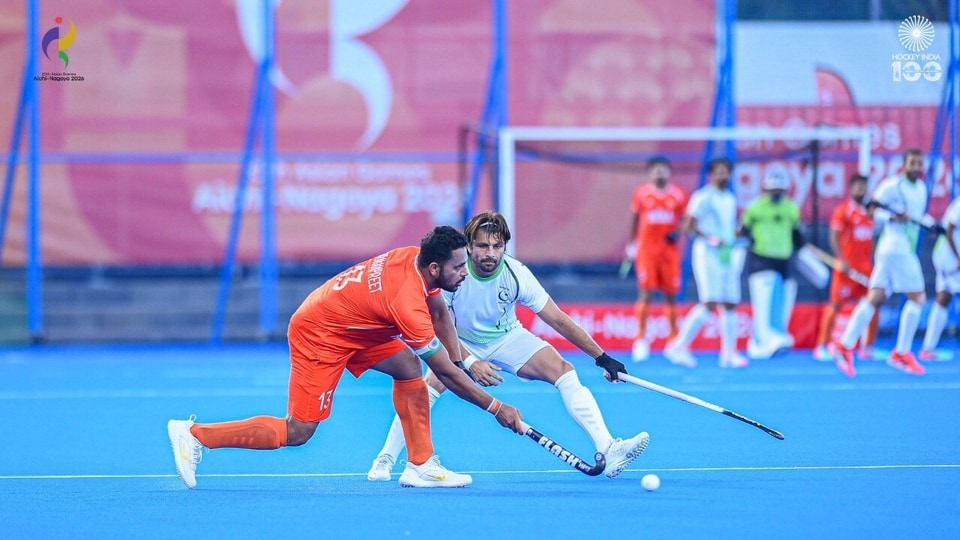
That was the sentiment of most Indian hockey fans after the Harmanpreet Singh-led team escaped with a narrow 4-3 victory over Pakistan following Abhishek’s goal 49 seconds from the hooter.
India vs Pakistan. This iconic clash carries a lot of weight: history, legacy, prestige and with a dash of enmity. But unfortunately, the contest has lost its competitive bite in recent years: reduced to one-sided matches and a rivalry that exists only in the name.
With the rise of Indian hockey and the decline of the game in Pakistan, there is no uncertainty about which team starts as favourite. India have not lost to their neighbours in a decade, with the last setback coming at the 2016 South Asian Games final in Guwahati. Since then, India have won 19 of the 22 matches, with two draws and one no-result.
But Thursday’s Asian Games semi-final in Kakamigahara rekindled the romance of the rivalry, the volatile passion of South Asia’s greatest sporting feud, the nostalgia-drenched memory of an epic rivalry that once ruled world hockey. The teams once played three Olympic finals, one World Cup final, and nine Asian Games finals.
In a throwback moment on Thursday, former centre-forward Ashok Kumar immediately remembered the 1975 World Cup final at the Merdeka Stadium in Kuala Lumpur, where Pakistan captain Islahuddin Siddiqui walked up to the him just moments before the start.
Also read: Great escape: Abhishek’s last-minute goal rescues India in thriller vs Pakistan
Standing opposite each other at the 50-yard line, Islahuddin made a request that captured the spirit and camaraderie of the era: “Ashok, gaana gao.”
Ashok looked back in utter surprise, reminding his rival that the summit clash was about to start. But Islahuddin only laughed. Seeing his opponent’s persistence, Ashok straightened his hockey stick, rhythmically started beating it and sang the popular track Jai Jai Shiv Shankar. “That just showed how confident the two teams were back then,” two-time World Cup winner Islahuddin had told this correspondent in an earlier interview. “There was mutual respect between the players too.”
That 1975 final ended in immortal glory for India. Ashok went on to score the winning goal — the most significant hit of his career — to give his team a momentous 2-1 victory, securing India’s first and only World Cup crown.
In that golden era, hockey was the pre-eminent sport in South Asia with India and Pakistan standing as absolute masters of the game, winning almost everything on offer. Yet, off the field, the fierce competitors shared an extraordinary bond.
“We shared a great relationship with some Pakistan players. We spent a lot of time together and also went for their weddings. Some of the players’ mothers would come to receive us at the airport too,” Ashok, son of Major Dhyan Chand, told HT.
Former India goalkeeper Ashish Ballal recalled how that camaraderie translated into a unique off-pitch dynamic during the 1990s, anchored by shared Punjabi heritage.
“In our times, most of the Pakistani guys were friendly with our Punjabi players. Most of the Pakistan players used to hang around with our Punjabi players, listen to Punjabi music and get smashed in the evenings,” Ballal told HT with a chuckle.
“The rapport was there. It was only on the ground that it was very aggressive with Punjabi lingo at its best. After matches we would sit down in the evenings, chat and drink at times. The next morning on the ground, you’d become aggressive again because everybody wants to win.”
Ballal confessed that non-Punjabi players like himself were initially offended by the colourful language thrown around during matches. “One day, they got us all together and told us, ‘Listen, even when we talk to our dads, we talk like this! It is a kind of fondness in our lingo.’ Today, when I speak with my old teammates, it comes automatically.”
On the pitch, though, the intensity was ferocious. Fights broke out, wrong-side tackles carried dangerous follow-throughs and both teams played with a wildly volatile unpredictability. But that aggression also brought out the excitement with moments of sheer magic of individual brilliance or at other times, mediocrity at its best.
Even as global dominance shifted towards European powerhouses and Australia in the 1990s and 2000s, individual stars kept the fixture spellbinding. Pakistan boasted icons such as Shahbaz Ahmed, Sohail Abbas and Rehan Butt while India had wizards such as Pargat Singh, Dhanraj Pillay and Dilip Tirkey in their ranks.
At the 2010 World Cup in New Delhi, 16,000 fans packed the Major Dhyan Chand National Stadium, the only contest of the tournament that saw a full house.
Former India skipper Sardar Singh, who captained India during high-stakes battles including their gold medal win at the 2014 Incheon Asian Games, stressed that mental strength was paramount in these fixtures.
“Ninety per cent of the matches were won by teams which were mentally stronger,” Sardar told HT. “When I was captain in Incheon, the crowd was very negative, abused us while we walked back to the stadium at half-time. What is important is to control your mind, stay relaxed and focus on the plan given by the coaches.”
Sardar fondly remembered playing alongside Pakistani stalwarts in the erstwhile Premier Hockey League (2005–2008), forging warm friendships with Shakeel Abbasi and Muhammad Saqlain.
In the past decade, however, the paths of the two nations diverged dramatically. Heavy investment flowed into Indian hockey which provided state-of-the-art infrastructure and top-level foreign coaches. This systemic overhaul returned India to the Olympic podium after a gap of 41 years, making them the only men’s team to medal at the last two Olympic Games.
Conversely, Pakistan’s hockey has plummeted. They failed to qualify for the last three Olympics and two of the last four World Cups. “Hockey culture has just suddenly died in Pakistan,” the legendary Shahbaz Ahmed, the only player to win back-to-back Player of the Tournament awards at World Cups (1990 and 1994), told HT last year.
Financial neglect further crippled Pakistani hockey. Ahead of the 2018 World Cup, the team barely secured travel funds at the 11th hour through a private sponsor. Former head coach Siegfried Aikman resigned in 2023 after going unpaid for an entire year.
However, Thursday’s clash reminded the world why this fixture remains unmatched.
From flashes of individual brilliance to sudden swings of momentum and raw emotional intensity, the contest showed that no matter how deep the structural divide grows, an India-Pakistan hockey match retains its unique, unpredictable magic, rekindling the timeless romance forged when two friends sang together on the Kuala Lumpur turf five decades ago.


