
 E-Paper



CWG 2026: What is Lawn Bowls? Rules, scoring and India's medal hopes explained
At Birmingham 2022, India's bowlers delivered a historic double, winning and gold and a silver.

 Prefer HTon Google


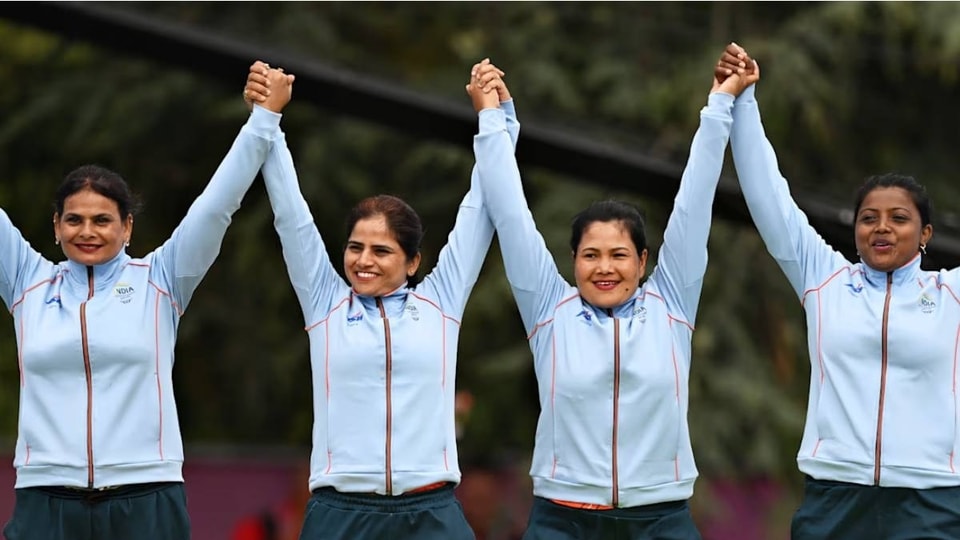
Lawn bowls rarely gets the attention that athletics, boxing or wrestling do in India. Yet it has quietly become one of the country's most dependable medal sources at the Commonwealth Games. At Birmingham 2022, India's bowlers delivered a historic double: the women's fours team of Lovely Choubey, Pinki, Nayanmoni Saikia and Rupa Rani Tirkey won gold, beating South Africa 17-10 in the final, while the men's fours side took silver. Those were India's first-ever Commonwealth Games medals in the sport. Four years on, as the Games return in a smaller format in Glasgow, lawn bowls is again being spoken of as one of India's better bets for a podium finish.
What is lawn bowls?
Lawn bowls involves rolling asymmetric balls called "bowls" as close as possible to a smaller target ball known as the "jack". Because each bowl is weighted unevenly on one side, it curves as it slows down rather than travelling in a straight line, which makes touch and judgement matter more than raw power. Matches are played on flat, closely mown greens split into rinks, in four formats: singles, pairs, triples and fours, depending on how many players make up a side.
ALSO READ: Commonwealth Games 2026: The biggest changes, India's challenges and why this edition is unique
The game's roots go back to ancient Egypt and Rome, though the version played today took shape in Britain, with Scotland formalising its rules in the mid-1800s. It has been part of the Commonwealth Games since 1930, missing only the 1966 edition in Jamaica. In India, lawn bowls has stayed a fringe sport for decades, confined to a handful of greens rather than schools or colleges. Jharkhand and Assam became its unlikely strongholds after the 2007 National Games, largely because state governments offered players stipends and government jobs.
Several current bowlers arrived from other sports: Rupa Rani Tirkey took up bowls after starting out in kabaddi, while Lovely Choubey switched over from athletics once injuries ended her track career. Results took time to catch up with the effort. India finished fourth in the men's fours at Glasgow 2014 and reached the quarter-finals in three events at Gold Coast 2018, but a medal stayed elusive until Birmingham.
How does the scoring work?
A match is divided into rounds called "ends". At the start of each end, the jack is rolled out first, and then players from both sides take turns rolling their bowls towards it, trying to get closer than the other side.
In singles, each player rolls four bowls per end, and the match simply continues until one player reaches 21 shots first. Team formats such as pairs are usually played over a fixed number of ends instead, commonly between 15 and 21, and whichever side has scored more shots in total once the last end is done wins the match.
Once everyone has bowled, whichever team has the single closest bowl to the jack wins that end and picks up one point for it, known as a "shot". If that same team also has other bowls lying closer to the jack than the opposing side's nearest bowl, each of those counts as an extra shot too. So a team could win four or five points from one end if it has bowled well and the opponent hasn't.
Glasgow 2026 has trimmed the lawn bowls programme down to just singles and pairs. The fours and triples events that brought India its Birmingham medals are not on the schedule this time, and the competition will be held indoors, at the SEC Centre, for the first time in Commonwealth Games history.
India's eight-member squad still carries plenty of that 2022 experience. Rupa Rani Tirkey and Nayanmoni Saikia, both part of the gold-winning fours team, return in the women's pairs and singles respectively, while Navneet Singh, a silver medallist in 2022, pairs up with Dinesh Kumar in the men's pairs. That combination arrives in strong form, having won gold at the Asian Lawn Bowls Championships in New Delhi earlier this year. With seasoned campaigners across both disciplines, a change in format may not stand in the way of India adding to its lawn bowls medal count in Glasgow.


