
 E-Paper



Proton’s Lumo will compete with ChatGPT and Gemini, but privacy remains a clause
As AI chatbots and assistants continue to find traction, Proton’s arrival on the scene with an open-source model based Lumo comes with a familiar privacy pitch.


Swiss technology company Proton has released Lumo, which will be an artificial intelligence (AI) chatbot competitor for OpenAI’s ChatGPT, Google Gemini and Anthropic’s Claude. But as with all things Proton, the company insists user data privacy and security remains a priority. Lumo is using a collection of open source models, but Proton doesn’t detail the specifics. Lumo also doesn’t reveal anything, simply saying, “I don’t have specific details about the underlying AI models I use”. The AI service has been weaved into Proton’s other apps, including Proton Mail, Drive, Calendar, VPN, Bridge and Scribe, which find relevance with consumers and enterprise users.
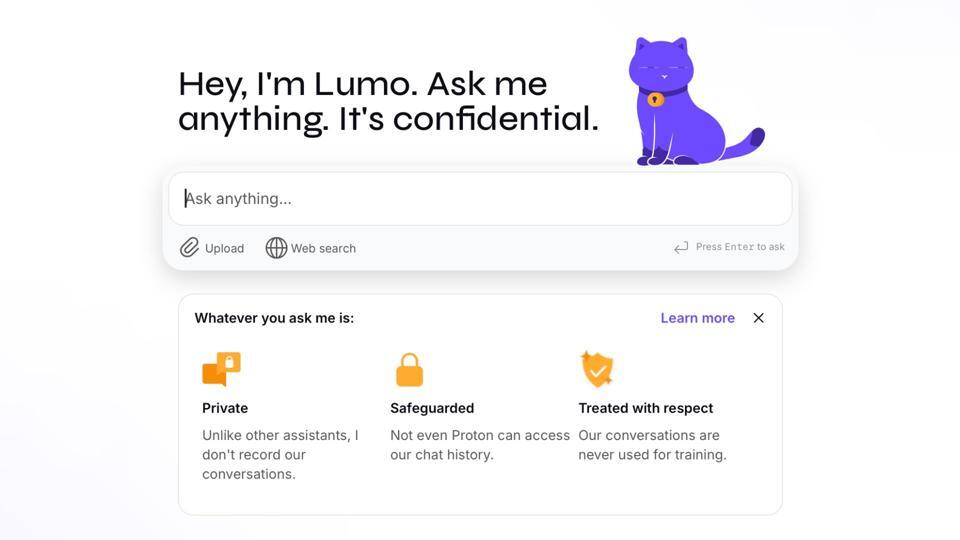
“Today, hundreds of millions of ordinary people interact with AI tools, unwittingly handing over sensitive information that is far more intimate than search or browsing history. Businesses, too, are risking their secrets. And because alternatives for generative AI have so far been limited, we all have to take our chances with AI companies that are mostly owned and operated out of the US or China. Lumo is here to change all that,” says Eamonn Maguire, who leads the machine learning team at Proton.
Also Read:Fidji Simo, OpenAI’s new CEO, insists AI can put power in the hands of people
Proton says conversations with Lumo remain under a sort of confidentiality clause, with zero-access encryption that means conversations a user saves can only be decoded and read on the original device they were done using. “Proton can never see them, and neither can anyone else,” the company says. Lumo user data will not be used to train the AI models underlying the AI chatbot
“AIs from Big Tech are built on harvesting your data. But Proton is different. We keep no logs of what you ask, or what I reply. Your chats can’t be seen, shared, or used to profile you,” is the big pitch for Lumo. While Proton doesn’t share specifics of the open-source AI models that are being used, they do say that the product’s underlying code will remain verifiable, for security researchers. Proton also says that no user data is shared with advertisers, or governments — and since this is a European Union based service, the GDPR, or General Data Protection Regulation, rules about deleting user data apply.
An important thing to note is, Proton has compared Lumo’s policy of not using user data to train the models, an ad-free model of business, deletion of chat logs and no data sharing with DeepSeek’s models as well, alongside Gemini, ChatGPT, and the ChatGPT underlined Copilot. Does that rule out DeepSeek being part of the model foundation equation for Lumo? Likely.
Also Read:Perplexity vs Google: A tug of war for India’s AI mind space
“Lumo is based upon open-source language models and operates from Proton’s European data centers. This gives you much greater transparency into the way Lumo works than any other major AI assistant. Unlike Apple Intelligence and others, Lumo is not a partnership with OpenAI or other American or Chinese AI companies, and your queries are never sent to any third parties,” adds Proton’s Maguire.
From the launch itself. Proton’s Lumo is accessible via a web browser, as well as apps for Android devices, as well as Apple’s iPhone and iPad. There is a free tier of usage, that doesn’t require a user to sign up or log in, though that’ll be essential if you’d like a basic chat history. There is also a Lumo Plus tier that is priced at $9.99 per month for what Proton lists as ‘unlimited chats’ and a much larger limit for file uploads for conversations with AI. At this time, any plans to include Lumo usage within existing Proton Unlimited or Proton Duo subscriptions, doesn’t seem to be on the agenda.