
 E-Paper



5 fascinating throwback pics of Earth by NASA that are timeless marvels
NASA often takes to social media to share incredible images of our home planet Earth. Here are five pictures that will make your jaw drop.

 Prefer HTon Google


Embark on an exciting journey with throwback pictures by NASA that show the splendour and beauty of the Earth. Be it the Moon casting a dark shadow on a part of the Blue Planet or our home planet looking like a speck of dust when viewed from Mars, these breathtaking images are gems that are worth revisiting. We have collected five such photos for you to enjoy.

1. Earth as seen from Mars
Though taken a decade ago, this picture of Earth remains one of the most fascinating photos ever captured. This image taken by NASA Curiosity Rover shows our home planet ‘shining brighter than any star in the Martian night sky.’ The photo was captured during the rover’s 529th Martian day and close to 80 minutes after sunset.
Take a look at this incredible picture of Earth:
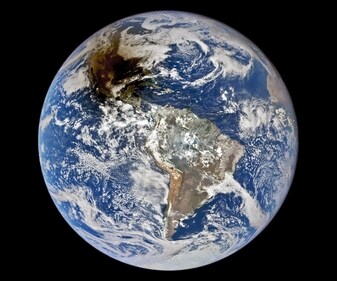
2. Earth darkened by Moon’s shadow
NASA’s EPIC (Earth Polychromatic Imaging Camera) imager aboard DSCVR (Deep Space Climate Observatory) captured an incredible image of a part of Earth darkened by the moon's shadow. It happened during the annual solar eclipse that took place on October 14, 2023.
According to NASA, in the image, “the shadow, or umbra, from the Moon, can be seen falling across the southeastern coast of Texas, near Corpus Christi.”
3. Photo of crescent-shaped Earth and Moon
This incredible picture was captured on September 18, 1977, by NASA's Voyager 1. The spacecraft was about 11.66 million kilometers away from our Blue Planet and directly above Mt. Everest when this image was taken.
According to NASA, “The photo was made from three images taken through colour filters, then processed by the Jet Propulsion Laboratory's Image Processing Lab. Because the Earth is many times brighter than the Moon, the Moon was artificially brightened by a factor of three relative to the Earth by computer enhancement so that both bodies would show clearly in the print.”
4. Earth from orbit around the Moon
“NASA's Lunar Reconnaissance Orbiter (LRO) captured a unique view of Earth from the spacecraft's vantage point in orbit around the moon,” this is what NASA wrote while sharing an incredible picture of Earth. It is a composite image where “we see Earth appear to rise over the lunar horizon from the viewpoint of the spacecraft, with the centre of the Earth just off the coast of Liberia (at 4.04 degrees North, 12.44 degrees West).”
5. Earth - a ‘pale blue dot’
According to NASA, “This narrow-angle colour image of the Earth, dubbed ‘Pale Blue Dot’, is a part of the first-ever ‘portrait’ of the solar system taken by Voyager 1.”
The picture was crafted from a total of 60 frames acquired by the spacecraft. In this image, the Earth is seen through three colour filters - green, blue, and violet.
Which of these images left you stunned? Do you love exploring such visuals shared by NASA?


