E-Paper



UNESCO adds three Indian sites to Tentative List, including Sirpur temples and Andaman volcanoes
UNESCO has included three Indian sites in its Tentative List, featuring ancient temples, limestone caves and volcanic islands.

 Prefer HTon Google


Three Indian sites, ranging from ancient temple ruins to unusual volcanic landscapes, have been added to UNESCO’s World Heritage Tentative List. The additions cover two locations in the Andaman and Nicobar Islands and one in Chhattisgarh, highlighting India’s geological and cultural heritage.
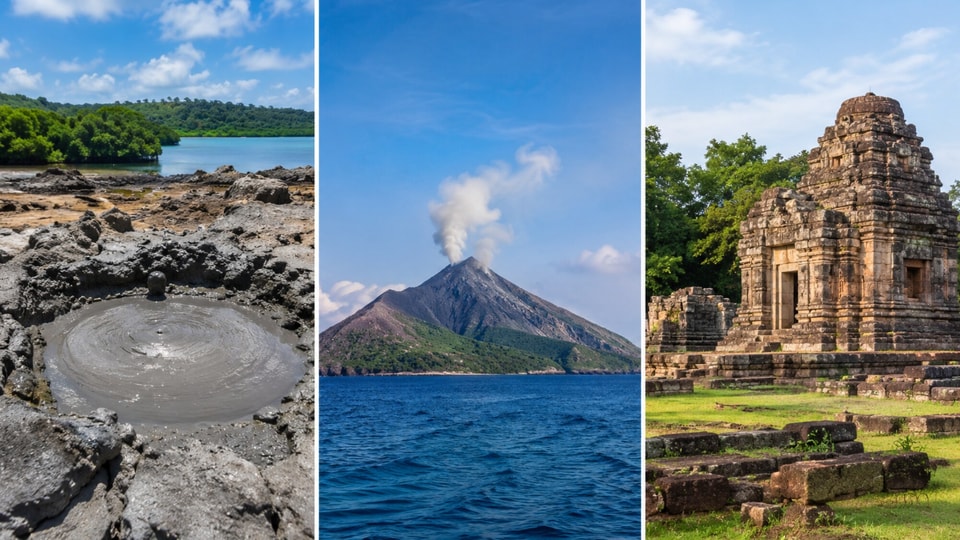
The new entries are the Karst-mud-volcano Complex of Baratang, the Andaman Subduction Volcanoes and the Sirpur Cultural and Archaeological Landscape. The move is an initial step towards possible World Heritage status, but does not mean the sites have received the designation. According to UNESCO’s official Tentative List, India has 81 properties on the list.
(Also Read: Chick-fil-A made $23.9 billion despite shutting every Sunday. Its CEO says staff well-being matters more than sales)
Baratang’s limestone caves and mud volcanoes
Located in the Andaman and Nicobar Islands, Baratang is known for its limestone caves and mud volcanoes. Unlike conventional volcanoes that release molten rock, mud volcanoes push mud, water and gases to the surface.
The island’s limestone formations developed over millions of years as marine material accumulated and hardened. Its rugged terrain also contains crevices, fissures and caves. These geological features make Baratang significant for studying how landscapes evolve.
Andaman’s two volcanic islands
The second entry, Andaman Subduction Volcanoes, includes Barren Island and Narcondam Island. Both are part of a volcanic chain shaped by tectonic activity in the region.
Barren Island is home to South Asia’s only confirmed active volcano, making it a notable geological feature. Narcondam, meanwhile, is a volcanic island rising sharply from the sea.
Together, the islands offer opportunities to study volcanic processes and ecosystems that have developed in relative isolation.
Sirpur’s ancient temples and archaeological remains
The third site, Sirpur Cultural and Archaeological Landscape, lies on the banks of the Mahanadi in Chhattisgarh’s Mahasamund district, around 78 km from Raipur.
Known historically as Shripur, the town developed as an important centre under the Kosala Kingdom and later the Panduvamshi dynasty. Its remains include ancient temples and Buddhist structures, reflecting the presence of different religious traditions in the region.
Sirpur’s archaeological landscape also reflects its history of trade, architecture and cultural exchange.
(Also Read: Man who watched Moon landing as a child donates $400,000 to save Neil Armstrong’s childhood home)
What UNESCO’s Tentative List means
A place must be included on a country’s Tentative List before it can be formally nominated for UNESCO World Heritage status. Inclusion signals that a country considers the site a potential candidate, but it does not guarantee eventual recognition.
The three sites showcase India’s heritage, from Andaman’s volcanoes to Sirpur’s ancient temples.