E-Paper



A 300-meter-deep coal mine in Spain is now a giant lake holding 547 billion liters, and the transformation took 4 years
A Spanish coal mine that once swallowed trucks is now an 865-hectare lake with beaches, kayakers, and deer. The transformation took four years.

 Prefer HTon Google


There’s a hole in the ground in northern Spain that once swallowed mining trucks whole. Today, that same hole is a lake, and it has a sandy beach, deer roaming the shores, and people kayaking across the clear turquoise water. It’s Lake As Pontes, a former coal mine in Galicia that is now one of the biggest lakes in the country. In a 2022 paper in Mine Water and the Environment, the authors note that abandoned mines can often serve as "beneficial end uses" such as recreational centers and habitats for wildlife if the entire process of mine closure is planned effectively right from the start. And Pontes is one of the best examples of this concept.
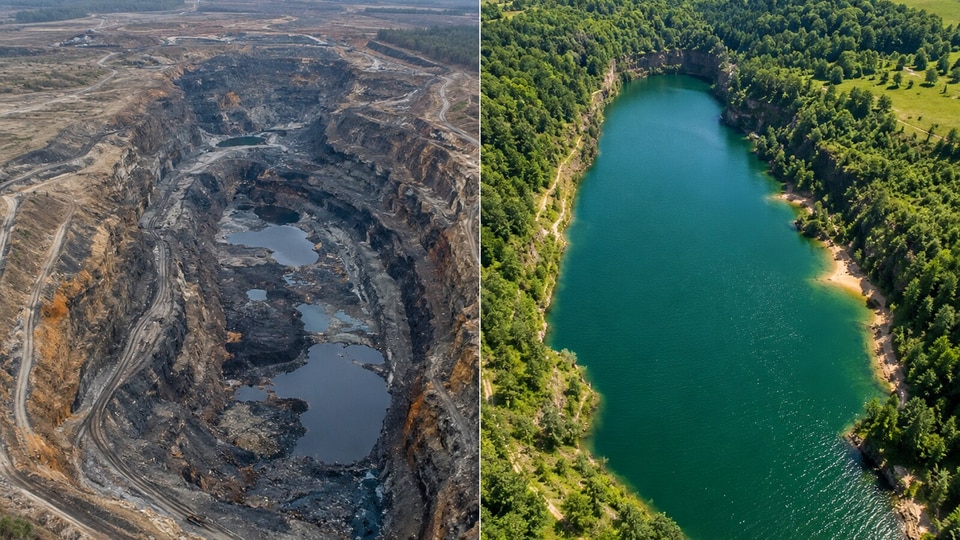
From a 30-million-year-old coal seam to an 865-hectare lake
As Pontes is located within the province of A Coruña in the Galicia area of northwestern Spain. As pointed out by Endesa, the energy corporation that runs the facility, a lignite deposit (lignite being a soft brown coal) had sat under this land for almost 30 million years. The mining process started during the 1940s, and the land was acquired by Endesa in 1972 to develop what became the country's largest mine. After many decades of mining activities, the depth of the pit exceeded 300 meters, which is comparable to the height of the Eiffel Tower.
Tighter European Union rules on emissions led to the eventual closure of the mine. Production ceased at the mine in December 2007. The following year, in 2008, Endesa decided to flood the pit and rehabilitate the surrounding land instead of leaving it as an open scar. José Antonio Menéndez, who was the last director of the mine, explains that while industrial activities tend to affect the environment, such damage can be avoided when the final objective is known, and the work is planned from the very start.
Turning a hole into a habitat isn't simple
Digging a pit and filling it with water might sound simple enough. But it couldn’t be farther from the truth. The same 2022 study warns that mining pits left unmanaged often become polluted, highly acidic lakes. Turning a mining pit into a usable lake requires lots of planning, effort, and time: reshaping unstable hillsides, water management, and letting nature restore itself on its own.

In As Pontes, however, this patience proved to be worthwhile. Belén Soto, the Head of Environment at Endesa, clarifies that after many years of restoration work, four different ecosystems have been created near the lake. Meadow, scrub, wood, and wetlands sit there in addition to the lake itself, which developed alongside local wildlife, including deer. By 2022, the lake had become the second-largest area of inland water in Galicia and the largest in A Coruña, having won a Blue Flag in that year, an environmental certificate issued by the Foundation for Environmental Education.
Why a lake can be good for you, not just the planet
This matters even if you have never been to Galicia. Having access to water bodies, referred to as "blue space" by researchers, seems to provide real health benefits. A meta-analysis in the International Journal of Environmental Research and Public Health found that being around lakes, rivers, and coastal areas was associated with decreased stress and increased positive emotions and physical activity. The paper's authors add that the presence of water bodies not only creates an aesthetic experience but also provides restorative benefits for the mind.
The study explains why As Pontes is more than just an environmental success on paper. It has become a successful recreational location, and while it was a coal mining town in the past that generated money from mining, it now draws people for water sports such as canoeing. Tourism Councilor Elena López has described the shift in similar terms, telling Endesa's own press materials that the lake's Blue Flag certification "is very important for the unique space concerned," part of the town's broader move from an industrial identity toward a tourism-driven one.
The bigger picture for a coal-shrinking world
Coal mines all over the world are closing down as countries move towards greener sources of energy. Most of these sites will need a new purpose once the equipment moves out. In this regard, Pontes is unlikely to be the last case. What this shows is that a defiled industrial site can very well become a place where people wish to swim, breathe, and relax, as long as the transition is treated as serious long-term ecology work rather than an afterthought bolted on at the end.